Israeli Army Demolishes Lebanese School — And the Official Justification Is Falling Apart
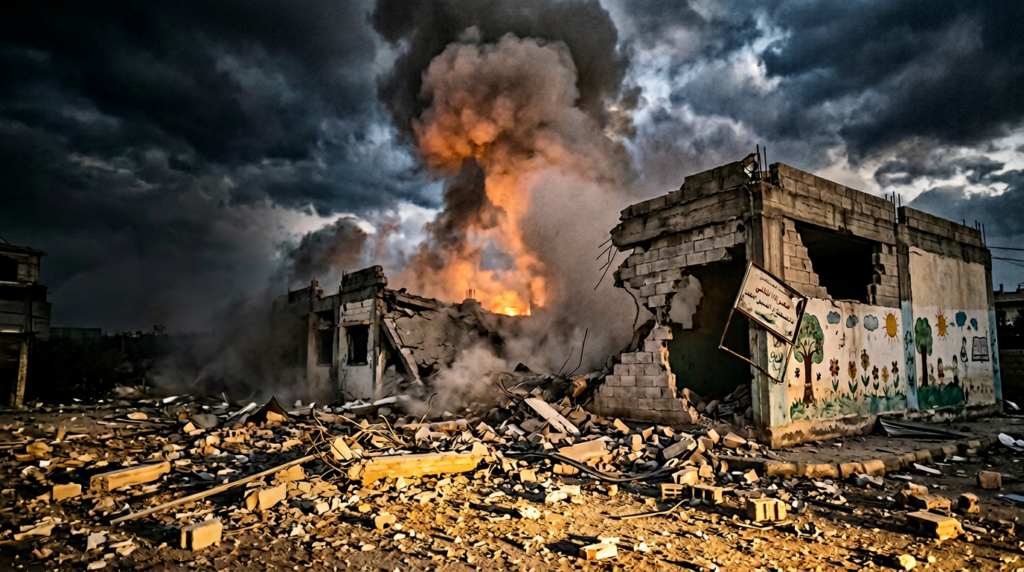
A public school in southern Lebanon was reduced to rubble on April 16. Israel cited weapons storage. A Lebanese court says the evidence photos weren’t even taken in the building. Someone is lying — and it matters enormously.
On the morning of April 16, 2026, a three-wing public secondary school in Marwahine — a small border town in southern Lebanon’s Sour district — ceased to exist. Israeli army soldiers, reportedly from the elite Givati Brigade, detonated the structure in a controlled demolition, reducing it to concrete dust and twisted steel. Drone footage captured the moment in devastating detail.
The building had already survived the scars of Israel’s 2024 ground invasion. It did not survive this. And if the story ended there — a school destroyed during a military operation — it would already demand serious scrutiny. But the story does not end there. What followed the demolition may be more troubling than the demolition itself.
Support Independent Local Journalism
TheTownHall.News is a non-profit reader-supported journalism. Just $5 helps us hire local reporters, investigate important issues, and hold public officials accountable across Alameda County. If you believe our community deserves strong, independent journalism, please consider donating $5 today to support our work.The Claim That Doesn’t Hold Up
The Israeli army’s justification was swift and specific. Military spokesperson Ella Waweya published images showing soldiers standing beside rifles, handguns, and rounds of ammunition — claiming more than 130 weapons belonging to Hezbollah had been discovered stored inside the school. It is the kind of claim that is difficult to contest at face value. Schools used as weapons depots are a documented Hezbollah tactic, and the images, on the surface, appeared to support the narrative.
Except, according to a Lebanese judicial source, those images did not come from the school at all.
The judicial source stated directly that the weapons shown in the published photos were not seized from the Marwahine school — they were judicially held items stored inside the Bint Jbeil courthouse, a separate government facility used to house items already in Lebanese court custody. In other words: the Israeli military appears to have published photographs of another building’s contents to justify the demolition of a school.
Independent video analysis of the demolition footage found no evidence of military activity at the site. The precision and nature of the explosion confirmed a controlled demolition using pre-planted explosives — meaning Israeli forces had controlled the building for a substantial period before detonating it. That timeline alone undermines any claim of immediate military necessity.

Why the Justification Matters as Much as the Act
The destruction of civilian infrastructure — schools especially — carries enormous moral and legal weight in any military context. But when the justification for that destruction appears to be fabricated, the demand for accountability does not merely grow. It becomes non-negotiable.
In any functioning system grounded in law and order, the burden of proof falls on the party exercising force — particularly irreversible, destructive force against civilian institutions. Governments that wield power and then construct false narratives to cover it are not just violating international law. They are corroding the foundational principle that authority must answer for its actions.
This principle is not ideological. It does not belong to the left or the right. It is the bedrock of civic order — the guarantee that state power is not self-authorizing. When a school is reduced to rubble, the justification had better be unimpeachable. This one, by available evidence, is not.
What Was Actually Destroyed
The Marwahine Official Secondary School was not a symbol. It was a place where Lebanese children studied — a community institution serving a border region that has endured years of conflict, displacement, and slow reconstruction. The building had already been damaged in the 2024 ground offensive. Its total destruction now means an entire generation of students in this community has no secondary school to return to.
Lebanese Education Minister Rima Karameh did not mince words. She condemned what she described as “the atrocities committed by the Israeli aggression against civilians, educational infrastructure, homes and towns in Lebanon,” stressing that the school was “devoid of any military or even civilian presence” at the time of demolition.
Support Independent Local Journalism
TheTownHall.News is a non-profit reader-supported journalism. Just $5 helps us hire local reporters, investigate important issues, and hold public officials accountable across Alameda County. If you believe our community deserves strong, independent journalism, please consider donating $5 today to support our work.She issued a direct appeal to UN Secretary-General António Guterres and all major international bodies, urging them to protect educational institutions and prevent the further targeting of schools in Lebanon. The response from the international community, as of this writing, has been muted — which is itself a story worth telling.
The Counterargument — and Why It Falls Short
There are those who will argue that Israel faces genuine, documented security threats along its northern border, and that Hezbollah’s long-established practice of embedding military infrastructure within civilian areas places the moral burden squarely on Hezbollah — not on the forces responding to it.
That argument carries weight in the abstract. Hezbollah has used civilian buildings for military purposes. That is a documented reality, not a contested claim. Any honest accounting of southern Lebanon must include the role Hezbollah’s strategy plays in endangering civilian infrastructure.
But the merit of that broader argument does not rescue this specific incident. When the photographic evidence offered to justify the demolition of a civilian school appears to have been taken in a different building entirely — a courthouse — the legal defense of military necessity collapses. International humanitarian law does not permit the destruction of civilian objects on the basis of fabricated or misattributed evidence.
If the evidence was real, show the real evidence. If it wasn’t — what happened in Marwahine on April 16, 2026, carries the legal and moral weight of a war crime. Legal Agenda, a well-regarded Lebanese legal research institution, has stated precisely that: the demolition constitutes a serious violation of international humanitarian law and indicates the perpetration of a war crime.
A Pattern the World Cannot Afford to Ignore
This incident does not exist in isolation. Reports indicate Israel is working to demolish border villages in southern Lebanon to establish a “security buffer zone” — a military cordon requiring the physical erasure of Lebanese communities and their institutions. That objective may be strategically argued in certain quarters. But when it is pursued through the destruction of schools, and when the justifications offered are contradicted by judicial sources and video evidence, it becomes something that every government claiming to value rule of law must confront directly.
Civic institutions — courts, schools, houses of worship — are not incidental structures. They are the physical expression of a community’s investment in its own future. Destroying them is not a tactical inconvenience. It is a generational wound. And explaining it away with evidence a courthouse official says came from a different building entirely is not a justification. It is an insult to the intelligence of the watching world.
Key Takeaway
The destruction of the Marwahine school is not simply a story about military operations in a contested border region. It is a story about accountability, truth, and the limits of state power — principles that transcend geography and political affiliation. When governments destroy civilian institutions and then offer justifications that dissolve under basic scrutiny, demanding answers is not anti-war sentiment. It is the rule of law in action.
Children in southern Lebanon no longer have a school. The people responsible offered evidence that appears to have come from a courthouse. The world is watching to see whether that is enough — or whether accountability still means something.
Stay Informed. Keep the Pressure On.
Independent journalism keeps these stories alive when governments hope the news cycle moves on. If you believe in transparent government, the protection of civilian life, and the principle that power must answer for what it does — share this article, follow the story, and don’t let it disappear.
The Town Hall News depends on engaged readers who refuse to look away. Subscribe, share, and make your voice heard.