State Department Visa Restrictions Target U.S. Adversaries — And It’s Long Overdue
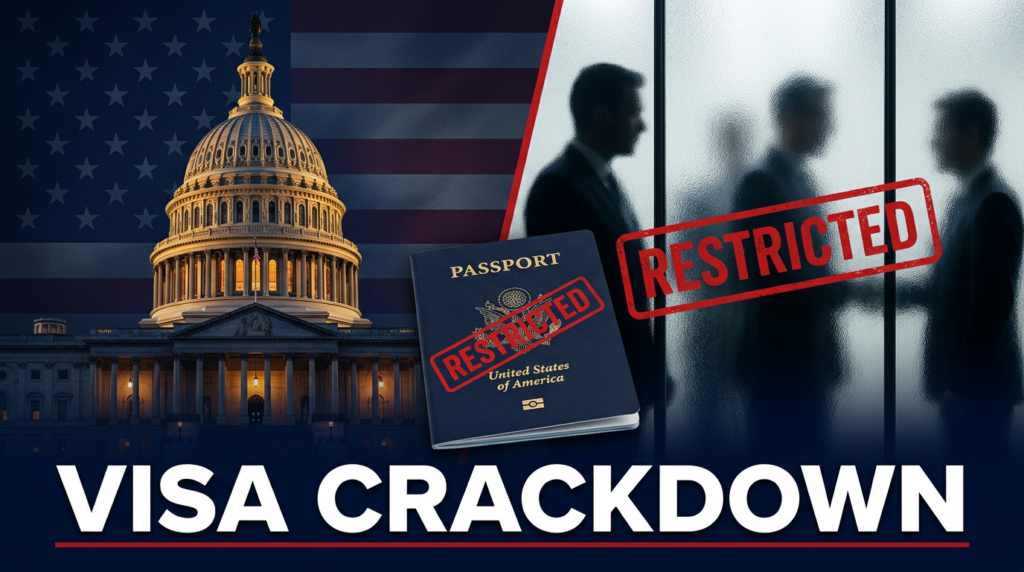
The Trump administration’s decision to restrict visas for individuals working against American interests isn’t a radical departure — it’s a return to sovereign common sense. Here’s why it matters more than you think.
For decades, the United States operated under a quiet but dangerous assumption: that anyone seeking to enter this country was entitled to the benefit of the doubt, regardless of what they were doing on behalf of foreign adversaries. That assumption is now being dismantled — and it’s about time.
On April 16, 2026, the State Department announced a significant expansion of its visa restriction policy, explicitly targeting individuals who are “working on behalf of U.S. adversaries to undermine” American interests across the Western Hemisphere. Twenty-six individuals have already had their visas stripped under the new framework. The move reflects a hard-nosed, unapologetically American foreign policy posture — one grounded not in ideology, but in accountability.
Support Independent Local Journalism
TheTownHall.News is a non-profit reader-supported journalism. Just $5 helps us hire local reporters, investigate important issues, and hold public officials accountable across Alameda County. If you believe our community deserves strong, independent journalism, please consider donating $5 today to support our work.What the Policy Actually Does — and Why It’s Reasonable
The expanded policy is rooted in the Immigration and Nationality Act, a long-standing federal law that gives the Secretary of State authority to restrict entry when a foreign national’s presence would have “potentially serious adverse foreign policy consequences” for the United States.
That’s not a new power — it’s an existing one finally being exercised with teeth.
Under the expansion, individuals who “knowingly direct, authorize, fund, or provide significant support” to U.S. adversaries operating in the hemisphere become ineligible for U.S. entry, along with their immediate family members. Covered activities include enabling foreign powers — China chief among them — to acquire strategic assets and resources in the region, destabilizing regional security, undermining American economic interests, and running influence operations against sovereign nations.
This isn’t a ban on political dissent. It isn’t a crackdown on tourists or students with the wrong opinions. It is a targeted, legally grounded enforcement tool directed at individuals actively working against American interests — the same interests that protect jobs, trade, and security for millions of American families.

The China Problem Washington Refused to Name
What makes this policy shift significant isn’t just what it says — it’s what it implies. While the State Department’s announcement carefully avoided naming China directly, the subtext is unmistakable. Beijing has spent years deepening its economic and political foothold across Latin America, financing infrastructure deals, cultivating political allies, and positioning itself to challenge U.S. influence in its own backyard.
This isn’t speculation. The Council on Foreign Relations has documented China’s sweeping investment networks across the region — from ports in Chile to energy projects in Venezuela. At the same time, Trump’s “Donroe Doctrine” — a contemporary reboot of the 1823 Monroe Doctrine — has made reasserting U.S. dominance in the hemisphere a cornerstone of his foreign policy agenda.
Allowing foreign operatives linked to adversarial powers to operate freely inside the U.S., or to leverage U.S. visa privileges as cover, is not tolerance. It is negligence.
The visa crackdown forces a long-overdue reckoning: access to the United States is a privilege, not a right — and with that privilege comes an expectation that you are not actively working to undermine the country granting it.
A Pattern of Accountability, Not Persecution
Critics will try to frame this as another chapter in a story of overreach, lumping the new policy in with contested visa revocations involving student protesters or political figures. But those comparisons obscure a crucial distinction.
Support Independent Local Journalism
TheTownHall.News is a non-profit reader-supported journalism. Just $5 helps us hire local reporters, investigate important issues, and hold public officials accountable across Alameda County. If you believe our community deserves strong, independent journalism, please consider donating $5 today to support our work.The individuals targeted under this expansion aren’t being penalized for holding unpopular opinions. They are, according to the State Department, actively facilitating the strategic interests of nations that view the United States as an adversary.
In practice, recent enforcement actions illustrate the range of that accountability. Brazilian Supreme Court Justice Alexandre de Moraes — whose court pursued former President Jair Bolsonaro on charges many legal analysts found politically motivated — had his U.S. visa revoked in July 2025. Colombian President Gustavo Petro lost his visa in September 2025 after urging U.S. soldiers to disobey orders in protest of American policy in Gaza. More recently, at least seven Iranian nationals with documented ties to the Iranian regime had their legal statuses in the United States terminated.
Each case is different. But the common thread is clear: the United States is no longer treating its borders and its visa system as a global open house. Nations, institutions, and individuals that act against American interests will face consequences — starting with losing the privilege of access.
What Critics Get Wrong
The predictable counterargument runs something like this: visa revocations silence foreign critics, weaponize immigration law against political opponents, and set a dangerous precedent for punishing speech rather than actions.
It’s a serious concern — and it deserves a serious answer.
First, the legal standard applied here is not ideological alignment; it is whether an individual’s presence poses “potentially serious adverse foreign policy consequences.” That standard has existed in statute for decades, well before this administration.
Second, no one is being imprisoned or prosecuted. Visa ineligibility is a restriction on access, not a criminal penalty. The U.S. government has both the right and the responsibility to decide who enters its borders based on national interest.
Third — and most importantly — nations around the world, including those that routinely lecture the U.S. on democratic norms, maintain far stricter visa controls than anything announced last week. The expectation that the United States must accept individuals working on behalf of its geopolitical adversaries, while those same adversaries impose rigid access controls of their own, is not a principle. It’s a double standard.
The answer to legitimate civil liberties concerns is rigorous legal oversight of individual cases — not the abandonment of sovereign border authority altogether.
Why American Families Should Pay Attention
This isn’t just a story about diplomacy or geopolitics. It has direct implications for everyday Americans.
When foreign adversaries gain influence over critical infrastructure, natural resources, and regional governments in the Western Hemisphere, American economic interests take a hit — in the form of higher supply chain costs, disrupted trade relationships, and national security vulnerabilities that eventually translate into higher government spending and expanded military commitments.
The fiscal conservative case for this policy is straightforward: preventing adversarial infiltration now is far cheaper than managing the fallout later.
And for families concerned about the rule of law, the message is equally clear. A nation that cannot enforce meaningful consequences for those who undermine its interests — from inside its own borders or through visa-granted access — is a nation that has quietly surrendered one of its most fundamental responsibilities: protecting the sovereignty and security of its own citizens.
🔑 Key Takeaway
The State Department’s visa expansion is not a political stunt. It is a measured, legally grounded application of existing authority, designed to ensure that the privilege of access to the United States comes with a basic condition: that you are not actively working to harm it. Twenty-six individuals have already learned that lesson. The message to those who follow in their footsteps is simple — America is paying attention now.
Conclusion: The Privilege of Access Has a Price
Sovereignty has always required enforcement. The idea that America can be the world’s most powerful nation while remaining indifferent to how it manages who gains access to its territory, institutions, and political influence has never been anything more than wishful thinking.
The State Department’s crackdown on visas for those working on behalf of U.S. adversaries is not a revolution — it is a recalibration. It is a recognition that borders mean something, that laws exist for reasons, and that the American government’s first obligation is to the American people, not to the convenience of foreign nationals with adversarial agendas.
As China continues its push into Latin America, and as the geopolitical stakes of the Western Hemisphere grow higher by the month, the question isn’t whether the United States should enforce its interests. The question is why it waited so long to start.
Stay informed. Share this article. And remember: civic engagement is the most powerful tool a free people has.
Sources: U.S. State Department announcement (April 16, 2026); Time Magazine (April 17, 2026); Al Jazeera (April 16, 2026); Council on Foreign Relations backgrounder on China’s influence in Latin America; Immigration and Nationality Act (8 U.S.C. § 1182).