America Officially Exits the WHO: Why the U.S. Was Right to Walk Away from the World Health Organization
After 77 years of funding an organization that failed catastrophically during the world’s greatest public health crisis, the United States has closed the door on the World Health Organization. Here’s why the decision is justified — and why the critics are missing the point.
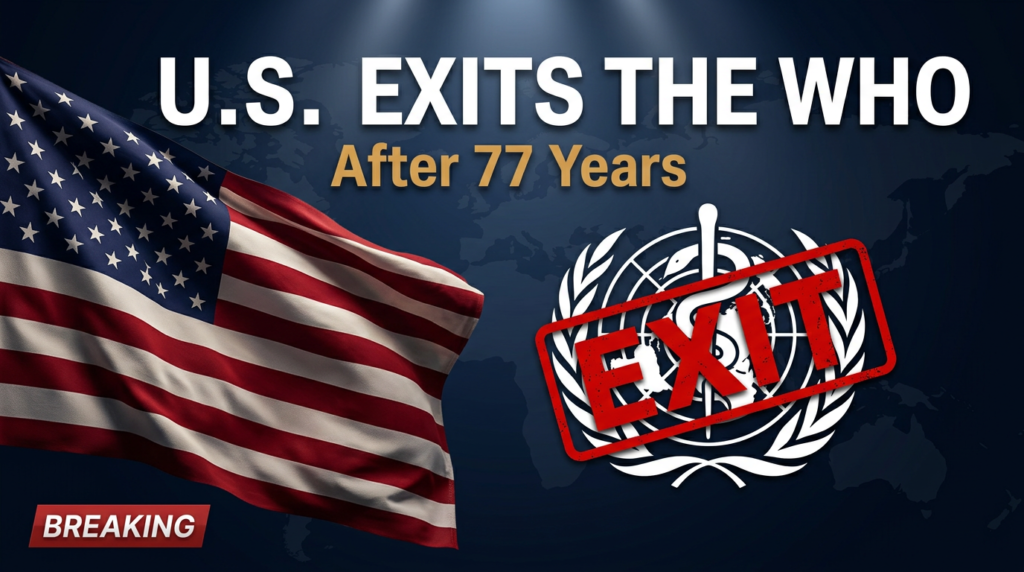
On January 22, 2026, the United States formally completed its withdrawal from the World Health Organization — ending a 77-year membership and drawing a clear line between American leadership and the kind of unaccountable multilateral bureaucracy that failed the world when it mattered most.
The exit was announced jointly by Secretary of State Marco Rubio and HHS Secretary Robert F. Kennedy Jr., completing a process launched by President Trump’s executive order on his first day back in office, January 20, 2025. For the millions of Americans who watched the WHO fumble the deadliest public health crisis of a generation, the departure wasn’t just overdue — it was the only credible option left.
Support Independent Local Journalism
TheTownHall.News is a non-profit reader-supported journalism. Just $5 helps us hire local reporters, investigate important issues, and hold public officials accountable across Alameda County. If you believe our community deserves strong, independent journalism, please consider donating $5 today to support our work.A Year in the Making — What Actually Happened
The withdrawal didn’t happen overnight. WHO bylaws require a formal one-year notice period before membership terminates. The Trump administration used that year deliberately: halting all U.S. funding to the WHO, withdrawing every American personnel member stationed at the organization, and redirecting global health activities toward direct bilateral partnerships with nations, the private sector, and non-governmental organizations.
On January 22, 2026, the process was complete. The United States became the first country to leave the World Health Organization since the body was founded in 1948 — and it did so with a detailed, evidence-based rationale that the WHO has never seriously refuted.
A Record of Failure the WHO Cannot Escape
The Trump administration cited three core reasons for leaving: the WHO’s mishandling of the COVID-19 pandemic, its failure to adopt meaningful reform in the years that followed, and its inability to operate free of political pressure — most visibly from China.
The record is damning. In the critical early weeks of the COVID-19 outbreak, the WHO delayed declaring a global public health emergency while simultaneously praising China’s response — even as evidence mounted that the Chinese government had suppressed early case data, delayed confirming human-to-human transmission, and restricted access to Wuhan laboratories. Those lost weeks cost lives on a massive scale.

Equally troubling: when the WHO evaluated possible COVID-19 origins, it dismissed the lab-leak hypothesis in a report produced while China refused to share early genetic sequences and denied investigators access to Wuhan lab records. That is not independent science. That is institutional cowardice dressed up in scientific language.
Post-pandemic, the WHO made no meaningful structural changes. No serious governance reforms. No reduction in political influence from member states. For an organization that consumed roughly 20 percent of its operational budget from American taxpayers, that is not just a disappointment — it is a disqualifying failure.
The WHO had five years to earn back American trust. It chose not to.
The $278 Million Question — Fiscal Responsibility Has to Mean Something
Here is a figure that deserves public attention: the United States left behind $278 million in unpaid membership dues for 2024 and 2025. WHO defenders argue the withdrawal is therefore incomplete until the debt is settled. The State Department disagrees — and on the merits, so should any taxpayer who takes fiscal accountability seriously.
American taxpayers had already been the WHO’s single largest funder for decades, underwriting roughly one-fifth of its entire operational budget. When that organization mismanages the worst global health crisis in a century, shields the responsible party from accountability, and refuses structural reform — the argument that Americans owe it more money is not a policy position. It is an institutional shakedown.
Support Independent Local Journalism
TheTownHall.News is a non-profit reader-supported journalism. Just $5 helps us hire local reporters, investigate important issues, and hold public officials accountable across Alameda County. If you believe our community deserves strong, independent journalism, please consider donating $5 today to support our work.Fiscal responsibility is not just about cutting spending. It is about demanding results for every dollar spent. Continued WHO membership failed that test comprehensively.
What the Critics Get Wrong
Not everyone is applauding. The Infectious Diseases Society of America called the move “shortsighted and misguided,” warning of weakened flu vaccine development through loss of access to the Global Influenza Surveillance and Response System. Doctors Without Borders criticized what it sees as a transactional shift in American foreign health assistance.
These are concerns worth taking seriously — and they deserve a direct answer.
The United States is not stepping back from global health. The administration’s “America First Global Health” strategy, released in September 2025, commits to continued international health engagement through direct bilateral partnerships, private sector innovation, and NGO collaboration. Aid will be tied to accountability and results, not institutional dues paid to Geneva.
The critics’ core argument — that the U.S. must remain in the WHO because alternatives don’t yet exist — is not a defense of the WHO. It is an acknowledgment that better systems still need building. That is a problem worth solving. It is not a reason to indefinitely subsidize an institution with a broken track record.
America First Is Not the Same as America Alone
The conflation of “America First” with isolationism is a deliberate misreading — and it does not survive scrutiny.
Holding international institutions accountable is not a retreat from global leadership. It is exactly what responsible governance demands. Consider any private foundation that continued funding an organization that mismanaged a crisis, covered for the responsible parties, and rejected reform. No credible board would tolerate it. Neither should American taxpayers.
The United States remains the world’s leader in biomedical research, pharmaceutical innovation, and emergency public health response. That leadership does not disappear because Geneva no longer receives a membership check. What changes is the expectation: American health engagement will now come with transparency requirements, measurable outcomes, and clear lines of accountability. That is not isolationism. That is governance.
What Comes Next — The Stakes Are Real
The implications of this withdrawal will play out over years. In the near term, the global health community faces genuine pressure to fill the funding gap the U.S. previously covered. Other economies — in Europe, Asia, and the Gulf — must decide whether to step up or allow the WHO to scale back.
That pressure is not inherently destructive. For decades, the assumption that Washington would underwrite a disproportionate share of global health costs allowed other member states to avoid hard conversations about accountability and efficiency. The U.S. exit forces those conversations into the open, where they belong.
For American families, the bottom line is simpler: their government has stopped subsidizing an institution that failed them at the worst possible moment, and committed to health investments that demand real results in return.
Key Takeaway
This isn’t about retreating from global health. It’s about demanding that global institutions earn the resources they receive — and prove they can operate free of political manipulation.
The Verdict
The United States’ exit from the World Health Organization is one of the most consequential foreign policy decisions of the Trump era. It is also, on the available evidence, one of the most defensible.
An organization that failed during COVID-19, shielded Chinese opacity, and chose five years of institutional self-protection over meaningful reform had forfeited the credibility required to justify continued American membership. The American people deserved a government prepared to say so. On January 22, 2026, they got one.
The real test lies ahead: whether the United States builds the bilateral and multilateral frameworks needed to sustain global health leadership outside the WHO structure. That challenge is real. But the alternative — staying inside a compromised institution and calling it leadership — was never a solution.
Stay Informed. Make Your Voice Heard.
Independent journalism depends on engaged readers. Share this article with someone who deserves the full story, not just the talking points. Stay subscribed as the U.S. constructs its post-WHO global health strategy — because the decisions made in the next twelve months will define American public health leadership for a generation. Civic engagement starts with staying informed. Do your part.