Las Vegas Fentanyl Cartel Bust: 30,000 Pills, AR-15, and a Stark Warning About Border Security
Federal agents just dismantled a cartel drug operation in the middle of Las Vegas. The haul was staggering. The message is unmistakable: years of lax border enforcement have allowed transnational criminal networks to embed themselves in American cities — and ordinary families are paying the price.
On April 9, 2026, federal agents with the Las Vegas Homeland Security Task Force executed a series of search warrants on stash houses and a storage locker in the Las Vegas metropolitan area. What they found should shock every American who believes in law, order, and the safety of their community.
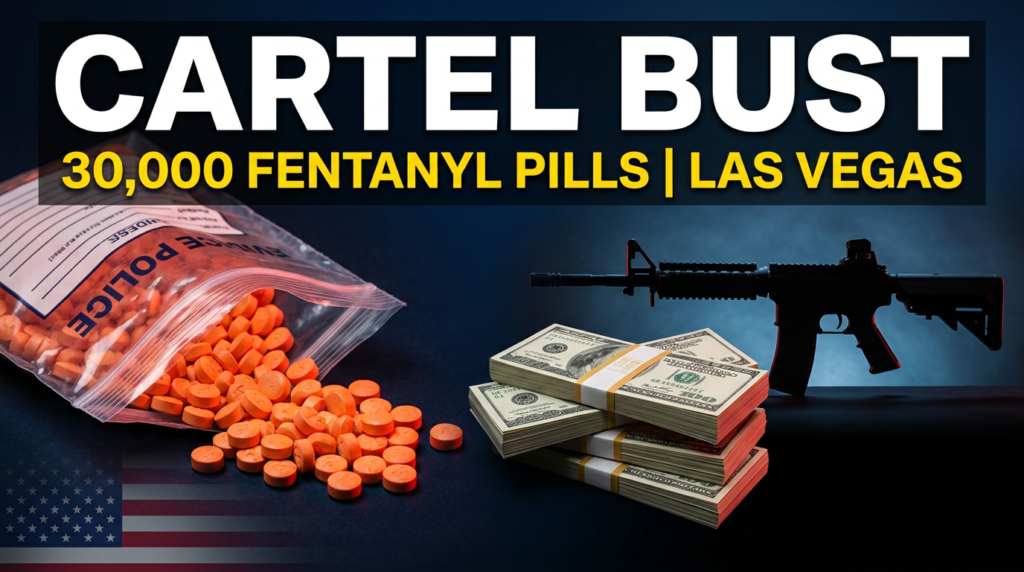
Approximately 30,000 fentanyl pills. More than two kilograms each of fentanyl powder and heroin. A pound of methamphetamine. Over $30,000 in cash. And a semi-automatic rifle loaded and ready. Two men — Francisco Felix and Alexis Arturo Martinez, also known as Arego Martinez Reglado — were arrested the following day and now face 16 federal charges, including conspiracy to distribute controlled substances and money laundering. Proceeds from their operation were allegedly routed directly back to Mexico. A jury trial is scheduled for June 15, 2026.
Support Independent Local Journalism
TheTownHall.News is a non-profit reader-supported journalism. Just $5 helps us hire local reporters, investigate important issues, and hold public officials accountable across Alameda County. If you believe our community deserves strong, independent journalism, please consider donating $5 today to support our work.This was not a small-time drug bust. This was a cartel distribution network operating openly on American soil.
The Scale of the Threat: What 30,000 Fentanyl Pills Actually Means
To understand why this case matters beyond the headlines, consider the math. A lethal dose of fentanyl for an average adult is approximately two milligrams. A single kilogram contains 500,000 potentially fatal doses. The 2.25 kilograms of fentanyl powder seized in this bust alone represents enough poison to kill over a million people — if distributed in lethal concentrations.
The 30,000 fentanyl pills are typically pressed to resemble legitimate prescription medications. They are designed to deceive — sold at high schools, college campuses, and on social media apps to teenagers who believe they are buying something safe. According to the CDC, fentanyl is now the leading cause of death for Americans aged 18 to 45. This is not a statistic to gloss over. It is a national emergency being played out one pill at a time in American living rooms.
“Fentanyl isn’t just a drug problem — it’s a weapon of mass destruction being manufactured abroad and distributed in our neighborhoods.”

Felix and Martinez weren’t just users or low-level street dealers. Federal prosecutors allege they were operating stash houses — infrastructure — in Las Vegas. The money laundering charges make clear that this was a business, with profits flowing back across the border to sustain and expand cartel operations.
How Cartels Set Up Shop Inside American Cities
Transnational criminal organizations like Mexico’s Sinaloa and Jalisco New Generation cartels — the dominant fentanyl suppliers to the United States — don’t simply smuggle drugs across the border and disappear. They establish networks. They rent storage units. They move product through multiple cities. They launder money through layered financial transactions back to Mexico.
The Las Vegas bust is a textbook example. Agents didn’t just find drugs on a person — they found multiple stash houses and a storage locker. That requires time, money, local contacts, and, critically, the ability to operate in the U.S. without immediate detection.
The DOJ press release confirms this prosecution is part of the Homeland Security Task Force, established under Executive Order 14159, which specifically targets criminal cartels and transnational criminal organizations operating within U.S. borders. The HSTF represents the kind of whole-of-government, interagency law enforcement that border security advocates have demanded for years.
FBI Las Vegas Special Agent in Charge Christopher S. Delzotto stated plainly: “If you peddle drugs and carry guns in our community, we will find you, and we will stop you.” That is the clear, unambiguous language of law enforcement doing its job — finally with full institutional backing.
Support Independent Local Journalism
TheTownHall.News is a non-profit reader-supported journalism. Just $5 helps us hire local reporters, investigate important issues, and hold public officials accountable across Alameda County. If you believe our community deserves strong, independent journalism, please consider donating $5 today to support our work.Why This Happened: Years of Enforcement Failures
The uncomfortable truth is that cartel infrastructure doesn’t materialize overnight. It is built slowly, methodically, and it thrives in environments where border enforcement is inconsistently applied and interior enforcement is politically discouraged.
For years, policies that limited cooperation between federal immigration authorities and local law enforcement — so-called “sanctuary” policies — gave criminal networks breathing room to operate. Reduced deportation enforcement, stretched border resources, and politically motivated resistance to interior enforcement all created conditions under which cartels could expand their American footprint with reduced risk.
This is not a partisan talking point. It is a logical consequence of policy choices. When the cost of operating a drug network inside the United States drops — because enforcement is deprioritized — the incentive to establish that network rises. The Las Vegas bust is a case study in what that dynamic produces.
It is also worth noting that the money seized in this case was being laundered back to Mexico. Every dollar that flows south funds cartel leadership, buys weapons, corrupts officials, and finances the next shipment of poison into American communities. These are not isolated criminal acts — they are part of a supply chain with international dimensions.
The Counterargument: “This Is a Law Enforcement Success Story”
Some commentators will look at this case and argue that the system worked — that federal agents identified the network, built a case, executed their warrants, and made their arrests. And on a narrow reading, they are correct. The FBI and DEA deserve credit for a significant takedown.
But that argument misses the larger point. A successful arrest does not answer the question of how an alleged cartel distribution network with multiple stash houses was allowed to operate in Las Vegas in the first place. It does not explain how tens of thousands of fentanyl pills and kilograms of heroin were stockpiled inside an American city without earlier detection.
Law enforcement success at the prosecution stage is not a substitute for prevention at the border. Celebrating the arrest while ignoring the conditions that enabled the operation is like praising firefighters while refusing to fix the faulty wiring that started the blaze.
The goal should not simply be more prosecutions — it should be fewer opportunities for cartels to establish operations on American soil at all.
How This Affects Your Community
Las Vegas is not a border town. It is a major American city, home to millions of residents, a global tourism economy, and families trying to build normal lives. The fact that an alleged cartel distribution network was running stash houses there is a reminder that fentanyl trafficking is not a problem confined to the southern border regions. It has spread into the American interior.
Every community in this country is now a potential market for cartel product. Suburbs. College towns. Midwestern cities far from any border crossing. The distribution networks are established, the supply lines are functioning, and the pills are designed to look harmless.
Parents, educators, and community leaders cannot afford to look away.
The individuals facing charges in this case now face a federal mandatory minimum of ten years in prison and a maximum of life. That is appropriate for the scale of harm alleged. Federal prosecutors and the court should ensure that any conviction carries the full weight the charges allow.
The Bottom Line: Enforcement Matters, and So Do Consequences
The Las Vegas bust is a significant law enforcement win — and it should be reported as such. The Las Vegas Homeland Security Task Force, the FBI, and the DEA delivered results. Two alleged cartel-linked traffickers are in federal custody, and enough fentanyl to devastate entire communities has been taken off the streets.
But wins like this one do not happen in a vacuum. They happen because an administration committed institutional resources, interagency coordination, and political will to making them happen. They also serve as a reminder of what the cost of inaction looks like — because for every network that gets dismantled, others are operating until they don’t.
Americans who believe in law and order, the safety of their families, and the rule of law should pay close attention to this case as it moves toward trial in June 2026. They should also pay attention to the policy debates that determine whether the next cartel network is caught before or after it has already put 30,000 pills on the street.
The stakes could not be higher.
Key Takeaway
Federal agents seized 30,000 fentanyl pills, multiple kilograms of hard narcotics, and a semi-automatic weapon from an alleged cartel-linked operation inside Las Vegas. Two suspects face up to life in prison. This case is a direct consequence of cartel networks that were allowed to take root inside American cities — and a reminder that meaningful border and interior enforcement is not optional.
If this article informed you, share it with someone who needs to read it. Independent journalism depends on readers who stay engaged and hold power accountable. Subscribe, share, and stay informed.