Diablo Canyon Nuclear Plant Gets 20-Year License Extension — The Narrative Was Always Wrong
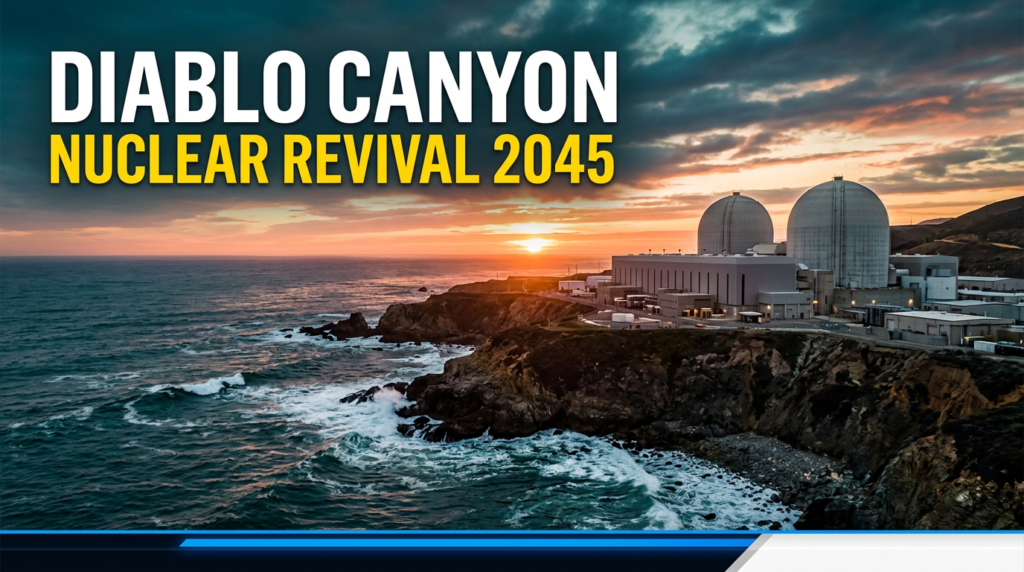
California’s only nuclear plant just cleared its biggest federal hurdle in decades. The 20-year license extension is a victory for common sense, energy reliability, and the millions of families who depend on affordable power — but the real fight is just beginning in Sacramento.
For years, the story of Diablo Canyon Nuclear Power Plant was written as a eulogy. California’s last nuclear facility, perched on the Central Coast near Avila Beach, was supposed to go dark in 2025. The state had decided. The narrative was settled. Activists celebrated. And the people who depend on reliable, affordable electricity were simply expected to trust that wind turbines and battery storage would fill the void.
On April 2, 2026, the U.S. Nuclear Regulatory Commission signed a 20-year license renewal for Diablo Canyon — extending the plant’s federal operating authorization through 2045. It was a moment that exposed just how badly California’s energy establishment had misjudged its own power grid, its own people, and the basic laws of physics.
Support Independent Local Journalism
TheTownHall.News is a non-profit reader-supported journalism. Just $5 helps us hire local reporters, investigate important issues, and hold public officials accountable across Alameda County. If you believe our community deserves strong, independent journalism, please consider donating $5 today to support our work.Why Diablo Canyon Matters More Than Politicians Admitted
The numbers are stark, and they always were. Diablo Canyon’s two reactors generate approximately 2,200 megawatts of electricity — roughly 8.5% of California’s total power supply, according to the California Public Utilities Commission. It provides clean, carbon-free electricity to more than four million Californians, around the clock, regardless of whether the sun is shining or the wind is blowing.
That kind of firm, dispatchable power doesn’t just appear when you shut down a nuclear plant. It has to be replaced — megawatt for megawatt, hour for hour. The people who planned Diablo Canyon’s closure either didn’t understand that, or chose not to say it out loud.
For nearly a decade, California policymakers operated under the assumption that renewables plus battery storage could absorb the loss of the state’s single largest source of clean electricity. The grid blackouts of 2020, soaring electricity rates, and chronic reliability warnings from grid operators have since made that assumption very difficult to defend.
This was never an energy problem. It was a narrative problem. And it cost California years of unnecessary grid instability.

The Remarkable Reversal No One Wants to Fully Credit
The political reversal on Diablo Canyon has been nothing short of extraordinary — even if officials are reluctant to frame it that way.
In 2022, the California Legislature passed Senate Bill 846, explicitly directing PG&E to seek a license extension because, in the Legislature’s own words, “not enough clean energy had been produced in the state to replace the power plant.” That admission, buried in a bill and largely unremarked upon by media, was a quiet concession that the original closure plan had been a mistake.
PG&E’s nuclear chief, Paula Gerfen, made no effort to hide her emotion at the April 2 press conference. “Today the NRC’s approval confirms what we already know — we are safe, and we are environmentally sound,” she said, visibly moved. NRC Acting Director Jeremy Groom called Diablo Canyon “a stabilizing force on a dynamic grid” and “a facility unlike any other.”
That’s quite a description for a plant California’s energy planners were once ready to decommission.
What the Environmental Opposition Gets Wrong
Opponents of the extension haven’t disappeared. The California Coastkeeper Alliance has filed legal petitions challenging water permits, citing the plant’s once-through cooling system, which draws approximately 2.5 billion gallons of seawater per day. Other organizations are fighting to limit the Clean Water Act certification to 2030 rather than 2045.
Support Independent Local Journalism
TheTownHall.News is a non-profit reader-supported journalism. Just $5 helps us hire local reporters, investigate important issues, and hold public officials accountable across Alameda County. If you believe our community deserves strong, independent journalism, please consider donating $5 today to support our work.These concerns deserve genuine scientific scrutiny. But the framing of the broader opposition — that Diablo Canyon is an unacceptable environmental risk — collapses under honest comparison.
What is the actual environmental cost of replacing Diablo Canyon’s output? More natural gas peaker plants. More transmission lines cutting through sensitive landscapes. More battery storage requiring mined lithium and cobalt. More of the grid instability that triggers emergency fossil fuel burn.
The California Coastal Commission, after weighing the tradeoffs, issued PG&E a coastal development permit in December 2025 — requiring the company to conserve thousands of acres of land as mitigation. The Central Coast Regional Water Quality Board followed in February 2026 with wastewater discharge authorization. Regulators did their jobs. The plant cleared every required hurdle.
Opposing Diablo Canyon on environmental grounds while ignoring the environmental cost of replacing it is not environmentalism. It is symbolism dressed up as policy.
The Real Stakes: Sacramento Still Has the Final Word
Here is where the celebration must pause. The NRC license extends federal authorization to 2044 for Unit 1 and 2045 for Unit 2. But under California law, Diablo Canyon is only authorized to operate through 2029 and 2030 for its two units, respectively.
To run beyond those dates, PG&E will need the California Legislature to act — again. The company will also need an exemption from the State Water Resources Control Board’s current order requiring the once-through cooling system to cease operations by October 31, 2030.
The NRC approval is not the end of this story. It is the beginning of the most consequential energy debate California has had in a generation.
Every family paying a utility bill in California, every business owner watching electricity costs erode their margins, every parent worried about grid reliability during the next heat wave — they all have a direct stake in what happens next in Sacramento.
A Vindication for Practical Thinking
There is a broader lesson here that extends well beyond California’s power grid. For years, those who questioned the wisdom of shutting down a safe, operating nuclear plant were dismissed as obstacles to progress. The orthodoxy was enforced not by evidence but by social pressure and political momentum.
What broke the narrative wasn’t an ideological counterattack. It was reality. Grid operators sounded alarms. Blackouts happened. Electricity bills climbed. The renewables-plus-storage transition proved slower, more expensive, and more complicated than promised.
The 2022 reversal, the subsequent regulatory approvals, and now the NRC’s 20-year license extension represent the slow, reluctant return of practical thinking to California’s energy policy. That is worth acknowledging — not to score political points, but because honest accounting is how you avoid making the same mistake twice.
California did not save Diablo Canyon because it changed its values. It saved Diablo Canyon because it had no other choice. The difference matters for the debates ahead.
🔑 Key Takeaway
The NRC’s approval of Diablo Canyon’s 20-year extension is a victory for energy reliability and common sense — but the plant’s future beyond 2030 still requires California legislative action. The same political forces that pushed to close a safe, efficient plant are still active in Sacramento. Whether Diablo Canyon actually runs to 2045 depends entirely on whether Californians stay informed and engaged.
What You Can Do
Stay informed on the California Legislature’s next moves regarding Diablo Canyon’s post-2030 authorization. If you care about reliable energy, lower electricity costs, and honest policymaking, this debate deserves your attention. Share this article with someone who pays a California utility bill. And support independent journalism that covers energy policy without ideological blinders — because these decisions affect every family, every business, and every community in the state.
Have a perspective on California’s energy future? Engage in the conversation below.