Washington Just Warned Mexico: Your Cartel-Linked Politicians Are Next
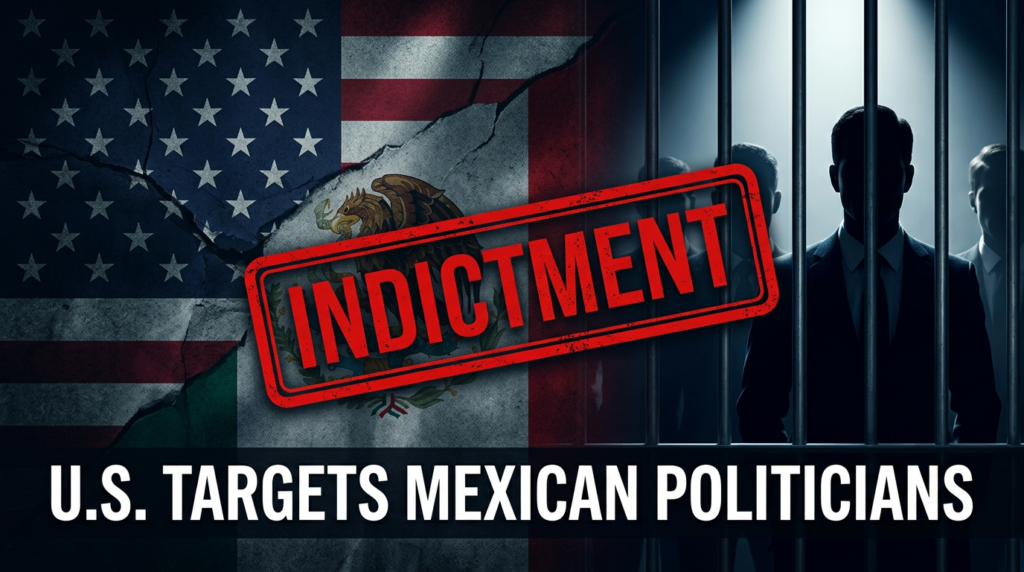
U.S. Ambassador Ronald Johnson walked into the heart of Sinaloa Cartel country and put Mexico’s political class on notice. Federal indictments — backed by cartel witnesses already in U.S. custody — may be coming.
Standing in Los Mochis, Sinaloa — a city carved from the territory of one of the world’s most powerful drug cartels — the U.S. Ambassador to Mexico looked into the cameras last week and delivered six words that reverberated through Mexico City: “We may soon see significant action.”
Ambassador Ronald Johnson wasn’t talking about trade tariffs or border policy. Sources familiar with U.S.-Mexico bilateral relations confirm Washington is preparing something far more aggressive: federal indictments of Mexican politicians in U.S. courts, potentially backed by testimony from cartel members already sitting in American prisons.
Support Independent Local Journalism
TheTownHall.News is a non-profit reader-supported journalism. Just $5 helps us hire local reporters, investigate important issues, and hold public officials accountable across Alameda County. If you believe our community deserves strong, independent journalism, please consider donating $5 today to support our work.It’s the most direct threat Washington has aimed at Mexico’s political class in decades. And President Claudia Sheinbaum’s careful, almost nervous response suggests she knows exactly how exposed some of her allies are.
Why Sinaloa — and Why Now?
Johnson didn’t deliver this warning from a conference room in Mexico City. He chose Los Mochis, Sinaloa — the birthplace of El Chapo, ground zero for cartel politics, and a region long associated with the infiltration of government offices at every level. That venue was a deliberate message.
His remarks came during the groundbreaking of a $3.3 billion methanol facility — a setting designed to project economic optimism. But Johnson pivoted fast.
“Corruption doesn’t just slow progress, it distorts it. It raises costs, weakens competition, and erodes the trust that markets depend on.” — U.S. Ambassador Ronald Johnson, Los Mochis, Sinaloa, April 23, 2026

He then invoked the USMCA trade agreement, noting it “requires our governments to criminalize bribery and corruption and enforce codes of conduct for public officials.” Then came the warning: “We may soon see significant action on this front.”
The speech drew immediate attention from diplomats and security analysts across both countries. Analysts called the USMCA framing deliberate and calculated — reframing potential indictments not as political interference, but as treaty compliance.
📎 Related: U.S. Revokes Visas of 50+ Mexican Politicians — Full List of What We Know
The USMCA Card: Washington’s Legal Weapon
By anchoring his threat in trade law, Johnson handed Washington a legal justification that extends beyond raw political muscle. The USMCA framework obligates all three signatory nations — the U.S., Mexico, and Canada — to enforce anti-corruption standards on public officials.
If Washington formally invokes that mechanism, Mexico won’t just face a legal crisis. It will face a trade crisis — one that could complicate the tariff negotiations already straining the bilateral relationship.
Support Independent Local Journalism
TheTownHall.News is a non-profit reader-supported journalism. Just $5 helps us hire local reporters, investigate important issues, and hold public officials accountable across Alameda County. If you believe our community deserves strong, independent journalism, please consider donating $5 today to support our work.“Washington isn’t just revoking visas anymore. It’s building court cases — and cartel bosses in U.S. prisons may be the star witnesses.”
Legal experts noted the move places Mexico in a near-impossible diplomatic position: fighting the indictments risks appearing complicit, while cooperating opens the door to further U.S. judicial reach into Mexican sovereignty.
50 Visas Gone. Indictments Could Be Next.
The Sinaloa speech didn’t emerge from a vacuum. In October 2025, Reuters reported that the U.S. had already revoked the visas of more than 50 Mexican politicians, citing “activities contrary to America’s national interest.” No names were made public. No charges were filed. That was the warning shot.
Johnson’s latest remarks suggest that phase is over. Sources indicate U.S. prosecutors have been quietly building cases using testimony from cartel figures detained in American custody — witnesses with direct knowledge of which officials took payoffs, provided protection, or deliberately looked away.
The legal architecture for prosecution already exists. Under U.S. federal narco-trafficking statutes, American prosecutors can pursue foreign nationals who facilitated drug distribution in the United States — regardless of where those crimes were coordinated.
📎 Related: El Mencho Is Dead: How U.S.-Mexico Intelligence Sharing Took Down the CJNG Boss
Sheinbaum Walks a Tightrope
Mexico’s president responded the only way she could — carefully. “That’s exactly what we’re working on,” Sheinbaum told reporters, before adding a pointed barb: “The United States should do the same.”
It was a diplomatic jab, not a rebuttal. Sheinbaum didn’t deny the underlying problem. She didn’t defend the officials in question. What she defended was sovereignty — a word her administration has returned to repeatedly as Washington’s footprint in Mexican security operations has expanded.
After a fatal crash in Chihuahua involving two suspected CIA operatives in April 2026, Sheinbaum ordered all Mexican governors to route any cooperation with foreign agencies through federal channels. The message to Washington was unmistakable: cooperation happens — but on Mexico’s terms.
The X-Factor: Cartel Witnesses Behind Bars
The most explosive detail in this story isn’t the ambassador’s speech. It’s the witnesses. Sources suggest U.S. prosecutors plan to draw directly on testimony from cartel leaders and mid-level operatives already held in American federal prisons.
These aren’t hypothetical informants. Since early 2025 — when Mexico extradited 29 cartel figures including Rafael Caro Quintero — and following El Mencho’s killing in February 2026, Washington has assembled a growing network of cooperating witnesses with detailed knowledge of how corruption flows between cartel money and Mexican government offices.
That’s not a political threat. That’s a prosecutorial foundation.