A 14-Year-Old’s Heart Disease AI App Proves American Innovation Still Beats Bureaucracy
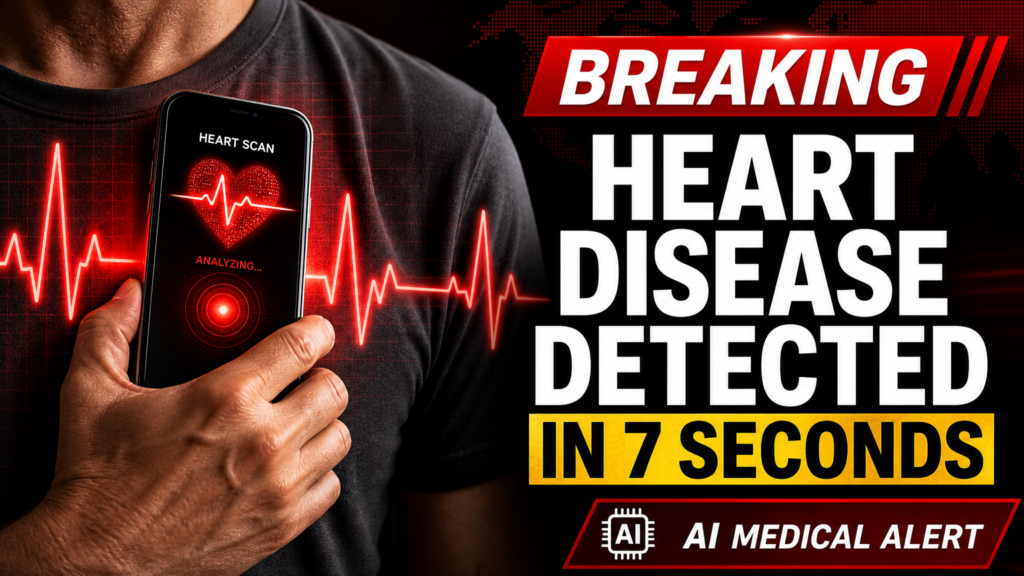
Siddharth Nandyala’s Circadian AI screens for cardiovascular disease in seven seconds using a smartphone — and exposes how private ingenuity, not federal mandates, delivers real healthcare breakthroughs.
While Washington spends billions debating how to “fix” American healthcare, a 14-year-old from Frisco, Texas, may have already done more for early heart disease detection than a decade of regulatory hearings. His name is Siddharth Nandyala, and his app — Circadian AI — can screen a patient’s heart in roughly the time it takes a politician to clear his throat.
The story is more than a viral feel-good headline. It is a case study in what happens when ambition, family support, and free enterprise are allowed to flourish without being smothered by gatekeepers. It is also a quiet rebuke to the assumption that meaningful medical innovation can only come from massive government grants or sprawling academic bureaucracies.
Support Independent Local Journalism
TheTownHall.News is a non-profit reader-supported journalism. Just $5 helps us hire local reporters, investigate important issues, and hold public officials accountable across Alameda County. If you believe our community deserves strong, independent journalism, please consider donating $5 today to support our work.Why This Story Matters Right Now
Cardiovascular disease remains the leading cause of death worldwide, responsible for roughly 32 percent of global fatalities, according to figures cited by the New York Post and other outlets covering Nandyala’s work. In the United States alone, heart disease kills hundreds of thousands of Americans every year.
The traditional pathway to early diagnosis is expensive, slow, and frequently inaccessible — particularly for working families and rural communities. An ECG, an echocardiogram, or a cardiologist consult often requires insurance approval, time off work, and a drive to a specialist who may be booked months out.
Nandyala’s app reframes the problem entirely. Place a smartphone near the chest, record for seven seconds, and a cloud-based machine-learning model analyzes the acoustic signature of the heartbeat. The reported accuracy in clinical trials: 96 percent or better, validated across approximately 15,000 patients in the United States and 3,500 in India, as reported by Smithsonian Magazine.
The American Dream, Still Alive in a Frisco Garage
Nandyala is the son of Indian immigrants who settled in Texas. He is, by all accounts, an extraordinary young man — but his story is not a fluke of genius. It is a textbook example of what happens when a culture rewards merit, hard work, and personal initiative.

By age 13, he had already designed a low-cost prosthetic arm. He founded a company called STEM IT, which produces science and technology kits for students. Now 14, he is a freshman studying computer science at the University of Texas at Dallas, according to Smithsonian Magazine and the Indian Eagle profile.
He didn’t wait for a federal program to give him permission. He built it.
“Even one life detected is one life saved.” — Siddharth Nandyala, in remarks to Smithsonian Magazine
How Circadian AI Actually Works
The app’s core functionality is elegantly simple. According to the official Circadian AI website and reporting by the New York Post:
- The phone’s microphone captures heart sounds when placed on the chest.
- Proprietary noise-cancellation algorithms filter ambient sound.
- A cloud-based AI model analyzes the acoustic patterns.
- The tool flags possible arrhythmias, early heart failure indicators, signs of coronary artery disease, and valve abnormalities.
Importantly, Nandyala has been transparent about the app’s scope. Circadian AI is currently positioned as a pre-screening tool for trained medical personnel — not a replacement for ECGs, echocardiograms, or hospital-grade diagnostics. That honesty is itself a refreshing departure from the hype-driven culture of Big Tech.
What Critics Get Wrong About Private-Sector Innovation
Predictably, some voices in the public-health establishment have raised concerns about AI tools developed outside traditional academic channels. They cite the need for FDA oversight, peer-reviewed validation, and equity audits.
Support Independent Local Journalism
TheTownHall.News is a non-profit reader-supported journalism. Just $5 helps us hire local reporters, investigate important issues, and hold public officials accountable across Alameda County. If you believe our community deserves strong, independent journalism, please consider donating $5 today to support our work.Those concerns are not baseless — but they are routinely weaponized to slow down or block competition from outsiders. The FDA’s medical-device approval process can take years and cost millions of dollars, a barrier that effectively locks out independent inventors and favors entrenched corporate players.
Nandyala’s team has wisely structured Circadian AI for clinical use by trained professionals, which allows the technology to be deployed responsibly while continuing to gather real-world validation data. That is exactly the kind of measured, market-driven approach that produces results without requiring federal mandates.
How This Affects Families and Communities
The implications for ordinary Americans — and for underserved communities globally — are significant. A pocket-sized pre-screening tool could mean:
- Early flags for fathers who haven’t seen a doctor in years.
- A simple check for grandparents in rural towns hours from the nearest cardiologist.
- A practical resource for community clinics, school nurses, and mission hospitals.
- Lower long-term healthcare costs by catching problems before they become emergencies.
This is what genuine healthcare access looks like — driven by technology, scaled by smartphones, and delivered without expanding the federal bureaucracy by a single employee.
Recognition Across the Political Spectrum
Nandyala’s work has drawn praise from across the political divide, which speaks to its substance. He has reportedly received letters of commendation from former Presidents Barack Obama and Joe Biden, as well as a Certificate of Recognition from the U.S. House of Representatives, according to the Indian Express.
The local Frisco Chamber of Commerce named him Innovator of the Year, awarding the then-seventh-grader more than $2,000 to support his fledgling company — a meaningful gesture from a community institution that invested in local talent, as reported by Smithsonian Magazine.
That is how civil society is supposed to function: local, voluntary, merit-based recognition that fuels the next generation of builders.
The Counterargument — And Why It Falls Short
Skeptics will argue that without rigorous FDA approval and large-scale peer-reviewed studies, no medical AI tool should be celebrated. They will warn of false positives, missed diagnoses, and the dangers of patients self-diagnosing through a smartphone.
These concerns deserve a serious response. Nandyala himself has addressed them directly: Circadian AI is not a diagnostic replacement. It is a screening tool meant for trained personnel. Reported clinical-trial validation across roughly 18,500 patients in two countries is not a trivial sample size.
Moreover, demanding perfection from a teenager’s startup while ignoring the well-documented failures of large healthcare bureaucracies is intellectually dishonest. The relevant comparison is not “Circadian AI versus an ideal hospital.” It is “Circadian AI versus nothing at all,” which is what millions of patients in underserved areas currently have.
Parental Rights, Family Values, and the Innovation Pipeline
Perhaps the most overlooked lesson here is about families. Nandyala’s accomplishments did not happen in a vacuum. They are the product of engaged parents, a supportive community, and an education system — including school choice and early college access — that allowed a gifted teenager to accelerate.
A culture that empowers families produces young Americans who build life-saving technology. A culture that undermines them does not.
When critics dismiss parental rights or push to centralize education under federal control, they are not just losing a political fight. They are quietly shutting the door on the next Siddharth Nandyala.
Key Takeaways
- A 14-year-old American built a heart-screening AI with 96%+ reported accuracy across ~18,500 clinical-trial patients.
- The project was driven by private initiative, immigrant family values, and local community support — not federal mandates.
- Circadian AI demonstrates how smartphones can democratize early diagnostics for working families and rural communities.
- The regulatory establishment should reward this kind of responsible private innovation rather than throttle it.
Conclusion: The Future Belongs to the Builders
The Circadian AI story is more than a viral headline. It is a reminder that America’s greatest asset has never been its government — it has been its people. Families who push their kids to excel. Communities that reward merit. A free-market system that lets a 14-year-old build something that doctors at Louisiana State University are now publicly endorsing as potentially life-saving.
We do not need more regulation to produce the next medical breakthrough. We need more space, more freedom, and more cultural respect for the builders, the doers, and the families who raise them.
Stay Informed. Share This Story. Support Independent Journalism.
If this story inspired you, share it. Talk about it at the dinner table. Tell your kids that a 14-year-old just changed cardiology with a smartphone — and that they can build something extraordinary too. Independent journalism survives when readers like you stay engaged, stay curious, and refuse to let mainstream narratives dictate which stories get told. Subscribe, share, and stand for the innovators rebuilding America from the ground up.