Birthright Citizenship Exceptions Explained: What the Ninth Circuit’s Ruling Really Means
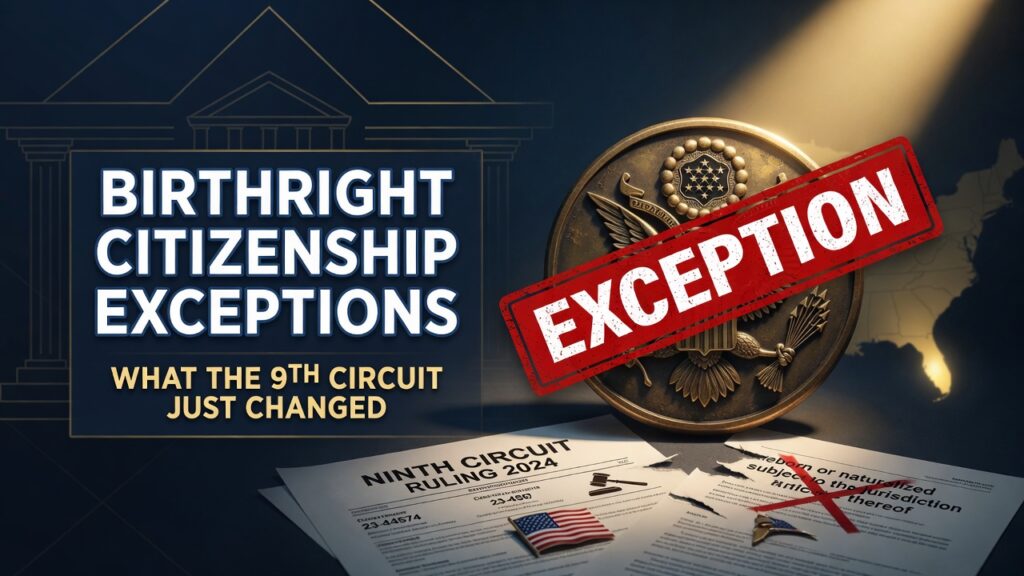
birthright citizenship exceptions
A federal court just ruled that a man who lived in America for 70 years, took five oaths of allegiance, and held five U.S. passports was never actually a citizen. The law was right — and the silence around it has been deafening.
The Constitution does not guarantee citizenship to every person born on American soil. Full stop.
That statement may surprise millions of Americans who have been told, repeatedly, that birthright citizenship is absolute, automatic, and beyond legal question. But the Ninth Circuit Court of Appeals — hardly a bastion of conservative jurisprudence — just reminded the country that the 14th Amendment has always carried a critical qualifier, one that courts, politicians, and media commentators have spent decades glossing over.
Support Independent Local Journalism
TheTownHall.News is a non-profit reader-supported journalism. Just $5 helps us hire local reporters, investigate important issues, and hold public officials accountable across Alameda County. If you believe our community deserves strong, independent journalism, please consider donating $5 today to support our work.The case is Moncada v. Rubio, decided August 20, 2025. Its facts are compelling, its legal reasoning is sound, and its implications for how we discuss citizenship in this country are significant. If you haven’t heard about it yet, that itself is worth asking about.
What Did the Ninth Circuit Actually Rule?
The court ruled that Roberto Moncada — born in New York City in 1950 — is not a U.S. citizen, despite living here for nearly 70 years. The reason is precise and legally grounded: his father, a Nicaraguan national, served as a diplomatic attaché to Nicaragua’s permanent UN mission in New York when Moncada was born. Under long-established international law, a diplomatic attaché and his family carry full diplomatic immunity — meaning they are not fully “subject to the jurisdiction” of the United States.
The 14th Amendment’s citizenship clause reads: “All persons born or naturalized in the United States, and subject to the jurisdiction thereof, are citizens.” That four-word phrase — subject to the jurisdiction — is doing enormous legal work that the public debate almost never acknowledges.
This exception isn’t new. It wasn’t invented by a Trump appointee or a conservative activist judge. It was recognized at the founding, affirmed by the Supreme Court in Wong Kim Ark (1898), and has remained settled law ever since. The Ninth Circuit panel — which included judges appointed by both Democratic and Republican presidents — applied it unanimously.

Is This About Trump’s Birthright Order? Not Even Close.
Here is where intellectual honesty matters. Moncada v. Rubio is not connected to President Trump’s January 2025 executive order attempting to end birthright citizenship for children of undocumented immigrants and temporary visa holders. That order has been blocked by federal courts at every level, and as of April 1, 2026, the Supreme Court heard oral arguments in Trump v. Barbara — with the majority of justices appearing skeptical of the administration’s position.
These are two entirely different legal questions. The diplomatic immunity carve-out applies to a genuinely tiny class of people — foreign nationals who are legally exempt from U.S. jurisdiction by treaty. The Trump order, by contrast, attempts to apply a far broader redefinition of “jurisdiction” to millions of people. The courts, and likely the Supreme Court, are treating them as the separate matters they are.
Conflating Moncada with the Trump order would be intellectually lazy — and factually wrong.
That distinction matters precisely because it allows for a more honest conversation: there are legal limits to birthright citizenship that have always existed, that have always made legal sense, and that have nothing to do with partisan immigration politics.
70 Years. Five Passports. And Still Not a Citizen — Is That Just?
The human dimension of Moncada is impossible to ignore, and the judges didn’t try to ignore it. The court explicitly stated, “It is impossible to conclude that this is justice.” The government itself called the outcome “very unfortunate and regrettable.” Moncada’s entire adult life was built on a citizenship status the government itself certified — five times.
Support Independent Local Journalism
TheTownHall.News is a non-profit reader-supported journalism. Just $5 helps us hire local reporters, investigate important issues, and hold public officials accountable across Alameda County. If you believe our community deserves strong, independent journalism, please consider donating $5 today to support our work.“Courts lack the equitable power to remedy the government’s errors by granting citizenship.” — Ninth Circuit, Moncada v. Rubio, August 2025.
That line should sit uncomfortably with everyone, regardless of political affiliation. The government made a mistake — a significant, decades-long mistake — and the individual bore the cost. If there is a genuine policy failure worth examining here, it is not the court’s application of the law. It is the State Department’s stunning failure to maintain accurate diplomatic records for 70 years, and the absence of any legislative remedy for cases like Moncada’s.
A man who served this country’s civic institutions faithfully for seven decades deserved better from his government — even if the law, correctly applied, could not save him.
What Do Supporters of Automatic Birthright Citizenship Actually Believe?
This is a fair question, and it deserves a real answer. Defenders of broad birthright citizenship make a powerful argument: the 14th Amendment was written as a bright-line rule specifically to prevent the government from making citizenship conditional on race, lineage, or political favor. After Dred Scott, the Framers of the amendment wanted no ambiguity. “Born here, citizen here” was the cleanest possible statement of national belonging.
They also argue, reasonably, that expanding the exceptions creates a slippery slope — that today’s diplomatic carve-out becomes tomorrow’s pretext for stripping citizenship from children of immigrants more broadly. It’s a concern the Supreme Court took seriously during April 2026 oral arguments, when Justice Sotomayor explicitly asked whether the government’s logic could someday be applied retroactively.
These are legitimate concerns. But they do not require pretending the existing exceptions don’t exist or are illegitimate. The diplomatic immunity exception is narrow, treaty-based, and universally recognized in international law. Acknowledging it honestly doesn’t open the floodgates — it demonstrates that the law is neither absolute nor arbitrary, but principled and precise.
The difference between a well-defined legal exception grounded in 150 years of precedent and a sweeping executive rewrite of constitutional text is not a small one. Both can be criticized or defended — but they cannot be treated as the same argument.
Who Is Actually Accountable When the Government Gets It Wrong?
That is the question Moncada ultimately forces us to ask. For 70 years, the State Department issued passports, accepted oaths of allegiance, and confirmed citizenship status to a man it was — by its own later admission — wrong about. No one has been held accountable for that failure. No systemic review was announced. No compensation was offered.
If the government can strip a man of citizenship after 70 years based on records it misread for seven decades, what exactly are the limits of administrative error — and who pays the price?
This is not a small procedural footnote. It is a case study in why civic trust erodes. Personal responsibility is a value worth defending — but it cuts both ways. Citizens are expected to follow the law precisely. Government agencies must be held to the same standard of accuracy and accountability.
70 years of misclassified diplomatic records. The question no bureaucrat in Washington has been asked to answer: how does this happen — and how do we make sure it never does again?
Why This Ruling Deserves More Attention Than It’s Getting
The broader birthright citizenship debate has consumed enormous political oxygen. But precisely because Moncada is narrow and fact-specific, it has been largely ignored — and that’s a mistake. It is, arguably, the clearest possible demonstration that the citizenship clause has always operated with principled limits rooted in law, not politics.
Understanding those limits matters. It allows for a more honest national conversation — one that doesn’t require either pretending the 14th Amendment is a policy-free absolute or accepting sweeping executive rewrites of constitutional text.
The law, applied carefully and consistently, is neither heartless nor political. Moncada is uncomfortable proof of both truths simultaneously.
Key Questions This Article Raises
- If the government misclassifies your status for 70 years and then corrects its “mistake,” who is legally and morally responsible for the consequences to you?
- Does the existence of the diplomatic immunity exception — unanimously upheld — change how you think about the phrase “subject to the jurisdiction thereof”?
- With the Supreme Court expected to rule on birthright citizenship by July 2026, is the public informed enough to evaluate what that decision actually means?
What do you think — does the law demand this outcome, or does justice demand something more? Share this article and tell us where you stand.
The real question isn’t whether birthright citizenship has legal limits. It’s whether Americans are being given the honest, complete picture they need to have that debate at all.
Still have questions? Subscribe for daily coverage of the cases reshaping American law and civic life. Think others need to hear this? Share the article — this conversation shouldn’t stay inside courtrooms. Want to make your voice count? Contact your congressional representative and ask what legislative protections exist for Americans whose citizenship is disputed due to government error.