Tooth Enamel Regeneration Gel: The Science That Could Replace Fillings
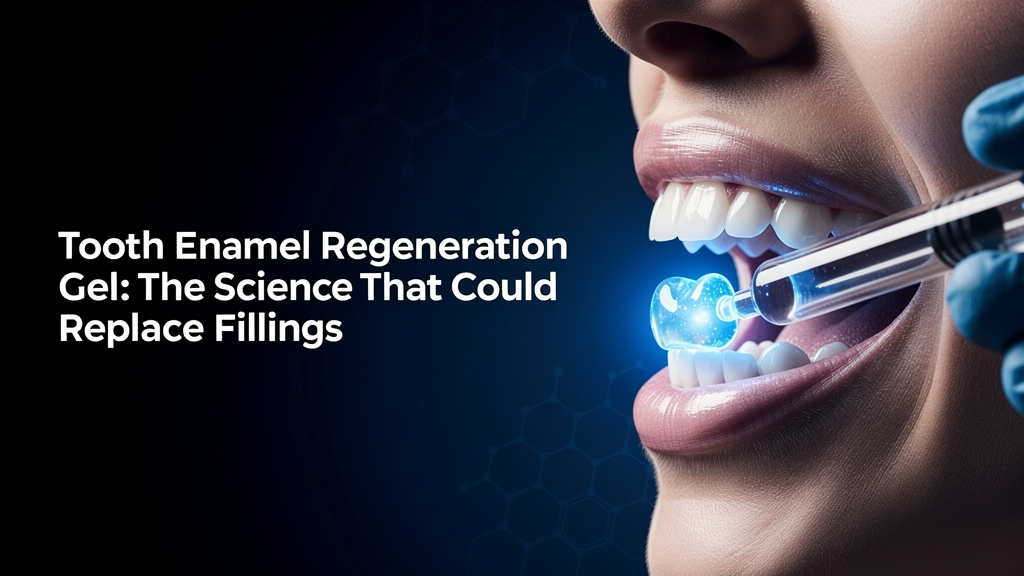
A protein-based gel developed at the University of Nottingham can rebuild tooth enamel — the one thing dentistry has insisted for decades could never come back. The question is whether patients will be the last to hear about it.
Lost enamel doesn’t come back. That’s been the foundational truth of modern dentistry for generations. Every filling, every crown, every costly restorative procedure rests on that assumption.
That assumption may now be wrong.
Support Independent Local Journalism
TheTownHall.News is a non-profit reader-supported journalism. Just $5 helps us hire local reporters, investigate important issues, and hold public officials accountable across Alameda County. If you believe our community deserves strong, independent journalism, please consider donating $5 today to support our work.In November 2025, researchers at the University of Nottingham published findings in Nature Communications — one of the most rigorous peer-reviewed journals in science — announcing a bioinspired gel capable of triggering the regrowth of tooth enamel. Not coating it. Not patching it. Regrowing it. The implications reach far beyond the dental chair: into personal health sovereignty, healthcare costs, and the question of who controls your access to breakthrough medicine.
What Does the Science Actually Show?
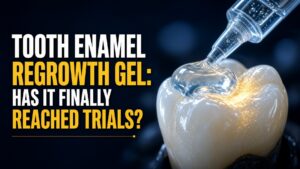
The gel works by mimicking the proteins the human body naturally uses to build enamel during infancy. Applied to a tooth the same way a dentist currently applies a fluoride varnish, the material recruits calcium and phosphate ions directly from saliva and triggers what scientists call epitaxial mineralization — essentially, growing new enamel crystals in the same organized, layered architecture as natural enamel.
Under electron microscopy, the transformation is striking. A chaotic, pitted, eroded surface is replaced by structured crystal growth indistinguishable in form and function from healthy enamel.
The gel is also fluoride-free. In the current political climate, where the Department of Health and Human Services is reexamining fluoride’s role in public water supplies, that’s not just a clinical footnote — it’s a meaningful alternative pathway for enamel protection.

Early lab results showed enamel restoration beginning within just two weeks of a single application.
Is This Too Good to Be True — Or Just Too Inconvenient for the Status Quo?
Skepticism is warranted. And fair. Here’s what the science does not yet show.
All testing to date has been conducted on extracted human molars in laboratory conditions — not inside living mouths. The regenerated enamel layer produced in a single application is approximately 10 micrometers thick. Natural enamel on a biting surface runs up to 2,000 micrometers. This is a beginning, not a cure.
The gel rebuilds enamel. It doesn’t yet rebuild all the enamel you’ve lost — and deep cavities still require traditional treatment first.
But here’s what matters: the scientific community is taking it seriously. The research was published in Nature Communications. The university has launched a commercialization spin-off, Mintech-Bio, with human clinical trials scheduled to begin in 2026. This is not fringe science. It is peer-reviewed, institutionally backed, and actively moving toward patients.
Support Independent Local Journalism
TheTownHall.News is a non-profit reader-supported journalism. Just $5 helps us hire local reporters, investigate important issues, and hold public officials accountable across Alameda County. If you believe our community deserves strong, independent journalism, please consider donating $5 today to support our work.“If it works — and if access follows — this technology could reduce the global burden of untreated dental decay more effectively than any public health campaign of the last fifty years.”
Who Is Really Paying for the Dental Crisis Right Now?
The global scale of dental decay is staggering. The World Health Organization estimates that untreated dental caries affects approximately 2.3 billion people worldwide. [WHO Global Oral Health Status Report]
2.3 billion people with untreated tooth decay. The question no one in healthcare policy wants to answer: how much of that suffering is preventable?
In the United States alone, roughly 26% of adults live with untreated cavities — concentrated disproportionately in low-income communities with limited access to routine dental care. [CDC National Center for Health Statistics] These are not people who chose bad habits. Many are people for whom a single filling costs more than a week’s groceries.
The current model asks patients to pay — in money, time, anxiety, and lost tissue — for a repair system that has never truly restored what decay destroys. A gel applied during a standard hygiene visit that rebuilds enamel rather than patches it would change that equation fundamentally. Personal responsibility only works when individuals have access to tools that actually solve the problem. For decades, dentistry’s best tool was a drill.
What Do Supporters of the Traditional Dental Model Actually Believe?
This is a fair question. The dental establishment has not dismissed this research — far from it. Many practitioners have welcomed it as an extension of the preventive care philosophy they already champion.
The core argument from supporters of the current model is one of caution: that clinical trials exist for a reason, that materials which perform brilliantly on extracted teeth in controlled lab conditions sometimes behave very differently inside the complex, bacteria-rich, constantly moving environment of a living mouth. They argue that a 10-micrometer regenerated layer, while scientifically remarkable, is not a replacement for comprehensive restorative care.
That argument deserves respect. Rigorous trials protect patients. The history of medicine includes promising breakthroughs that failed in practice.
But the counterargument is equally serious: regulatory timelines that stretch years or decades consistently harm the very patients who need new options most. If this technology performs as the lab work suggests, every year of delay translates into millions of people receiving drills and synthetic fillings when a biological alternative existed.
The goal of personal health freedom is not anti-science. It is pro-accountability — demanding that scientific advances reach patients without unnecessary institutional delay.
Are We on the Edge of a Genuine Turning Point in Dentistry?
The convergence of developments happening right now is difficult to ignore.
In November 2025, a separate research team published findings showing that keratin — the protein found in hair and skin — can also be used to repair and protect tooth enamel. Two independent scientific pathways, arriving simultaneously, pointing toward the same fundamental shift: biological regeneration replacing mechanical intervention.
Mintech-Bio, the University of Nottingham’s commercial spin-off, is actively developing the gel for clinical deployment. As of mid-2026, human trials are progressing toward launch. The company’s stated goal is an initial product available through dental offices — applied like a fluoride varnish — following regulatory approval.
If this technology succeeds, it doesn’t just change how dentists treat cavities. It changes the fundamental relationship between patients and preventive care.
That is a shift worth paying attention to — and worth demanding moves as quickly as the science allows.
Key Questions This Article Raises
- Will regulatory timelines keep a proven biological treatment out of patients’ hands for years while millions continue receiving synthetic fillings?
- If a fluoride-free enamel gel reaches the market, who controls its cost and access — and will low-income patients benefit or be left behind again?
- What obligation do dental institutions and insurers have to fast-track adoption once clinical trials validate what the lab work already shows?
The Bottom Line
A gel that rebuilds enamel is no longer a fantasy. It is a peer-reviewed, institutionally commercialized reality moving toward your dentist’s office. The science is compelling. The need is undeniable. The only remaining question is whether the systems standing between a laboratory breakthrough and a patient in the chair will move at the pace this moment demands.
Personal responsibility in healthcare means more than brushing twice a day. It means staying informed, asking hard questions, and expecting that when science delivers a solution, the institutions meant to serve patients actually deliver it.
The real question isn’t whether this will change dentistry. It’s whether it will reach you before your next filling.
What do you think — is the dental industry ready to embrace regenerative care, or will institutional inertia slow this down? Share this article and tell us.
Call to Action
Still have questions? Stay ahead of the breakthroughs — subscribe for daily health and policy coverage.
Think others need to hear this? Share this article with someone who’s avoided the dentist because of the cost.
Want to make your voice count? Contact your congressional representative and ask what their position is on FDA reform timelines for breakthrough dental treatments. A single email takes three minutes.