Is 2026 California Election System Finally Being Held Accountable — Or Is It Too Late?
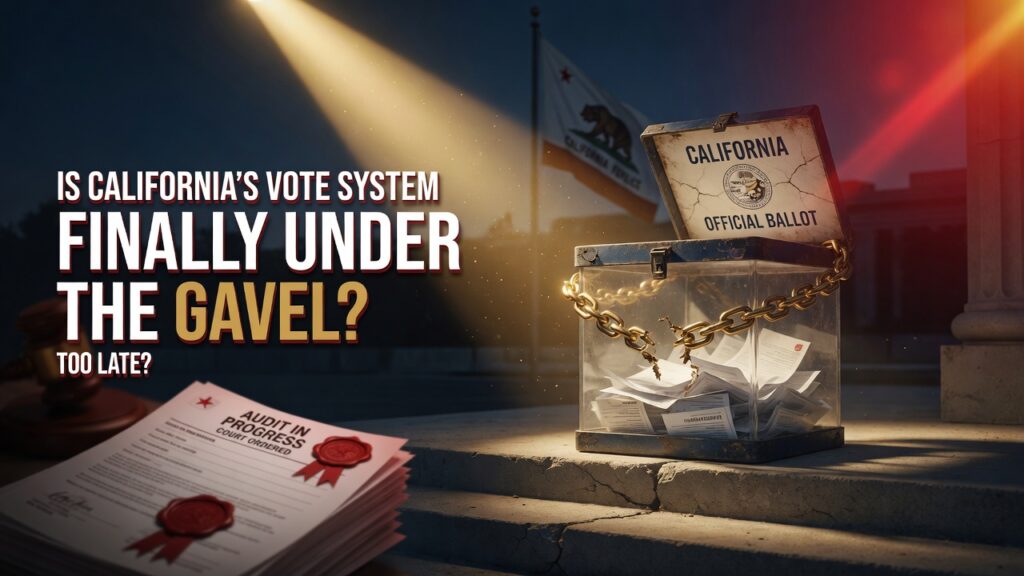
As federal prosecutors and the FBI open multiple election fraud investigations into California’s 2026 primary, millions of Americans are asking a question that has been building for years: who is guarding the integrity of the ballot — and who answers when no one is?
The ballots are still being counted. That alone should alarm you.
Nearly a week after California’s June 3, 2026 primary election — featuring races for Governor and Los Angeles Mayor — millions of votes remained uncertified, with official results not expected until July 10. While California officials insist the delay is legal and routine, the U.S. Attorney’s Office in Los Angeles has opened what it calls “multiple election fraud investigations,” working alongside the FBI. For voters who have spent years raising concerns about mail-in ballot vulnerabilities, that announcement was long overdue.
Support Independent Local Journalism
TheTownHall.News is a non-profit reader-supported journalism. Just $5 helps us hire local reporters, investigate important issues, and hold public officials accountable across Alameda County. If you believe our community deserves strong, independent journalism, please consider donating $5 today to support our work.Who Is Bill Essayli — and Why Did He Act Now?
Bill Essayli, First Assistant U.S. Attorney for the Central District of California, made the announcement publicly on June 5, 2026, posting on X that his office had launched multiple fraud probes in coordination with the FBI’s Los Angeles field office. Essayli, a Trump appointee, also confirmed that a federal prosecutor — Assistant U.S. Attorney Robert Renner — was physically dispatched to the Los Angeles County ballot processing center to observe operations in real time.
Essayli did not detail every investigation, but pointed to one charged case: a woman who pleaded guilty in May 2026 to paying homeless individuals on Skid Row to assist with getting ballot initiatives placed — a direct, documented example of election fraud in California, prosecuted within the past 30 days. He also confirmed his office is working with Assistant Attorney General Harmeet Dhillon to conduct a comprehensive audit of California’s voter rolls.
The federal government sent a prosecutor to watch ballots being counted in Los Angeles. When was the last time that happened — and what does it tell us about the state of trust in our elections?
What Does California’s Mail Ballot System Actually Look Like?
California’s election infrastructure is unlike almost any other state’s. Approximately 80% of votes are cast by mail [California Secretary of State data], and state law permits ballots postmarked on Election Day to arrive up to seven days afterward. Counties then have 30 days to finalize counts. Official certification is scheduled for July 10 — more than five weeks after Election Day.

That is not a clerical footnote. It is a structural reality that creates a prolonged window during which results shift, public confidence erodes, and the mechanisms of verification operate largely out of public view. Essayli noted that California’s system — with no universal voter ID requirement and extended mail-in windows — creates conditions where, in his words, “fraud can go undetected and unpunished.”
“Every legal vote deserves to be counted. Every illegal vote cancels one out.” — U.S. Attorney Bill Essayli, June 5, 2026
Supporters of the current system argue that signature verification serves as an effective identity check. That may be true in ideal conditions. But signature verification conducted at scale, under time pressure, across 58 counties, is not the same as a standardized, auditable identity confirmation process — and conflating the two shortcuts the very transparency voters deserve.
Is the Slow Count a Design Flaw or a Feature?
Here is the question too few are willing to ask plainly: does a system that consistently takes weeks to count ballots, routinely shifts results away from Election Night tallies, and resists external auditing serve the public interest — or institutional convenience?
California officials have an answer ready. Secretary of State Shirley Weber stated that the delay reflects “careful, accurate” counting of millions of ballots, and that the system “expands access” and “empowers voters.” Governor Gavin Newsom’s office anticipated the controversy so thoroughly that he sent a letter to county election officials last month — before a single vote was cast — warning them that delayed results would generate accusations of fraud.
0.000043% — the documented rate of mail-in ballot fraud according to a Brookings Institution study [Brookings Institution, November 2025]. The question no one in Sacramento wants to answer: if the system is airtight, why does a federal prosecutor need to physically watch the count?
Support Independent Local Journalism
TheTownHall.News is a non-profit reader-supported journalism. Just $5 helps us hire local reporters, investigate important issues, and hold public officials accountable across Alameda County. If you believe our community deserves strong, independent journalism, please consider donating $5 today to support our work.That Newsom pre-positioned his communications strategy suggests he understood the credibility problem his system creates, even if he disputes the fraud allegation itself. Awareness of a perception problem is not the same as solving it.
What Do Supporters of This Policy Actually Believe?
This question deserves a fair answer. California election officials, nonpartisan election law experts, and Democratic leaders make a consistent, substantive argument: the extended counting window exists because California processes more ballots than any other state, mail voting has been statistically shown to carry an extraordinarily low fraud rate, and the ballot-curing process — allowing voters to correct signature mismatches — protects legitimate voters from disenfranchisement. Thirty-four other states, including key battlegrounds, allow similar curing processes.
These are not frivolous points. Election experts broadly agree that isolated fraud cases do not constitute systemic theft, and that the “red mirage” — Republican leads shrinking as mail ballots are counted — is a statistical pattern tied to voting behavior, not manipulation.
But a low fraud rate is not a zero fraud rate. A system that produces confirmed prosecutions, resists voter roll audits through litigation, and takes five weeks to certify results is not above scrutiny — it is precisely the kind of system that demands it. Transparency and access are not competing values. They are both essential to public trust.
Why Are Millions of Americans No Longer Willing to Simply “Trust the Process”?
The erosion of election confidence did not begin with a single candidate or a single election. It has accumulated over years of structural decisions — expanded mail voting with limited auditing, extended counting windows, and fierce institutional resistance to independent verification — that have left ordinary citizens with no mechanism to personally confirm their vote was counted correctly and no one was fraudulently counted alongside them.
The real issue isn’t whether California’s officials believe their system is secure. It’s whether the public has any independent basis to verify that belief — and right now, the answer is uncomfortably unclear.
Essayli’s investigation, whatever its ultimate findings, represents something voters rarely see: a federal official willing to say, on the record, that the questions deserve formal answers. Whether the investigations produce charges or confirmations of clean conduct, the process of independent scrutiny is itself a civic good — one that California’s leadership has treated as an attack rather than an assurance.
Key Questions This Story Raises:
- If California’s mail ballot system is as secure as officials claim, why has the state spent years litigating against voter roll audits rather than welcoming them?
- Should federal law establish a national standard for the maximum number of days allowed between Election Day and certified results?
- At what point does a state’s election certification timeline cross from legally permitted into functionally incompatible with public confidence in democratic outcomes?
The Accountability Moment That Can’t Be Walked Back
The federal government has now stepped into California’s ballot counting room. Prosecutors are investigating. The FBI is involved. A documented fraud case was prosecuted last month. These are facts — not allegations, not spin.
The question every voter should be sitting with right now is not whether they trust the officials in charge. It is whether trust, without verification, is something a functioning democracy can afford to ask of its citizens indefinitely.
If accountability only arrives after public confidence has already collapsed, is it really accountability at all?
The real question isn’t whether this investigation will find wrongdoing — it’s whether America will demand transparent elections before the next ballot is cast.
Still have questions? Stay informed — subscribe for daily coverage of election integrity, federal investigations, and the issues that shape your vote.
Think others need to hear this? Share this article and tell us: what election reform would most restore your confidence in the system?
Want to make your voice count? Contact your U.S. Representative and ask them where they stand on a national election certification timeline standard. Find your representative at house.gov/representatives/find-your-representative.