New Tooth Enamel Repair Gel Could Replace Drilling — What You Need to Know
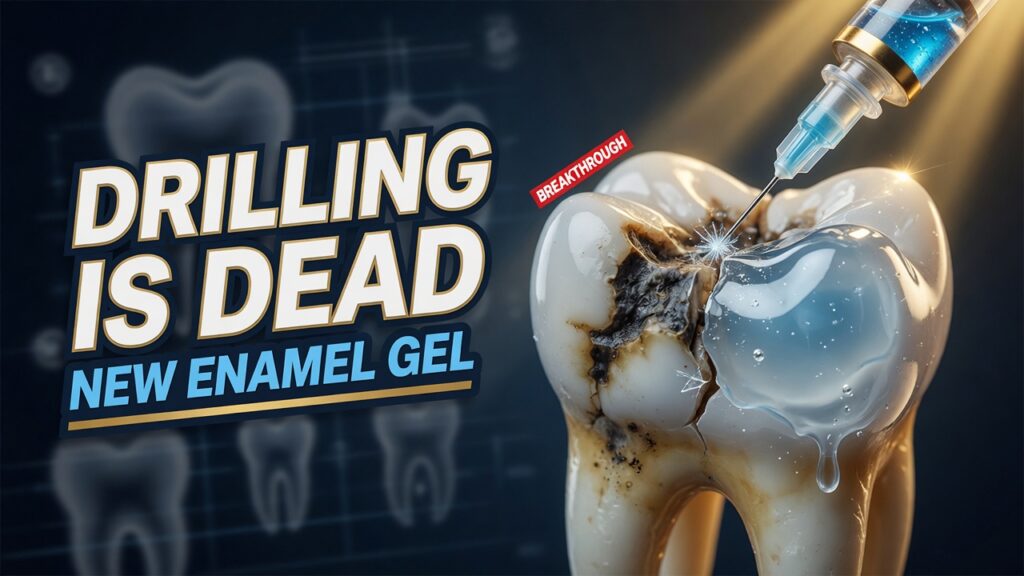
A protein-based gel developed at the University of Nottingham may be able to rebuild damaged tooth enamel without a drill — so why has it taken this long, and who benefits most when patients stay dependent on expensive restorations?
The dentist’s drill has ruled the examination chair for over a century. That may be about to change — and the implications reach far beyond your next dental appointment.
In November 2025, researchers at the University of Nottingham published findings in Nature Communications that stunned the dental science community. A protein-based gel, engineered to mimic the natural proteins responsible for building enamel in infants, was shown under electron microscopy to rebuild organized, enamel-like crystal structures on damaged teeth within just two weeks. Clinical trials in human patients are now scheduled for 2026. The question worth asking, plainly and seriously, is this: if this science was achievable, why are patients only hearing about it now?
Support Independent Local Journalism
TheTownHall.News is a non-profit reader-supported journalism. Just $5 helps us hire local reporters, investigate important issues, and hold public officials accountable across Alameda County. If you believe our community deserves strong, independent journalism, please consider donating $5 today to support our work.What Is the Tooth Enamel Repair Gel — and How Does It Actually Work?
The answer, for once in dental medicine, is straightforward. The gel is made from proteins called elastin-like recombinamers — engineered to behave like amelogenin, the protein the human body uses to construct enamel during early tooth development. Applied like a standard fluoride varnish, the gel seeps into microscopic cracks in damaged enamel, then draws calcium and phosphate ions directly from saliva. Those minerals are guided into alignment with the tooth’s existing crystal architecture, rebuilding the enamel from within rather than coating over damage from the outside.
The distinction matters. Most conventional treatments — fluoride varnishes, bonding agents, fillings — manage the consequences of enamel loss. They do not reverse it. This gel, developed by Professor Alvaro Mata and Dr. Abshar Hasan at Nottingham, represents the first credible, peer-reviewed technology that structurally rebuilds what was lost. Professor Paul Hatton of Sheffield University, a member of the British Dental Association’s Health and Science Committee, called enamel regeneration the “Holy Grail” of dental materials science. That is not hyperbole from an academic. That is a statement about how long this problem has gone unsolved.
If a protein gel can rebuild enamel in two weeks in a lab, the real question is: why has the drill remained the default answer for decades?
Is the Current Model of Dental Care Built Around Patient Dependency?
Personal responsibility demands honest information. Patients who maintain their teeth diligently — brushing twice daily, limiting acidic foods, attending regular checkups — still face the reality that once enamel is damaged, conventional dentistry offers no true repair. The only options are fillings, crowns, or veneers: each one permanent, each one expensive, and each one requiring the removal of additional healthy tooth structure in many cases.

The World Health Organisation estimates untreated dental caries currently affects approximately 2.3 billion people worldwide [WHO Global Oral Health Report]. In the United States, 26 percent of adults have untreated tooth decay, a figure disproportionately concentrated among lower-income populations who cannot access routine preventive care [CDC National Center for Health Statistics]. For those Americans, the financial cost of restorative dentistry is not a minor inconvenience. It is a barrier to basic health.
2.3 billion people worldwide are living with untreated tooth decay. The question no one in dental policy wants to answer directly: how much of that burden is preventable with the right tools?
A genuinely preventive treatment — one that could halt early decay before it becomes a filling, a crown, or an extraction — would represent not just a medical advance but a fiscal relief for millions of families managing healthcare costs without meaningful support.
What Does the Science Actually Confirm So Far?
Intellectual honesty requires a clear-eyed reading of the evidence. The Nottingham gel has not yet been tested in living human mouths. All published results come from laboratory work on extracted molars under controlled conditions. The regenerated enamel layer after a single application is approximately 10 micrometers thick. Natural enamel on a biting surface can reach 2,000 micrometers. The gap between a laboratory result and a clinical outcome is real, and responsible reporting demands it be stated plainly.
That said, the parallel science reinforces the Nottingham findings rather than undermining them. A second study published in ACS Nano the same month — led by researchers at Sichuan University — found that keratin, the protein found in human hair, can also form a protective, enamel-like mineral coating on damaged teeth. Two independent protein-based approaches, published weeks apart, targeting the same biological problem. The convergence is not coincidental. It signals that the field is approaching a workable answer.
Support Independent Local Journalism
TheTownHall.News is a non-profit reader-supported journalism. Just $5 helps us hire local reporters, investigate important issues, and hold public officials accountable across Alameda County. If you believe our community deserves strong, independent journalism, please consider donating $5 today to support our work.Professor Mata told New Scientist that crystal growth begins within a week of application. He and Dr. Hasan have already co-founded Mintech-Bio, a University of Nottingham spin-off company, to commercialise the technology. That is not the action of a research team hedging its results.
“Recreating natural enamel to repair teeth has been something of a ‘Holy Grail’ for dental materials scientists for many years — this paper suggests an exciting breakthrough has been made.” — Professor Paul Hatton, British Dental Association Health and Science Committee
What Do Supporters of the Current Dental Model Actually Believe?
This question deserves a fair answer. Mainstream dental professionals are not operating in bad faith. Fluoride therapy, when properly applied and maintained, has a documented, decades-long record of reducing cavity rates across entire populations. Restorative dentistry — fillings, crowns, root canals — saves teeth that would otherwise be lost to infection and structural failure. The existing system has delivered real outcomes for millions of patients, and the practitioners within it work within the best evidence available to them.
Defenders of the current approach will also note, correctly, that enamel regeneration gels are still unproven in human clinical settings. Regulatory caution is not obstruction — it is the appropriate application of the precautionary principle before an intervention is applied to millions of patients. Clinical trials exist precisely to catch problems that laboratory conditions cannot simulate: variable saliva chemistry, dietary acids, grinding habits, and long-term durability under real-world stress.
That counterargument is legitimate. It is also why the 2026 clinical trials matter so urgently. The science has cleared the laboratory bar. The question now is whether institutions — regulatory, professional, and commercial — will allow the next stage to proceed at the pace the public health crisis demands, or whether the pace will be set by other interests.
Are clinical trials moving as fast as the science — or are patients waiting longer than they should for an answer that the research already suggests?
Who Stands to Gain — and Who Might Resist This?
Follow the financial logic. The global dental restoration market — fillings, crowns, implants, veneers — is valued in the hundreds of billions of dollars annually. A gel that arrests early-stage enamel damage before it requires restorative intervention does not eliminate dentistry. It does, however, redistribute where dental revenue flows. Prevention is, by definition, less profitable than repair. That is not an accusation of bad intent. It is a structural reality that patients have a right to understand.
Parental rights advocates and those concerned with healthcare costs should pay particular attention. Dental disease in children remains one of the most common chronic conditions in school-age populations in the United States [CDC data]. A preventive gel applicable during a standard dental visit, at a projected cost of $50 to $150 per treatment area, represents a meaningful alternative to the far higher cost of restorative procedures that follow untreated early decay.
If a $100 gel applied in 2026 prevents a $3,000 crown in 2031, the question every fiscally minded parent should be asking is: why isn’t this already being prioritised?
Are We at the Threshold of a Genuinely Preventive Dental Era?
The signals are converging. Peer-reviewed publication in Nature Communications. A university spin-off company actively pursuing commercialisation. Human clinical trials scheduled to begin this year. A parallel discovery from Sichuan University reinforcing the same biological mechanism. Projected clinical availability in specialist settings by the late 2020s, with broader access estimated for 2027 to 2028 [analyst projections cited in dental industry commentary, January 2026].
This is not the first time dentistry has been promised a revolution. What separates the Nottingham gel from past overclaims is the quality and specificity of the underlying science, the transparency of its limitations, and the speed with which the research team has moved toward clinical validation. Cautious optimism is warranted. Passive acceptance of the status quo is not.
Key Questions This Article Raises:
- If enamel regeneration technology has reached this level of scientific validation, what is the realistic timeline — and what barriers might slow patient access?
- To what extent do the economics of restorative dentistry create structural resistance to genuinely preventive treatments?
- Should patients be demanding that their insurance providers and dental associations take a formal position on enamel regeneration gel before clinical trials conclude?
The real question is not whether this gel will eventually reach dental clinics. The evidence suggests it will. The question is whether the institutions meant to serve patients — professional associations, insurers, and regulators — will move at the speed the science demands, or at the speed that best protects the market they already control.
What do you think — is the dental industry ready to embrace a technology that prevents the procedures it profits from? Share this article and tell us where you stand.
Still have questions about emerging health policy issues? Subscribe for daily coverage of the stories that affect your wallet, your family, and your rights.
Think others need to hear this? Share the article — because informed patients make better decisions.
Want to make your voice count? Contact your state dental board or your Congressional representative and ask them directly: what is your position on accelerating regulatory review for enamel regeneration therapies?