Israel Bombs Beirut Despite US Requests: Is Washington’s Middle East Policy Failing?
Two ceasefire agreements shattered in six weeks. Iran firing missiles at Israel. Three thousand five hundred dead in Lebanon. The question every American taxpayer deserves answered is simple: who is actually in charge of U.S. foreign policy — and who answers when it fails?
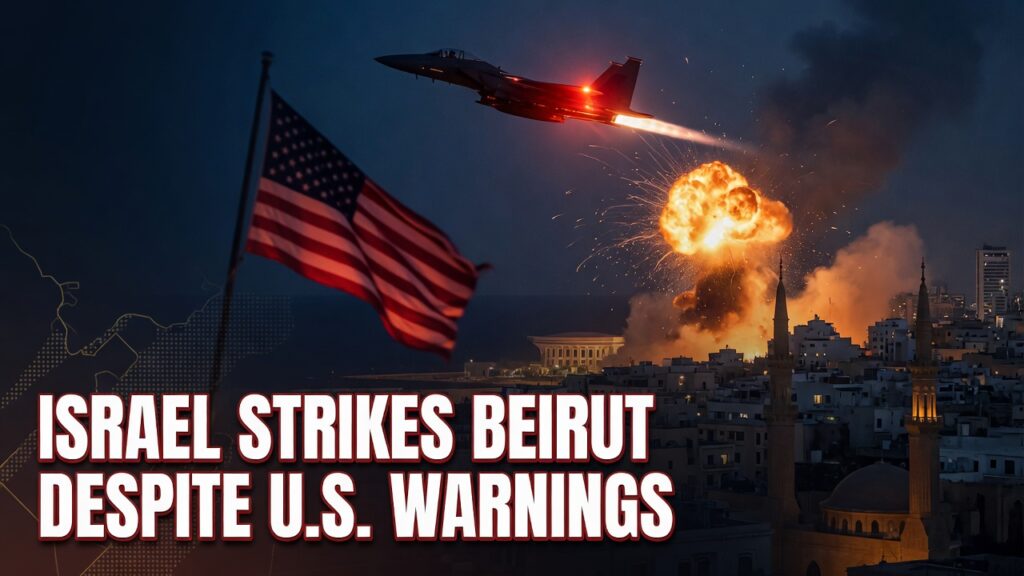
The bombs fell on Beirut’s southern suburbs again on Sunday, June 7, 2026. Israel struck the Dahieh district without warning — defying a direct request from the Trump administration to stand down. Within hours, Iran launched missiles toward northern Israel in retaliation, the first such bombardment since a fragile ceasefire had briefly taken effect in April. The Middle East, already teetering, moved another step closer to full regional war. Washington watched.
What Actually Happened — and Why It Matters Now
The facts are not in dispute. On June 1, President Trump publicly declared that he had persuaded Israeli Prime Minister Benjamin Netanyahu and Hezbollah to de-escalate. He called it a diplomatic breakthrough. On June 3, the U.S. State Department released a formal joint statement signed by the United States, Lebanon, and Israel, announcing a fourth high-level trilateral ceasefire agreement brokered in Washington. The deal required Hezbollah to cease fire and withdraw south of the Litani River. Israel agreed, conditionally.
Support Independent Local Journalism
TheTownHall.News is a non-profit reader-supported journalism. Just $5 helps us hire local reporters, investigate important issues, and hold public officials accountable across Alameda County. If you believe our community deserves strong, independent journalism, please consider donating $5 today to support our work.By June 5, Israel had killed at least 12 more people in southern Lebanon. By June 7, Israeli jets were bombing a residential building in Beirut’s Dahieh suburbs, killing two and wounding twenty, according to Lebanon’s Ministry of Public Health. The White House did not comment on the strike.
When an ally publicly defies the sitting American president — twice in six weeks — and Washington issues no formal consequence, the credibility of U.S. foreign policy is not just strained. It is shredded.
What Do the Numbers Actually Tell Us?
At least 3,558 people have been killed in Lebanon since Israel renewed its military campaign on March 2, 2026, per Lebanon’s Ministry of Public Health — a figure verified independently by the UN Office for the Coordination of Humanitarian Affairs (OCHA) in its June 4 flash update. [UN OCHA, June 4, 2026] Of those dead, 245 are confirmed children and 339 are women.3,558 deaths. 10,733 wounded. 135,300 people crammed into 636 overcrowded shelters as of June 4.
The question no one in Washington seems prepared to answer: at what point does American diplomatic cover for military operations that kill this many civilians become a foreign policy liability — not just a moral one?

The UN has simultaneously launched a revised emergency flash appeal calling for $639.9 million to assist 1.4 million people in Lebanon through August 2026. [UN OCHA Flash Appeal, June 5, 2026] The appeal was only 29 percent funded at the time of publication. Seven UN peacekeepers have been killed in Lebanon since March 2. One hundred thirty-one on-duty healthcare workers have died in 196 documented attacks on medical facilities. These are not abstractions. These are consequences of a policy that has no defined endgame.
Is This What “America First” Foreign Policy Was Supposed to Look Like?
Voters who supported a return to an “America First” doctrine in 2024 were promised disciplined, interest-based foreign policy — not open-ended entanglements where U.S. leverage evaporates the moment an ally decides to ignore the president’s phone call. The gap between the promise and the reality has become impossible to ignore.
Trump told NBC’s Meet the Press in an interview aired June 7 that he favored a “more surgical” approach to Hezbollah. He also said he was “not demanding” that Lebanon be included in any broader Iran ceasefire deal. That is a significant concession — and it arguably gave Israel the diplomatic runway to proceed with strikes on Beirut regardless of stated U.S. objections.
When the President of the United States publicly asks an ally to stop bombing a capital city — and that ally bombs it anyway — the word “ally” needs to be examined.
Personal responsibility is a core American value. So is accountability in government. If we demand those things of our own institutions at home, what principle exempts a foreign government receiving American diplomatic and material support from the same standard?
Support Independent Local Journalism
TheTownHall.News is a non-profit reader-supported journalism. Just $5 helps us hire local reporters, investigate important issues, and hold public officials accountable across Alameda County. If you believe our community deserves strong, independent journalism, please consider donating $5 today to support our work.“A U.S.-brokered ceasefire agreement, signed by three governments and announced from the State Department, collapsed within 72 hours. No one has been held accountable. That is not diplomacy. That is performance.”
What Do Supporters of This Policy Actually Believe?
This is a fair question, and it deserves a straight answer. Supporters of Israel’s military campaign argue — with legitimate basis — that Hezbollah poses a genuine and documented existential threat to Israeli civilians. Since March 2026, Hezbollah has continued launching rockets and drones into northern Israel, and the group has explicitly rejected every ceasefire proposal put forward, including the June 3 U.S.-brokered deal. Hezbollah’s leader Naim Qassem called the agreement “surrender and defeat.” Iran has made clear that it views Lebanon as a bargaining chip in broader nuclear negotiations.
The strategic case is real: an armed, Iranian-backed militia operating along Israel’s northern border, with a stated goal of Israel’s destruction, is not a problem that dissolves through diplomatic statements alone.
But strategic legitimacy and operational accountability are not mutually exclusive. Supporting an ally’s right to self-defense does not require abandoning the question of whether strikes on residential buildings in a capital city — after a ceasefire was formally agreed — serve that goal or undermine it. Israeli diplomat Alon Pinkas acknowledged publicly to Al Jazeera that Israel has “no coherent strategy for Lebanon” and that Netanyahu’s stated goal of destroying Hezbollah is “not achievable” without occupying the entire country. If that is the frank assessment of an Israeli insider, American policymakers owe their constituents an equally frank conversation.
Who Pays When the Strategy Has No Exit?
The immediate human cost is in Lebanon. But the long-term strategic cost lands on the American taxpayer and the American reputation. Washington has now hosted four high-level trilateral ceasefire talks since the conflict reignited in March. Each one has produced a formal statement. None has held. That is not a record of success — it is a record of performance without consequence.
Four ceasefire agreements in six weeks. Zero enforcement. Is this what $639.9 million in emergency humanitarian funding is supposed to normalize? [UN OCHA, June 5, 2026]
Lebanon’s own government — not Hezbollah, but the elected Lebanese state — has publicly pleaded for Iran to stop treating their country as “a bargaining chip.” Lebanese Prime Minister Nawaf Salam said on June 6: “Have mercy on our south.” Lebanese President Joseph Aoun told Iran directly: “It’s not your country, it’s our country.” These are the words of a sovereign government that has signed two U.S.-brokered deals and watched both collapse under the weight of actors — Hezbollah, Iran, and arguably Israel — who operate outside the agreements they nominally accept.
Is There Still Time for Accountability to Mean Something?
The path forward is not impossible, but it requires honest accounting. The June 3 U.S.-State Department joint statement called for the two parties to reconvene political and security tracks during the week of June 22. That meeting, if it happens, will be the fifth attempt to formalize what four previous attempts could not hold. The question is whether the Trump administration is willing to attach real consequence to noncompliance — from any party.
Limited government does not mean absent government. Fiscal accountability does not stop at the water’s edge. And law and order — values that Americans fight for at home — must be principles that inform how America conducts itself abroad, or they are simply slogans.
If America’s word means nothing to the allies who benefit most from it, what does that cost every American who depends on U.S. strength to keep global instability from arriving at our own front door?
Key Questions This Article Raises:
- If the U.S. brokered four ceasefire agreements that all collapsed, what specific consequence has any party faced — and what does that say about American leverage?
- At what threshold of civilian casualties does continued diplomatic cover become a liability to U.S. national interest and global credibility?
- Why has Netanyahu reportedly not formally approved ceasefire implementation, and what exactly is the Trump administration’s response to that refusal?
The real question is not whether this conflict affects American interests. It is whether anyone in Washington is prepared to say so out loud — and act like it.
What do you think — is it time for the United States to attach real conditions to its diplomatic support? Share this article and tell us where you stand.
Still have questions? Stay informed — subscribe for daily coverage of U.S. foreign policy and accountability journalism. Think others need to hear this? Share the article with someone who is watching this situation unfold. Want to make your voice count? Contact your congressional representative and ask them directly: what is the U.S. exit strategy in Lebanon, and who is accountable when ceasefire agreements fail? (Find your representative at house.gov or senate.gov.)