Are Law-Abiding Gun Owners Paying the Price for California SB 948 — While Politicians Look the Other Way?
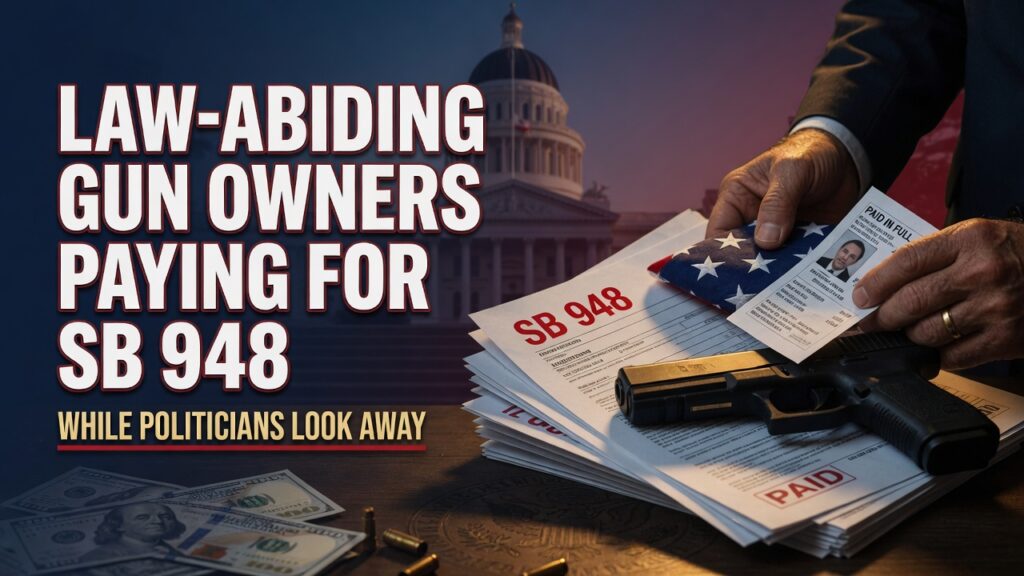
California’s latest gun control push would add hundreds of dollars and hours of mandatory hoops to a constitutional right — and the bill just hit the Senate floor.
As Senate Bill 948 advances through the California Legislature in June 2026, millions of law-abiding gun owners, new residents, and responsible citizens are left asking the same uncomfortable question: at what point does “safety” become a government permission slip to exercise a right the Constitution already guarantees?
What SB 948 Actually Does — And Why It Matters Now
The bill, authored by Berkeley Democratic Senator Jesse Arreguín, would require every Californian seeking a Firearm Safety Certificate — the document required by state law to purchase or receive any firearm — to complete a mandatory training course of no less than four hours beginning July 1, 2028. That course must include at least one hour of live-fire shooting exercises at a certified range. It passed out of the Senate Appropriations Committee in late May on a strict party-line vote, with every Republican opposed, and has now moved to the full Senate floor for a vote.
Support Independent Local Journalism
TheTownHall.News is a non-profit reader-supported journalism. Just $5 helps us hire local reporters, investigate important issues, and hold public officials accountable across Alameda County. If you believe our community deserves strong, independent journalism, please consider donating $5 today to support our work.This is not a peripheral tweak to California’s already extensive gun laws. It is a structural barrier placed between a citizen and a constitutionally protected right. And the timing matters: the bill arrives as Sacramento continues to expand the regulatory perimeter around firearm ownership, stacking requirement upon requirement in a state that gun policy researchers already rank among the most restrictive in the nation [Giffords Law Center annual state scorecards].
Who Is Really Paying for This Policy?
Second Amendment advocacy groups have done the math, and the numbers are not abstract. Gun Owners of California and the NRA’s Institute for Legislative Action estimate that mandatory training from a Department of Justice-certified instructor would add at least $400 to the cost of buying a firearm — before a single bullet is purchased, before range fees, and before gun rental costs for those who don’t yet own a firearm. California already layers on more than $100 in existing taxes and fees at the point of sale.
California already makes buying a gun one of the most expensive processes in the country — SB 948 would make it even more financially out of reach for working families who simply want to protect themselves.
That cost burden does not fall equally. It lands hardest on lower-income Californians, single parents in high-crime neighborhoods, and working-class residents who cannot easily take a half-day off to satisfy a government checklist. For the wealthy, a few hundred dollars and a free afternoon is inconvenient. For a night-shift worker in Fresno or a single mother in Stockton, it may be a genuine barrier — the kind that quietly price-controls a constitutional right without ever having to formally ban anything.

“When government makes a constitutional right expensive enough, complicated enough, and time-consuming enough — it doesn’t need to ban it. It simply prices out the people who need it most.”
The Burden on Americans Who Move to California
The bill’s reach extends well beyond first-time buyers. Under SB 948, any gun owner relocating to California — whether for a new job, military assignment, or family obligation — would be required to register their firearms with the Department of Justice and obtain a valid FSC within 180 days of establishing residency. After 2028, that means completing the full training course.
Clay Kimberling, a lobbyist for the NRA’s Institute for Legislative Action, put the practical reality plainly during the Senate Public Safety Committee hearing in March: lawful firearm owners arriving from other states would need to “search out an instructor, pay for the class and take hours out of their day for simply wanting to continue to practice their constitutional right.” [Senate Public Safety Committee testimony, March 2026].
The federal government estimates significant annual interstate migration into California, with many arrivals tied to military assignments and federal employment. These are not criminals. These are law-abiding Americans — people the state has an obligation to welcome without demanding they re-earn a right they already hold.
Requiring military families to complete a government training course just to keep the firearms they legally own is not public safety policy — it is bureaucratic punishment for following lawful orders to relocate.
Is This the Accountability Moment We’ve Been Waiting For?
Sacramento has tried this before. A nearly identical bill — with eight hours of mandatory training — died in the Assembly Appropriations Committee in 2025. The legislature did not abandon the concept; it simply reduced the hour requirement to four, recalibrated the political optics, and reintroduced it. That pattern deserves scrutiny.
Support Independent Local Journalism
TheTownHall.News is a non-profit reader-supported journalism. Just $5 helps us hire local reporters, investigate important issues, and hold public officials accountable across Alameda County. If you believe our community deserves strong, independent journalism, please consider donating $5 today to support our work.If this bill’s supporters genuinely believed an eight-hour requirement was necessary for public safety, why does a four-hour version now suffice? The answer may have less to do with evidence and more to do with legislative strategy — finding the minimum threshold that can survive a floor vote while still establishing the training mandate as legal precedent. Once the framework exists, future legislatures can expand the hours, raise the fees, and tighten the criteria.
$400. The estimated minimum cost SB 948 would add to purchasing a firearm in California — a state where the median household income in many counties already makes ends meet difficult. The question worth asking: who decided that was acceptable?
What Do Supporters of This Policy Actually Believe?
To be fair to SB 948’s proponents, the argument is not without substance. Senator Arreguín and the Brady Campaign point to a genuinely alarming statistic: more than 69,000 shootings resulting in death or requiring urgent medical care occurred in California between 2016 and 2021 [Brady Campaign testimony, March 2026]. Approximately one in three of those incidents were accidental, and many involved children.
The supporters’ case is straightforward: structured training saves lives, reduces accidents, and creates more responsible gun owners. Rebecca Marcus of the Brady Campaign argued before the Public Safety Committee that mandatory education addresses a real and preventable category of harm. Those are legitimate concerns that deserve honest engagement.
But the evidence that mandatory government-approved training courses reduce gun violence at a population level is far from settled. States with no training mandates have not uniformly produced worse safety outcomes than heavily regulated ones. And there is a meaningful distinction between encouraging responsible ownership — which virtually everyone supports — and mandating government certification as a precondition for exercising a constitutional right. The former is civic culture. The latter is state control.
If mandatory training truly saves lives, why is there no equivalent requirement for other constitutionally protected activities that carry comparable risks? The selective application of this logic to the Second Amendment — and only the Second Amendment — is itself a policy choice worth examining.
What Happens If the Senate Passes This Bill?
The bill now needs to clear the full Senate, then navigate Assembly committees, and survive an Assembly floor vote before landing on Governor Gavin Newsom’s desk. Newsom has not taken a public position on SB 948, which is notable given his national profile on gun control. His silence may reflect political calculation: the bill’s predecessor died quietly in committee, and signing a measure that immediately faces federal Second Amendment litigation may not serve his broader ambitions.
Second Amendment organizations have already signaled court challenges are likely if the bill becomes law. Given the U.S. Supreme Court’s 2022 ruling in New York State Rifle & Pistol Association v. Bruen — which established a historical tradition test for gun regulations — mandatory training requirements tied to a constitutional right face a challenging legal landscape [U.S. Supreme Court, 2022].
The bill must pass the full Assembly before this summer ends. The window is narrow. And the scrutiny should be intense.
The Question California Cannot Escape
Personal responsibility is a value most Californians share. Responsible gun ownership, safe storage, and proper handling are goals no reasonable person opposes. But personal responsibility is exercised by citizens — not mandated by governments that simultaneously trust those same citizens to vote, to speak, and to raise their children. When the state decides which rights require a $400 permission slip and which do not, it has stopped regulating safety and started regulating access.
The real question SB 948 forces onto the table isn’t whether gun safety matters — it is whether California’s government trusts its own citizens enough to let them exercise a constitutional right without first proving themselves to a state-approved instructor.
Key Questions This Story Raises:
- If an identical bill died in committee just one year ago, what has changed — and who decided a modified version deserves a second chance?
- At what point does the cumulative cost of exercising a constitutional right in California become a de facto ban for lower-income residents?
- If SB 948 is challenged in court under Bruen, who bears the legal costs — and who is ultimately accountable to California taxpayers?
What do you think — is mandatory training a reasonable safety measure, or a government barrier dressed up as public policy? Share this article and weigh in.
Still want to stay ahead of this story? Subscribe for daily coverage of California legislation that affects your rights and your wallet. Think someone needs to read this? Share it now. Want to make your voice count? Contact your California State Senator and Assembly member directly at leginfo.legislature.ca.gov — the vote is happening now.