Iran War Cost at 100 Days: Are Americans Paying the Price While Peace Talks Stall?
As the U.S.-Israel war with Iran enters its fourth month with no deal in sight, ordinary Americans are absorbing real and rising costs — at the pump, in their savings, and in the integrity of their constitutional order.
One hundred days in, the question no longer is whether this war was necessary. The question is whether anyone in Washington is being honest about what it is costing the people who actually foot the bill.
The 2026 Iran War began on February 28, when the United States and Israel launched nearly 900 strikes in 12 hours — eliminating Supreme Leader Ali Khamenei, decapitating much of Iran’s senior military command, and triggering a regional conflict that has now spread across the Persian Gulf, Lebanon, and the Strait of Hormuz. On June 7 — Day 100 — Iran fired fresh ballistic missile barrages at Israel, a ceasefire is visibly fraying, and peace talks have reached a stalemate. For American families, the war’s centenary is not a milestone of progress. It is a billing statement they never signed.
Support Independent Local Journalism
TheTownHall.News is a non-profit reader-supported journalism. Just $5 helps us hire local reporters, investigate important issues, and hold public officials accountable across Alameda County. If you believe our community deserves strong, independent journalism, please consider donating $5 today to support our work.What Does $891 Million a Day Actually Buy?
The numbers are not abstract. According to reporting from CNN, the Iran War is costing U.S. taxpayers approximately $891.4 million per day. The first week alone ran $6 billion, with roughly $4 billion attributed to munitions expenditure [Pentagon briefing data, reported by Fox 5 DC and CNN]. The White House subsequently requested an additional $200 billion in emergency military funding on top of an already-historic proposed $1.5 trillion defense budget. For a nation still wrestling with a $35 trillion national debt and a Congress that spent years insisting it could not find room for basic domestic spending, these figures demand an accounting.
$891.4 million per day. Every day. For 100 days. The question Americans deserve an answer to: who authorized this — and when does Congress get a vote?
At the one-week mark, the Pentagon’s classified briefing to lawmakers put the cost at $11.3 billion. A Harvard academic cited by CNBC has estimated the total long-run cost to U.S. taxpayers could reach $1 trillion if the conflict drags on without resolution. That is not a partisan number. That is a fiscal reality that transcends party affiliation — and one that fiscal conservatives, of all people, should be demanding answers about.
Are You Personally Paying for This War?
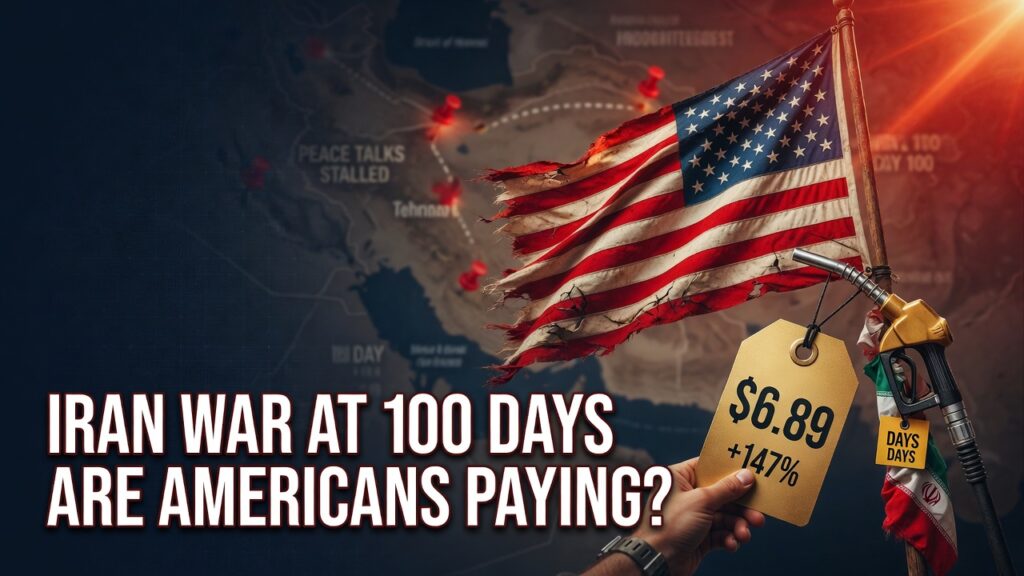
The answer, if you have filled your gas tank recently, is yes. According to an exclusive analysis from Moody’s Analytics shared with CNBC, the average American household has already paid $447.19 in additional energy costs since the war began on February 28 [Moody’s Analytics, May 2026]. Cumulatively, that has extracted nearly $60 billion from American consumers — money that did not go to groceries, mortgage payments, small businesses, or savings.

Gas prices have risen more than 47% since early March, with the average gallon of unleaded now sitting at approximately $4.39, and diesel — the lifeblood of American trucking, agriculture, and logistics — at $5.52 per gallon [AAA, May 2026]. Airline fares climbed more than 20% year-over-year in April [federal government inflation data]. The personal savings rate fell to 2.6% in April, among the lowest readings since the 2008 financial crisis, while credit card debt hit $1.25 trillion — near an all-time record [New York Federal Reserve, Q1 2026].
If a policy that was never put to a public vote is draining your savings and maxing out your credit card, at what point does accountability become non-negotiable?
Mark Zandi, Moody’s chief economist, was blunt: “Unless the war ends soon, financially pressed consumers will have no option but to turn more cautious in their spending, threatening the already soft economy.” Goldman Sachs projects that sustained high energy prices will particularly harm lower-income households, who spend a disproportionate share of their budgets on food and fuel — the very Americans least able to absorb the shock.
“The $447 every American household has already paid for this war was never approved by Congress, never voted on by the public, and never disclosed in any campaign promise. When did the cost of foreign policy become something we simply absorb in silence?”
Has Congress Abdicated Its Constitutional Duty?
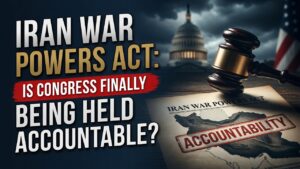
This is perhaps the most urgent question of the conflict’s first 100 days, and it goes to the heart of constitutional governance. The U.S. House of Representatives passed a War Powers Resolution on June 3, 2026, directing the president to remove U.S. forces from Iran — with four Republicans breaking ranks to join Democrats in the rare bipartisan rebuke [Al Jazeera, Congress.gov record H.Con.Res.38]. The resolution is expected to face a presidential veto.
The War Powers Act of 1973 exists precisely to prevent executive overreach in committing American military power without Congressional authorization. President Trump formally notified Congress of hostilities on May 1 — more than 60 days after the first strikes. That timeline has drawn scrutiny from constitutional law scholars and international relations experts, several of whom have described the legal basis for the campaign as deeply contested, if not outright unlawful under existing U.S. statute.
Support Independent Local Journalism
TheTownHall.News is a non-profit reader-supported journalism. Just $5 helps us hire local reporters, investigate important issues, and hold public officials accountable across Alameda County. If you believe our community deserves strong, independent journalism, please consider donating $5 today to support our work.The House just passed a war powers rebuke of its own president. The story that should be on every front page: four Republicans voted for it.
The Islamabad Talks, mediated by Pakistan, have collapsed. A two-week ceasefire brokered in April held only partially before Iran’s June 7 missile launches on Israel brought the conflict back to full boil. Trump told NBC’s Meet the Press on June 7 that a deal was expected “Monday, Tuesday, or Wednesday” — but that same day, Iranian missiles were intercepted over Israel and the Israeli military vowed a “powerful” response. Peace talks are not merely stalling. They are now in active competition with renewed military escalation.
What Do Supporters of This Policy Actually Believe?
This is a fair question, and it deserves a serious answer rather than dismissal. Supporters of the military action — including 71% of Republican-aligned voters [Pew Research, March 2026] — argue that Iran’s nuclear ambitions posed an existential threat that diplomatic negotiations had failed to contain. They point to Iran’s massacre of thousands of civilians during the January 2026 crackdown on domestic protesters as evidence that the regime had exhausted its legitimacy. They argue that eliminating Supreme Leader Khamenei and Iran’s ballistic missile infrastructure was not an act of aggression but of strategic necessity — preventing a nuclear-armed theocracy from destabilizing the entire Middle East.
Those are not frivolous arguments. The threat posed by a nuclear Iran was real, documented, and long-standing. The IAEA had confirmed Iran refused post-war inspections of damaged sites. The opening strike’s military precision — 900 strikes in 12 hours with only 13 U.S. fatalities — was a testament to American military capability.
But precision in execution does not substitute for transparency in justification. A majority of Americans — 59% — told Pew Research the decision to use military force was wrong [Pew Research Center survey of 3,524 U.S. adults, March 16–22, 2026]. Nearly 70% told The Economist/YouGov they want the war concluded “as quickly as possible.” When nearly seven in ten citizens want a conflict over, and peace talks are collapsing, the burden of justification shifts squarely back to the decision-makers.
What Happens If No One Speaks Up?
History’s answer to that question is not encouraging. Open-ended military commitments, launched without formal declarations of war and funded through emergency supplemental requests, have a way of expanding in scope and cost long past the moment when the public stops paying attention. The war has already cost the U.S. an estimated $18 billion by March 19, with the Pentagon requesting $200 billion more — and a Harvard estimate placing the long-term ceiling at $1 trillion [CNBC, April 2026].
If energy prices remain elevated through year-end, the average American household will absorb nearly $2,000 in additional energy costs by the war’s first anniversary, per Moody’s. That is $2,000 that will not go into retirement savings, college funds, or the small business investments that form the backbone of a free economy. It is a transfer of wealth — not from the rich to the poor, not from the government to citizens, but from every working American family to a conflict they were not consulted about.
Fiscal accountability is not a partisan issue. It is the bedrock of representative government. A democracy that cannot account for how it spends $891 million per day on a war is not fully governing itself.
Key Questions This Story Raises:
- At what point does the War Powers Act require Congress to formally authorize or terminate the Iran conflict, and will Trump’s expected veto of the House resolution face a constitutional challenge?
- If the average American household absorbs $2,000 in war-related energy costs by February 2027, which elected officials will be held accountable — and by whom?
- With peace talks stalled, Iran launching fresh missiles on Day 100, and Israel vowing a “powerful” response, is a negotiated deal still realistic — or is the cost to American families just getting started?
The Accountability Moment Is Already Here
The Iran War did not begin with a declaration of war from Congress. It did not begin with a national conversation about what it would cost, how long it would last, or what victory would actually look like. It began with 900 strikes in 12 hours, a Supreme Leader’s death, and a Strait of Hormuz closure that sent gas prices spiking across every zip code in America.
One hundred days later, peace is not at hand. A ceasefire is fraying in real time. The House has rebuked the president in a rare bipartisan vote. The fiscal meter is running at nearly $900 million a day. And the average family is quietly spending down savings and piling onto credit cards to pay for diesel and airline tickets they cannot afford.
Personal responsibility is a value that commands broad, genuine respect — but it cuts both ways. It asks something of citizens, and it asks something of governments. It demands that those who commit the nation’s military power and the people’s treasure be equally answerable for the consequences. That accountability cannot wait for a history book. It has to happen now, in committee hearings, at the ballot box, in every conversation between a constituent and a representative.
The real question isn’t whether this war will affect you — it already has. The question is whether you’ll demand answers before the bill gets any larger.
Still have questions about how this war is affecting your wallet and your rights? Stay informed — subscribe for daily coverage. Think others need to hear this? Share the article and start the conversation. Want to make your voice count? Contact your representative through house.gov and ask them where they stand on the War Powers Resolution — and who is authorizing the next $200 billion.