Supreme Court Parental Rights Ruling: What Parents Need to Know Now
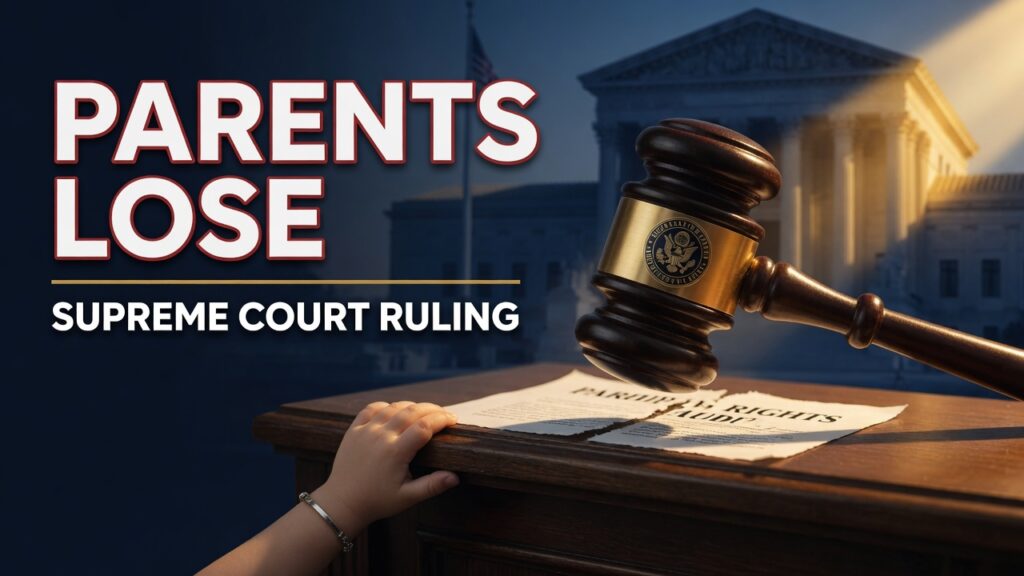
The Supreme Court just handed parents a landmark First Amendment victory — but the real battle over who controls what children learn is only beginning.
For decades, parents have asked a deceptively simple question: do we have any meaningful say in what our children are taught? On June 27, 2025, the U.S. Supreme Court answered with a resounding yes — at least when it comes to religious freedom and the public school curriculum.
The 6-3 ruling in Mahmoud v. Taylor represents one of the most significant parental rights decisions in over fifty years. With conservative justices in the majority and the court’s three liberals in sharp dissent, the case has reignited a national debate that goes far beyond a handful of storybooks in a Maryland school district. At its core, this is a fight about authority — who holds it, who abuses it, and whether ordinary American families can ever reclaim it.
Support Independent Local Journalism
TheTownHall.News is a non-profit reader-supported journalism. Just $5 helps us hire local reporters, investigate important issues, and hold public officials accountable across Alameda County. If you believe our community deserves strong, independent journalism, please consider donating $5 today to support our work.What Actually Happened — and Why It Matters Right Now
The dispute began in Montgomery County, Maryland, home to one of the nation’s largest public school systems with nearly 160,000 enrolled students. In October 2022, the county school board introduced a set of LGBTQ+-themed storybooks — including titles such as Uncle Bobby’s Wedding and Pride Puppy — into its elementary-school language arts curriculum. Initially, the district permitted parents to opt their children out of lessons using the books. Then, in March 2023, that accommodation was quietly eliminated. School officials cited logistical inconvenience and high rates of student absence as justification.
A group of Muslim, Catholic, and Ukrainian Orthodox parents refused to accept that explanation. They sued, arguing that compelling their young children to sit through instruction that directly contradicted their religious teachings on marriage and family — with no notice and no alternative — violated their First Amendment right to freely exercise their religion. Both a federal district court and the Fourth Circuit Court of Appeals ruled against them. The Supreme Court disagreed.
What the Court Actually Ruled — and What It Did Not
Writing for the majority, Justice Samuel Alito was careful about the scope of the ruling. The parents, he wrote, were “not seeking the right to micromanage the public school curriculum.” They were asking for something far more targeted: advance notice when specific books would be used, and the ability to excuse their children from those lessons. That is a meaningful distinction. The ruling does not ban LGBTQ+-themed content from public schools. It does not give parents veto power over general curriculum design. What it does establish is that when a government policy substantially interferes with a family’s religious upbringing of their children, that policy must survive the most rigorous constitutional scrutiny.
The Supreme Court ruled 6-3 that forcing elementary school children into religious instruction they cannot opt out of is a First Amendment violation — not a culture war talking point.

Alito further noted that Montgomery County already permitted opt-outs for sex education and other sensitive content. That existing system of exceptions, he argued, directly undermined the board’s claim that religious opt-outs were administratively unworkable. If the district can manage one category of opt-outs, it can manage another. The logic is difficult to dispute.
Is This the Most Important Parental Rights Ruling in 50 Years?
The ruling explicitly expands the precedent set by Wisconsin v. Yoder (1972), in which the Supreme Court held that Amish families could withdraw their children from compulsory schooling beyond eighth grade on religious grounds. For more than five decades, Yoder was treated as a narrow carve-out for a uniquely insular religious community. Mahmoud v. Taylor signals that the Court’s conservative majority views parental religious rights as broadly applicable — not as a historical curiosity.
“Their ability to present that message is undermined when the exact opposite message is positively reinforced in the public school classroom at a very young age.” — Justice Samuel Alito, writing for the majority
Justice Clarence Thomas went even further in his concurrence, suggesting that the school board’s curriculum design amounted to an attempt to “standardize” the views of students — language that raises serious questions about the ideological direction of American public education and whether parents have been naive to trust institutions that were supposed to serve their children, not shape them.
6 Supreme Court Justices agreed: a public school cannot compel children to absorb messages that contradict their family’s religious beliefs without consequence. How did we get to a point where that needed to be litigated at all?
What Do Supporters of This Policy Actually Believe?
This is a fair question, and it deserves a serious answer. Supporters of the Montgomery County curriculum argue that LGBTQ+-inclusive books serve a genuine social purpose: they help children of same-sex parents feel seen, they prepare all students for life in a diverse society, and they reduce bullying and social exclusion. Justice Sonia Sotomayor made this case forcefully in her dissent, warning that the ruling “threatens the very essence of a public education” by allowing individual religious beliefs to hollow out what schools can collectively teach.
Support Independent Local Journalism
TheTownHall.News is a non-profit reader-supported journalism. Just $5 helps us hire local reporters, investigate important issues, and hold public officials accountable across Alameda County. If you believe our community deserves strong, independent journalism, please consider donating $5 today to support our work.The National Education Association argued the decision would “hamstring efforts to give students a full, engaging, and inclusive public education.” Legal scholars have raised concerns that a broad reading of the ruling could allow opt-out claims to extend to history lessons, science units, or literature involving any theme that conflicts with someone’s stated religious convictions.
These are legitimate concerns that deserve engagement. But they do not answer the original injustice: a school board that actively removed an existing accommodation — one it had already proven it could administer — because it found parental involvement inconvenient. That is not inclusion. That is coercion dressed in institutional language. Protecting religious freedom does not require anyone to agree with the beliefs being protected. It only requires that the government respect that parents, not school administrators, are the primary educators of their children.
Who Bears the Cost When Institutions Overstep?
63 percent of Americans support parental opt-out rights for school curriculum, according to survey data from the Brookings Institution [Brookings survey data]. The question no one in the school board meeting wanted to answer: why was that majority ignored for two full years?
If a school board removes an accommodation it already offered — without a compelling reason — and forces families into costly federal litigation to restore it, who is really protecting children here?
The answer matters because this case is not unique to Maryland. School districts across the country are watching the ruling closely, and many administrators are already reassessing their own policies. The implications extend to questions of transparency, governance, and the basic accountability of publicly funded institutions to the families they serve.
Key Questions This Story Raises
- Should any public school be permitted to eliminate an existing parental opt-out without a compelling and documented justification?
- Does the Mahmoud v. Taylor precedent open the door to religious opt-out claims across a wide range of curriculum subjects — and how should courts draw that line?
- If 63 percent of Americans support parental opt-out rights, why do so many school boards continue to resist them?
The Real Question American Parents Should Be Asking
This ruling is a victory. It should be recognized as one. But a Supreme Court battle to restore a right that a school board casually revoked by administrative memo is also a warning. It is a signal of how far the institutional presumption of authority over children has drifted from the constitutional reality of where that authority actually rests — with parents.
No family should need a federal lawsuit to be treated as a partner in their child’s education rather than an obstacle to it. The First Amendment did not create parental rights in 2025. It has always protected them. What changed is that a school district decided those rights were negotiable — and had to be reminded, at the highest court in the land, that they are not.
The real question is not whether this ruling goes too far. The real question is why it took this long — and whether the institutions entrusted with educating America’s children have learned anything at all.
What do you think — should every school district in America be required to offer religious opt-outs for curriculum content? Share this article and tell us where you stand.
Still have questions about parental rights and education law? Subscribe for daily coverage of the cases and policies that affect your family.
Think someone needs to read this? Share the article with a parent in your community.
Want to make your voice count? Contact your local school board representative and ask whether your district has a clear, accessible opt-out policy in place.