Willows California Police Loses Coverage After Sheriff Ends Contract June 30
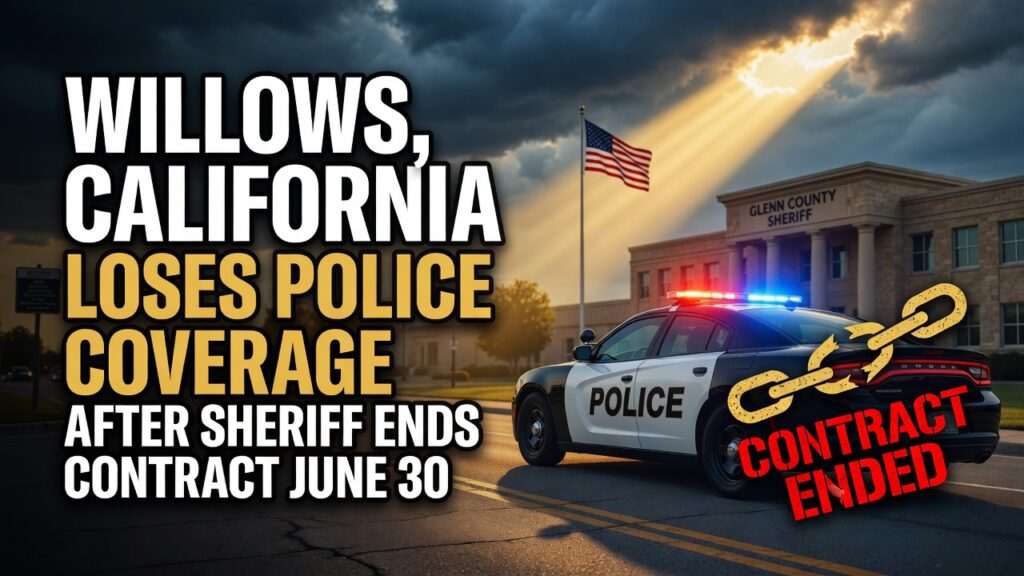
As June 30 approaches, a California city of 6,300 residents faces a midnight deadline with no police department, no new contract, and no clear plan — raising urgent questions about what local government owes the people it was elected to protect.
When a city runs out of police, it doesn’t happen overnight. It happens the way fiscal crises always do: gradually, then all at once.
Willows, California — the county seat of Glenn County, 85 miles north of Sacramento — is days away from losing every sworn law enforcement officer within its borders. The Glenn County Sheriff’s Office has announced it will not renew its contract with the city after June 30, citing a $1 million annual shortfall that the county can no longer afford to absorb. What began as a cost-cutting move in 2017, when Willows dissolved its own police department, has become a slow-motion public safety emergency.
Support Independent Local Journalism
TheTownHall.News is a non-profit reader-supported journalism. Just $5 helps us hire local reporters, investigate important issues, and hold public officials accountable across Alameda County. If you believe our community deserves strong, independent journalism, please consider donating $5 today to support our work.A Deal That Was Never Sustainable
The math was never on anyone’s side. The Sheriff’s Office currently spends approximately $3.4 million per year providing law enforcement and animal control to Willows. The city pays $2.355 million. That gap — nearly $1 million annually — has been quietly subsidized by Glenn County taxpayers for years.
Willows accounts for 56% of the Glenn County Sheriff’s Office’s total law enforcement caseload while contributing less than 70% of the cost. Someone has been paying the difference — and it wasn’t the city.
Sheriff Justin Gibbs notified Willows in March that the discounted arrangement would end when the current 2023–2026 contract expired. Under California Government Code 51350, counties are legally required to charge cities the actual cost of contracted services — meaning the subsidy was never supposed to be permanent in the first place.
The Sheriff’s Office says it gave the city years to close the gap. The city, by the county’s account, made no meaningful effort to reopen its police department and refused to meet the actual cost of services. The county’s position is straightforward: it cannot continue funding city services while its own budget deficit grows.

What Happened When Willows Chose to Outsource Its Safety?
The decision to dissolve the Willows Police Department in 2017 was framed as fiscally prudent. Contracting with the Sheriff’s Office appeared to offer professional coverage at a reduced rate. On paper, it made sense.
But outsourcing core government functions carries long-term risk. When a city gives up its police department, it also gives up institutional knowledge, local accountability, and — critically — leverage. Willows spent nearly a decade dependent on a contract that the other party had every right to walk away from.
“If your city’s entire public safety infrastructure depends on a contract that expires every few years, you don’t have a police force — you have a lease agreement.”
Mayor Evan Hutson has acknowledged that rebuilding a city-run department has been discussed for years. The startup cost is estimated at several million dollars — a steep price for a small city, but one that compounds with each year of delay. Voters in Willows did pass Measure I in November 2024, a 1.5% local sales tax intended to fund critical services including public safety. Whether that revenue is sufficient to bridge the gap, or fund a new department entirely, remains an open question.
Who Is Really Paying for This Impasse?
Negotiations broke down over a gap that, in government terms, is not enormous. In January 2026, the Sheriff’s Office offered two paths forward: a full-cost contract at $3.42 million annually, or a hybrid model requiring Willows to hire its own police chief at a reduced rate of $2.85 million. The city countered with a Consumer Price Index adjustment that would have raised payments to roughly $2.45 million — a proposal the Sheriff’s Office rejected as insufficient.
$975,000. That’s the annual gap between what Willows pays and what policing actually costs — and it’s the number that neither side has been willing to close.
Support Independent Local Journalism
TheTownHall.News is a non-profit reader-supported journalism. Just $5 helps us hire local reporters, investigate important issues, and hold public officials accountable across Alameda County. If you believe our community deserves strong, independent journalism, please consider donating $5 today to support our work.The people bearing the cost of this failure are not elected officials on either side of the table. They are the 6,300 residents of Willows who, beginning July 1, may find that emergency calls are routed to the California Highway Patrol or the city fire department — agencies with separate mandates, separate jurisdictions, and no dedicated patrol presence in Willows.
The Sheriff’s Office has indicated it will implement an online crime reporting system for city residents after the contract lapses. An online form is a poor substitute for a patrol car at 2 a.m.
What Do Supporters of the City’s Position Actually Believe?
To be fair, Willows did not simply refuse to negotiate. City officials say they engaged in contract discussions with the Sheriff’s Office beginning in September 2025. They argue the county’s demands represent an abrupt escalation — from $2.36 million to $3.42 million is a 45% increase in one contract cycle, a burden few small cities could absorb without significant planning time.
The city also invoked a mediation clause in the existing contract and has claimed it did not receive complete records it requested from the Sheriff’s Office. On June 9, Willows filed legal action seeking a court order to compel continued service while negotiations proceed.
These are legitimate procedural arguments. Contracts should include dispute resolution mechanisms, and a city of 6,300 people cannot rebuild a police department in 90 days.
But the counterargument misses a larger point. The county’s obligation to subsidize city services was never codified in law — it was a courtesy that became an expectation. Expecting a neighboring government agency to lose $1 million per year indefinitely is not a fiscal strategy. It is an abdication of local responsibility.
Is This the Accountability Moment Small Cities Can’t Afford to Ignore?
What is happening in Willows is not unique to Northern California. Across the country, small municipalities are facing the same structural tension: rising service costs, stagnant local revenues, and a growing dependence on intergovernmental agreements that were never designed to be permanent.
The Willows situation is a case study in what happens when civic leaders defer hard decisions. The city dissolved its police department to save money. It negotiated contracts that never covered actual costs. It delayed rebuilding local capacity for nearly a decade. Now, with a June 30 deadline and a lawsuit in the courts, residents are left to wonder who is actually in charge of their safety.
If a city government cannot guarantee basic law enforcement for its own residents, what exactly is it governing?
Law and order is not a partisan issue. It is the foundational promise of local government. When that promise is broken — through financial mismanagement, failed negotiations, or simple inertia — citizens pay the price in ways that no online crime reporting portal can replace.
Key Questions This Story Raises
- If Willows had maintained its own police department after 2017, would residents now be facing this crisis — or did outsourcing create a dependency that was always going to collapse?
- Who is legally and morally responsible for public safety in Willows after June 30, and does the pending lawsuit change that?
- Is the Measure I sales tax revenue sufficient to fund a rebuilt police department, and why hasn’t that question been publicly answered before the deadline?
The real question for Willows — and for every small city watching this unfold — is not whether the contract should have been renegotiated. It’s whether local governments can be trusted to make hard decisions before a crisis forces them to.
A city without police is not a policy position. It is a failure of governance. And the clock runs out at midnight on June 30.
What do you think — is it too late for Willows to avoid this? Share this article and tell us.
Still have questions? Subscribe to The Town Hall for daily coverage of local government accountability stories that matter.
Think your representatives need to hear about this? Contact your city council directly and ask what their public safety contingency plan looks like — before you need one.