Iranian Hackers Claim Breach of California Water Utility Systems in 2026
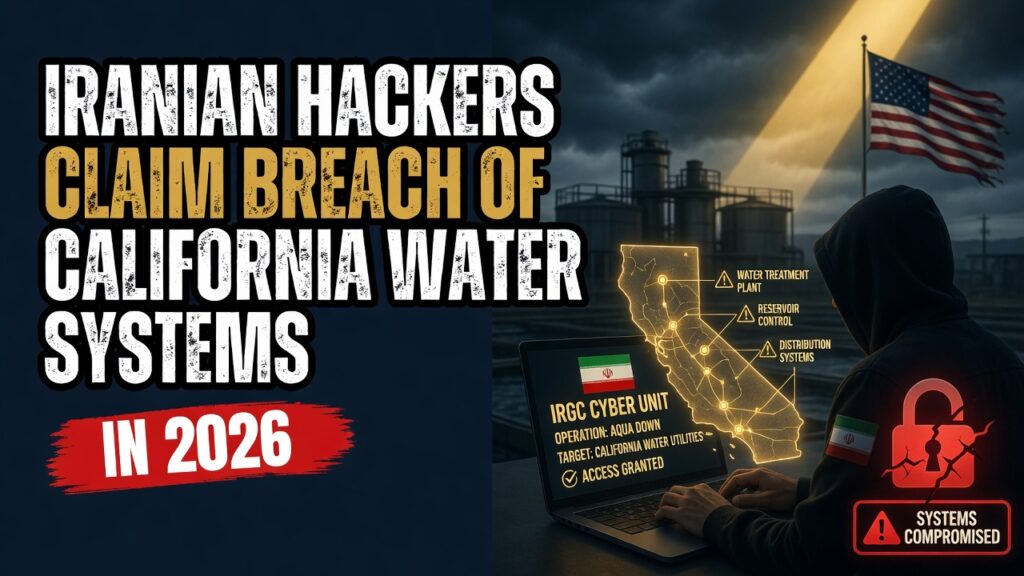
An Iranian-linked hacker group just claimed it infiltrated water utility systems serving millions of Californians. No pipes ran dry — this time. But cybersecurity experts say the window for inaction is closing fast.
Foreign hackers just threatened to shut off your water — and they may have had the access to do it.
On June 12, 2026, an Iranian-linked cyberattack group called Handala publicly claimed it had breached systems connected to California Water Service (Cal Water), one of the largest investor-owned water utilities in the United States. The group published what appeared to be customer billing data from cities including Bakersfield, Visalia, and Chico — and sent a direct message to Washington: “We could have easily cut off the water to American cities.” The timing was no coincidence. The attack came days after U.S. military forces reportedly struck water reservoirs inside Iran, and as American and Iranian officials stood on the edge of open conflict.
Support Independent Local Journalism
TheTownHall.News is a non-profit reader-supported journalism. Just $5 helps us hire local reporters, investigate important issues, and hold public officials accountable across Alameda County. If you believe our community deserves strong, independent journalism, please consider donating $5 today to support our work.What Actually Happened — and How Deep Did They Get?
According to threat intelligence firm Dataminr, Handala’s breach was real, but limited in scope. The group appears to have gained unauthorized access to an RTKBase instance — a GPS correction server used for geospatial data — and then moved laterally into a customer billing database. The hackers exfiltrated approximately 5 gigabytes of data, including customer personal information and login credentials for the RTKBase platform.
Cal Water, which serves roughly two million customers across more than 100 communities in California, said its preliminary investigation found no signs of compromise within its core IT networks, water production systems, or delivery infrastructure. “Our preliminary findings indicate that there are no known operational disruptions to our water and wastewater systems, including the billing platform,” spokesperson Yvonne Kingman said in a statement. The investigation remains ongoing.
That is a meaningful distinction. Billing systems hold sensitive personal data. Operational technology (OT) systems and industrial control systems (ICS) control the actual treatment, pumping, and distribution of water. Handala, by all current evidence, reached the former — not the latter. But analysts warn the two are not always as separated as utilities claim.
“Iranian hackers claimed they could have shut off water to American cities — and cybersecurity analysts say they aren’t entirely wrong about the vulnerability.”

Who Is Handala — and Why Should Americans Pay Attention?
Handala is not a fringe operation. The group is assessed by cybersecurity researchers to be linked to Iran’s Ministry of Intelligence and Security (MOIS) — the same apparatus responsible for years of state-sponsored digital espionage targeting governments, hospitals, and critical infrastructure across the United States, Israel, and Europe.
The group framed this operation explicitly as retaliation. In a post published on its blog on June 11, Handala said the hack was payback for recent U.S. military strikes on Iranian infrastructure, including what it described as attacks on civilian water facilities. The group shared screenshots with Iranian state broadcaster IRIB and Press TV, and characterized the incursion as a “warning” rather than a full attack — implying the capability for something far more disruptive exists.
Handala has previously targeted critical infrastructure in Albania and Israel. Its operations are timed deliberately around geopolitical flashpoints, which means the June 12 breach was not opportunistic — it was strategic.
“We could have easily cut off the water to American cities.” — Handala, via Iranian state media, June 2026
Is This the Accountability Moment America’s Water Sector Has Been Avoiding?
The United States has known for years that its water infrastructure is dangerously under-protected. The Environmental Protection Agency and the Cybersecurity and Infrastructure Security Agency (CISA) have both issued warnings about the vulnerability of water and wastewater systems to cyberattacks, particularly from nation-state actors. A 2024 EPA enforcement alert noted that 70 percent of water systems inspected failed to meet basic cybersecurity requirements under the Safe Drinking Water Act. [EPA enforcement data]
Despite these warnings, funding for water system cybersecurity remains inconsistent, regulatory enforcement is uneven, and many utilities continue to operate aging infrastructure with minimal IT security protocols. The problem is structural: water utilities are largely locally governed and funded, making national coordination difficult and leaving individual systems exposed to threats that operate at a global scale.
Support Independent Local Journalism
TheTownHall.News is a non-profit reader-supported journalism. Just $5 helps us hire local reporters, investigate important issues, and hold public officials accountable across Alameda County. If you believe our community deserves strong, independent journalism, please consider donating $5 today to support our work.70 percent. That is the share of water systems that failed EPA cybersecurity inspections in 2024. The question that demands an answer: what has changed since then?
“If 70% of U.S. water systems failed basic cybersecurity checks in 2024, and Iranian hackers just proved the point — who in Washington is being held responsible?”
What Does This Mean for the Millions of Customers Whose Data Was Stolen?
While no water service was disrupted, the 5GB of data reportedly exfiltrated by Handala represents a serious privacy concern for affected customers. Water utility billing records typically contain full names, service addresses, account numbers, payment history, and in some cases banking or credit card information used for automatic payments.
Cal Water customers in Bakersfield, Visalia, Chico, and the broader service area — which includes communities across Northern and Southern California such as Menlo Park, San Mateo, Livermore, and Salinas — should treat this as a potential identity theft risk. The company has not yet confirmed the full scope of the data exposure or notified affected customers publicly as of the time of this writing.
Personal responsibility demands that individuals take steps now rather than wait for official guidance. That means monitoring financial accounts, considering a credit freeze, and watching for phishing attempts that may exploit stolen billing data to appear legitimate.
What Do Supporters of the Current Infrastructure Policy Actually Believe?
Defenders of existing federal cybersecurity frameworks argue that the system is working as intended. They point to the fact that Cal Water’s operational systems — water treatment, pumping, delivery — appear to have remained uncompromised. They argue that separating billing systems from OT environments is standard practice, and that the absence of any water disruption validates the layered defense approach.
Some cybersecurity professionals also caution against overstating Handala’s capabilities. The breach of an RTKBase server and a billing database, while serious, is a different order of magnitude from compromising the industrial control systems that actually govern water flow and treatment. Lateral movement from billing infrastructure to OT would require overcoming additional security layers that many utilities do maintain.
These are legitimate points. But they do not answer the harder question: if 70 percent of water systems failed EPA cybersecurity inspections just two years ago, and a state-sponsored threat actor just demonstrated the ability to penetrate a major utility’s network, why is the federal response still measured in strongly worded advisories rather than enforceable standards with real consequences?
What Comes Next — and What Can Citizens Actually Do?
The geopolitical context matters here. The Handala hack occurred at the peak of U.S.-Iran tensions, with American military forces reportedly within hours of launching strikes inside Iran before a ceasefire agreement was announced. Iran’s leaders and their affiliated cyber units have demonstrated a consistent pattern: diplomatic setbacks and military pressure produce escalating cyberattacks against U.S. infrastructure.
That means this incident is almost certainly not isolated. Water systems, power grids, financial networks, and hospital infrastructure all remain attractive targets for a regime that views cyber operations as a low-cost, deniable form of retaliation. The question for Americans is not whether more attacks are coming — it is whether the institutions responsible for protecting critical infrastructure will treat this warning as the serious escalation it is.
“Iranian hackers chose not to shut off the water this time. They called it a warning. The question is whether Washington is listening.”
KEY QUESTIONS
- Why are U.S. water utilities still running billing systems on the same network as operational infrastructure — years after known vulnerabilities were flagged?
- What specific regulatory reforms — if any — has the federal government implemented to protect critical water infrastructure from state-sponsored cyberattacks?
- If Handala had chosen to disrupt service rather than issue a warning, how many of the 2 million Cal Water customers would have had any recourse — and who would be held accountable?
The Real Question Isn’t Whether It Can Happen — It’s Whether We’ll Be Ready
The Handala breach should not be dismissed as a near-miss. It is a demonstration — carefully staged, deliberately publicized, and precisely timed — that adversaries with state backing can penetrate American water infrastructure and walk out with data about millions of customers. They chose not to turn off the taps. This time.
For years, warnings about water system cybersecurity have been met with underfunding, inconsistent enforcement, and bureaucratic inertia. The communities served by Cal Water deserve better. So do the residents of every city whose utility quietly failed its last cybersecurity review and hasn’t told anyone.
The real question isn’t whether a foreign adversary can hack your water system. June 12 answered that. The real question is: when the next group decides not to hold back, will anyone in authority be able to say they did everything possible to stop it?
What You Can Do Right Now
Still have questions? Stay informed — subscribe to The Town Hall for daily coverage of the stories that affect your community.
Think others need to hear this? Share this article and ask your network: is your city’s water infrastructure actually protected?
Want to make your voice count? Contact your congressional representative and ask them directly what cybersecurity standards apply to your local water utility — and what happens when utilities fail to meet them. Find your representative at house.gov/representatives/find-your-representative.