Ceuta Migrant Crisis: What Really Happened At Spain’s Border?
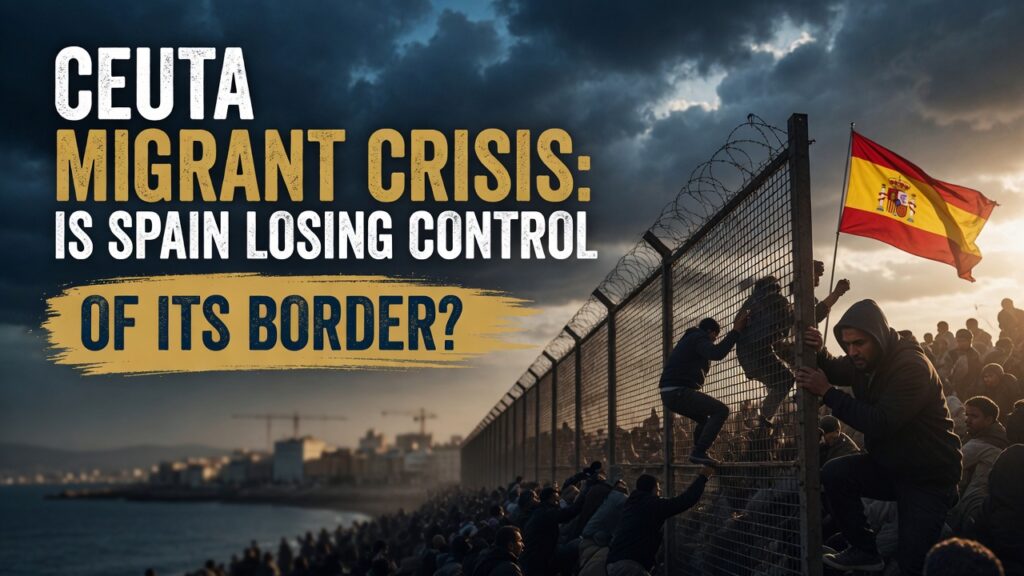
As thousands of migrants pour into the Spanish enclave of Ceuta, the question hanging over Madrid is simple: who is actually in charge of Spain’s southern border — and why won’t the government say so?
A Spanish city is being overwhelmed right now. That is not hyperbole.
On July 30, 2026, Ceuta’s regional government confirmed that between 1,500 and 2,000 migrants had entered the North African enclave over the past ten days, with hundreds more arriving in a single day this week. Regional president Juan Jesús Vivas called it an “absolute humanitarian and social emergency” and asked Madrid to send troops. The national government said no.
What Do We Actually Know About The Ceuta Crossing?
The numbers matter, and they are not fully settled. Spain’s state broadcaster TVE reported that 2,000 to 3,000 people crossed on Thursday alone. Reuters was not able to independently confirm that higher figure, and it should be treated as a state-media estimate rather than a verified count.
What is confirmed, across Reuters, Al Jazeera, and ABC News reporting, is that crowds swam or floated in on inflatable devices around the Tarajal breakwater, while others scaled border fencing that was, for a period, unguarded. Local paper El Faro de Ceuta reported that entire families crossed, including parents carrying young children. Spain’s Interior Ministry said Moroccan security forces are “closely cooperating” and have stopped “numerous” attempted crossings — though clearly not all of them.
A Spanish city just absorbed thousands of unplanned arrivals in ten days. Where was the plan?
Support Independent Local Journalism
TheTownHall.News is a non-profit reader-supported journalism. Just $5 helps us hire local reporters, investigate important issues, and hold public officials accountable across Alameda County. If you believe our community deserves strong, independent journalism, please consider donating $5 today to support our work.Why Won’t Madrid Declare A National Emergency?
This is where the accountability question sharpens. Ceuta’s government explicitly requested a national emergency declaration and military deployment to secure the border. Spain’s Interior Ministry refused, stating that its legal framework for national emergencies does not classify migration surges as a national security risk.
That is a legal technicality with real consequences. Local reception centers in Ceuta were already overwhelmed before this week’s surge, with people sleeping on the streets, according to regional officials. The ministry has promised “additional resources,” but has not detailed what that means or when it arrives. For a city of roughly 85,000 residents, absorbing thousands of new arrivals in ten days is not a paperwork problem — it is a governance test, and so far Madrid is failing to show its work.
If a national government won’t call an overwhelmed border an emergency, what would qualify?
Who Is Actually Fighting Over This — And Why?
The political response broke down almost immediately along familiar lines. Alberto Núñez Feijóo, leader of the opposition Partido Popular, posted on social media that “the situation in Ceuta is desperate” and that Spain is “facing a national security crisis,” directly blaming Prime Minister Pedro Sánchez’s government for allowing the situation to escalate.
Sánchez responded by telling Ceuta’s leadership that his government was “fully focused” on an immediate response, without offering specifics. That gap — between a public promise of focus and an absence of detail — is exactly the kind of accountability vacuum that erodes public trust in institutions meant to secure a nation’s borders.
Is a border only “secure” when the government is willing to admit it isn’t?
Has This Happened Before — And What Does That Tell Us?
Ceuta and Melilla, Spain’s two land borders with Africa, have seen this pattern repeatedly. In May 2021, more than 8,000 migrants entered Ceuta over just two days after Morocco temporarily eased border patrols amid a diplomatic dispute with Spain. In June 2022, a mass crossing attempt at Melilla ended in a deadly crowd crush that killed at least 18 people, according to Moroccan authorities, with dozens more injured on both sides of the fence.
This week’s surge coincided with Morocco’s Throne Day celebrations, though Spanish and Moroccan officials have not offered a clear explanation for the timing or the scale. What is consistent across all three episodes is that Spain’s response has been largely reactive — managing each crisis as it happens rather than preventing the next one.
1,500 to 2,000 people entered a single Spanish city in ten days [regional government figures]. The question no one in Madrid wants to answer: what is the actual plan for the next surge?
What Role Did The Courts Play In This?
Earlier this month, Spain’s Supreme Court ruled that migrants intercepted at sea while trying to reach Ceuta or Melilla cannot be returned to Morocco. The ruling was framed around due process and asylum protections, but it also removed one of the tools Spanish and Moroccan authorities had used to manage sea crossings before they reach shore.
Whatever one thinks of the ruling’s legal merits, its practical effect is that fewer at-sea interceptions can result in a return — meaning more people are likely to reach Spanish soil and enter the asylum system directly. That is a policy choice with downstream consequences for a city that is already, by its own government’s admission, out of capacity.
Are our leaders even listening to the cities left to handle the fallout?

What Do Supporters Of Spain’s Current Approach Actually Believe?
Advocates for Spain’s current posture, including refugee assistance groups like the Spanish Commission for Refugees, argue that migrants arriving in Ceuta — many of them families with children — have a legal right to seek asylum, and that a rapid, security-first response risks violating due process and international obligations. They point to the presence of vulnerable individuals among the arrivals as a reason for a humanitarian rather than a purely enforcement-based response.
That argument deserves a fair hearing. Spain, like every EU member state, has binding asylum obligations, and due process protections exist precisely so that legitimate claims are not dismissed alongside illegitimate ones. But due process and border security are not mutually exclusive. A government can process claims fairly while still controlling who crosses, when, and how — and right now, Madrid is struggling to demonstrate it can do either at scale. An emergency declaration and clear enforcement standards would not prevent asylum seekers from filing legitimate claims; it would simply restore order to a process that, on the ground in Ceuta this week, plainly had none.
Where Does This Leave Ceuta — And Spain?
Ceuta’s government wants troops. Madrid wants to avoid the word “emergency.” Meanwhile, families are sleeping outside overwhelmed reception centers in a city of 85,000 people that did not choose this and cannot absorb it alone.
The deeper issue is not any single crossing — it is whether Spain’s national government has a durable strategy for its external EU border, or whether every surge will be met with the same reactive scramble that followed 2021 and 2022. Local leaders are asking for a plan. So far, they have received assurances instead.
So which is it: is Madrid finally being forced to confront a border policy that has failed three times in five years, or will this, too, pass without lasting change? The real question isn’t whether another surge will happen — it’s whether anyone in Madrid will be ready when it does.
Still have questions about what happens next in Ceuta? Stay informed — subscribe for daily coverage. Think your neighbors need to see this? Share the article. Want your voice to count? Contact your representatives about U.S. border security policy and immigration enforcement funding, and follow how Spain’s response unfolds in the coming weeks.
Key Questions box:
- Why did Spain’s Interior Ministry refuse to declare a national emergency despite Ceuta’s own government requesting one?
- What actually caused the timing and scale of this surge — and why haven’t officials explained it?
- If this is the third major Ceuta/Melilla crisis in five years, why does Spain still lack a durable border strategy?