Beirut Strikes 2026: Why Ceasefire Deals Keep Failing — And Who Pays the Price
Ceasefire agreements are only as strong as the will to enforce them. In Beirut right now, that will appears to be in very short supply.
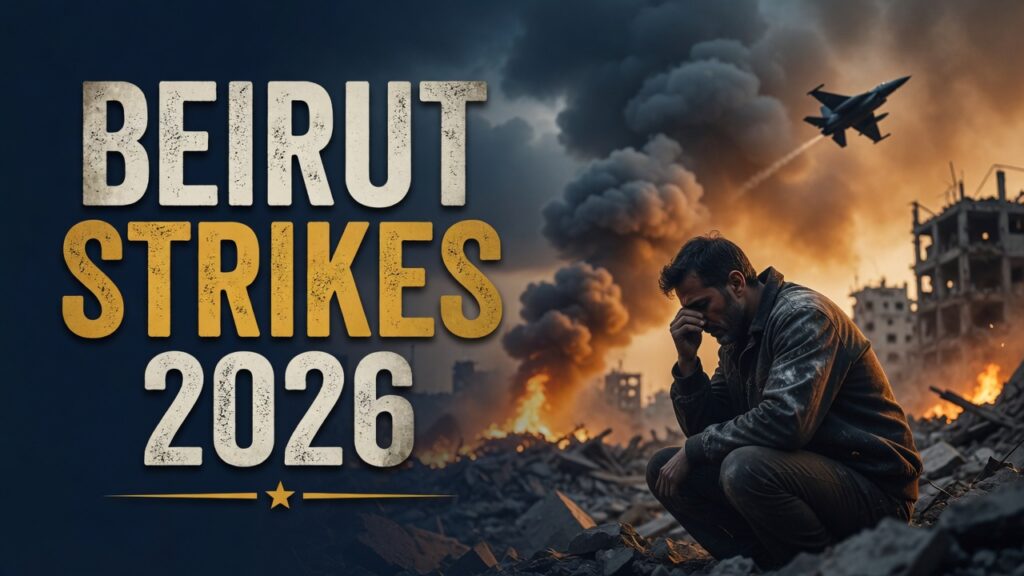
As residential neighborhoods in southern Beirut absorb fresh strikes in mid-June 2026 — with civilians fleeing on foot, smoke rising over Dahiyeh, and diplomatic negotiations hanging by a thread — a fundamental question demands an honest answer: what exactly is a ceasefire worth when it is broken almost every day and no one is held accountable?
What Has Actually Happened in Beirut This Month?
The facts on the ground are not in dispute. On June 7, 2026, Israel struck Beirut’s southern suburbs without advance warning, just days after a ceasefire agreement brokered in Washington went into effect. Lebanon’s health ministry confirmed two people killed and 20 wounded in strikes on a residential building. One week later, on June 14, Israel struck the Dahiyeh district again. Lebanese civil defense reported at least three people killed and seven wounded. An AFP correspondent on the scene witnessed smoke and dust rising near a heavily damaged apartment building as residents searched the rubble for survivors.
Support Independent Local Journalism
TheTownHall.News is a non-profit reader-supported journalism. Just $5 helps us hire local reporters, investigate important issues, and hold public officials accountable across Alameda County. If you believe our community deserves strong, independent journalism, please consider donating $5 today to support our work.Israel framed both rounds of strikes as retaliation. Its military stated that Hezbollah had launched three projectiles into northern Israeli territory — which it described as a blatant ceasefire violation — and that the Dahiyeh strikes targeted Hezbollah command infrastructure. Netanyahu’s office confirmed the operations publicly on both occasions.
If a ceasefire can be broken by both sides daily, called a violation by both sides daily, and result in residential buildings being destroyed daily — is it a ceasefire at all, or merely a pause between escalations?
Is This Pattern New — Or Has It Been Happening for Months?
It is not new. Brian Katulis, senior fellow at the Middle East Institute, stated plainly after the June 7 strikes: “These ceasefires between Israel and Hezbollah have been quite tenuous, and they’ve been broken almost on a daily basis over the last few weeks.” That assessment reflects a failure that stretches back much further than last week.
The original ceasefire, signed on November 27, 2024, and brokered by both the United States and France, was designed to permanently end hostilities between Israel and Hezbollah. It collapsed. A second agreement — the 2026 Israel–Lebanon ceasefire brokered exclusively by the US — took effect on April 16–17 following a new round of escalation in which over 2,000 people were killed in Lebanon and more than one million were displaced. By the time that agreement was struck, it was already understood to be fragile. According to Lebanese Ministry of Public Health records cited by the Action on Armed Violence research organization, total deaths in Lebanon from the conflict had reached approximately 4,633 by the end of the first ceasefire phase in March 2026.

“These ceasefires between Israel and Hezbollah have been quite tenuous, and they’ve been broken almost on a daily basis over the last few weeks.” — Brian Katulis, Middle East Institute
1,600,000. The number of people displaced in Lebanon by May 2026, per Lebanese Health Ministry and UN data. The question no one in Washington seems willing to answer directly: what does American diplomatic credibility cost when the agreements it brokers are openly and repeatedly violated within days of signing?
What Do the Stakes Look Like Beyond Beirut?
The stakes extend well past Lebanon’s borders, which is precisely what makes the current moment so consequential. Iran had made a ceasefire in Lebanon a non-negotiable condition for any deal to end the wider US-Iran war. Following the June 14 strikes on Dahiyeh, Iran’s chief negotiator Mohammad Bagher Ghalibaf stated there was “no point” in continuing peace talks with Washington. Iranian lawmakers warned of a “decisive and painful response.”
Trump publicly downplayed the strikes but acknowledged the deal would be delayed “by a few hours” — a telling admission that Israeli military actions were directly disrupting a US-mediated diplomatic process. The previous time Israel struck Beirut’s suburbs — on June 7 — it triggered what CBC News described as “the most serious escalation of fighting between Iran and Israel since the tenuous ceasefire took hold in April.”
The pattern is consistent and dangerous: every strike on Beirut that breaks a ceasefire raises the risk of a regional response that American taxpayers and American service members will ultimately bear.
The UN Security Council convened an emergency session following the latest strikes. UN Special Coordinator for Lebanon Jeanine-Hennis Plasschaert reported that southern Lebanon was “in flames” and roads in Beirut were “choked with people fleeing their homes.” UN Spokesperson Stéphane Dujarric condemned the loss of civilian lives and called for a diplomatic solution to end the cycle of violence.
Support Independent Local Journalism
TheTownHall.News is a non-profit reader-supported journalism. Just $5 helps us hire local reporters, investigate important issues, and hold public officials accountable across Alameda County. If you believe our community deserves strong, independent journalism, please consider donating $5 today to support our work.Who Is Really Enforcing These Agreements?
This is the question that cuts to the core of the problem. The April 2026 ceasefire was brokered by the United States. The November 2024 ceasefire was brokered by the United States and France. Both were broken. Both continue to be broken. And both sides — Israel citing Hezbollah provocation, Hezbollah citing continued Israeli strikes and occupation of southern Lebanese territory — claim the other fired first.
France has formally condemned the June 2025 and 2026 strikes and called on all parties to abide by the ceasefire monitoring mechanism. It has also called on Israel to fully withdraw from Lebanese territory. Israel has not fully withdrawn. Hezbollah has not stopped firing. The monitoring mechanism has not produced accountability for either party.
Who exactly is enforcing these agreements — and if the answer is “no one,” why does the United States keep signing them?
A US official told Al Jazeera that Washington “supports Israel’s right to self-defense and stands with the legitimate government of Lebanon” — a position that simultaneously endorses strikes on Beirut and the Lebanese state that is being struck. That contradiction is not a minor diplomatic nuance. It is a structural failure of American policy that is costing lives and costing credibility.
What Do Supporters of This Policy Actually Believe?
Defenders of the current approach make several serious arguments that deserve a direct answer. They contend that Hezbollah provoked each round of Israeli strikes through cross-border fire, and that a sovereign nation has an unambiguous right to respond militarily when its territory is attacked. They further argue that Hezbollah deliberately embeds within civilian areas, which makes civilian casualties in Dahiyeh a consequence of Hezbollah’s choices rather than Israel’s. The Trump administration has stated publicly that the United States “does not expect Israel to absorb ongoing attacks on its civilians by a terrorist organization.”
These arguments have merit on their own terms. Hezbollah did confirm launching drone attacks on Israeli forces before the June 7 strikes. Credible evidence exists that Hezbollah operates within civilian infrastructure. And no government can be expected to absorb cross-border fire indefinitely without response.
The problem is that these arguments, while accurate, do not resolve the central accountability failure. A ceasefire in which one party’s violations automatically justify the other’s violations is not a ceasefire — it is a framework for unlimited escalation with a diplomatic label attached. The United States cannot simultaneously broker peace agreements and provide unconditional political cover for one party to breach them. That position does not produce peace. It produces exactly what is visible in Dahiyeh right now: buildings in rubble, civilians displaced, and negotiations collapsed.
Has the Cost of Diplomatic Failure Finally Become Too High?
The cumulative cost of this pattern is now severe enough that asking whether it can continue is no longer a theoretical question. More than 2,679 people had been killed in Lebanon by early May 2026, according to Lebanese Health Ministry figures, with 8,229 wounded. France, after the April 8 strikes in which Israeli forces hit over 100 targets across Beirut in a single 10-minute window, stated in a formal government declaration that the strikes were “especially unacceptable” because they directly jeopardized a temporary ceasefire between the United States and Iran reached just the day before.
That is not a fringe assessment. That is the formal position of a NATO ally and a co-signatory of the original Lebanon ceasefire agreement. When France describes Israeli strikes as “especially unacceptable” and the United States simultaneously defends them as self-defense, the West’s diplomatic coherence has broken down in a visible and consequential way.
Accountability — genuine, enforceable accountability — is not a secondary concern in this situation. It is the only mechanism that makes ceasefire agreements mean anything. Without it, each new agreement is simply a countdown clock to the next round of strikes, the next displaced families, and the next emergency UN session that produces another statement no one is required to act on.
The real question is not whether Beirut will be struck again. Given the current trajectory, that question answers itself. The question is whether the United States, as the architect of these agreements, is prepared to enforce what it negotiates — or whether it will continue to watch ceasefires dissolve while families in Dahiyeh search through rubble for survivors.
Key Questions This Article Raises
- If the United States brokers a ceasefire and provides political cover when it is immediately broken, what leverage does American diplomacy actually have in the region?
- At what point does a pattern of daily ceasefire violations constitute the effective end of the agreement — and who has the authority to declare that?
- When civilian neighborhoods are repeatedly struck during active ceasefire periods, who bears legal and moral accountability — and is anyone actually pursuing it?
What do you think — can any ceasefire hold when no mechanism exists to enforce it? Share this article and tell us where you stand.
Still following this story? Subscribe to The Town Hall for daily coverage of the Middle East conflict and its consequences for American policy.
Think others need to read this? Share it — and contact your representatives to demand accountability for how US diplomatic capital is being spent.