California School Bonds and the Newsom Nonprofit: Where Is the Money Going?
As federal investigators close in on Jennifer Siebel Newsom’s finances, a troubling picture emerges — one that every parent who ever voted yes on a school bond deserves to see.
Every few years, the pitch arrives on your ballot: schools are underfunded, children are suffering, and only a new bond measure can close the gap. Californians have heard this story so many times they can recite it in their sleep. But what if the real story isn’t about a funding shortage — what if it’s about where the money actually goes once it arrives?
This week, that question became impossible to ignore. On June 15, Governor Gavin Newsom announced that the Department of Justice is investigating his wife, Jennifer Siebel Newsom, for potential tax fraud and related financial matters tied to her nonprofit organization, The Representation Project. The investigation — confirmed by CNN and rooted in whistleblower complaints filed with the U.S. Attorney’s Office in Sacramento — has put a national spotlight on a financial arrangement that critics flagged years ago and that official California largely chose not to see.
Support Independent Local Journalism
TheTownHall.News is a non-profit reader-supported journalism. Just $5 helps us hire local reporters, investigate important issues, and hold public officials accountable across Alameda County. If you believe our community deserves strong, independent journalism, please consider donating $5 today to support our work.The Money Trail Nobody Wanted to Follow
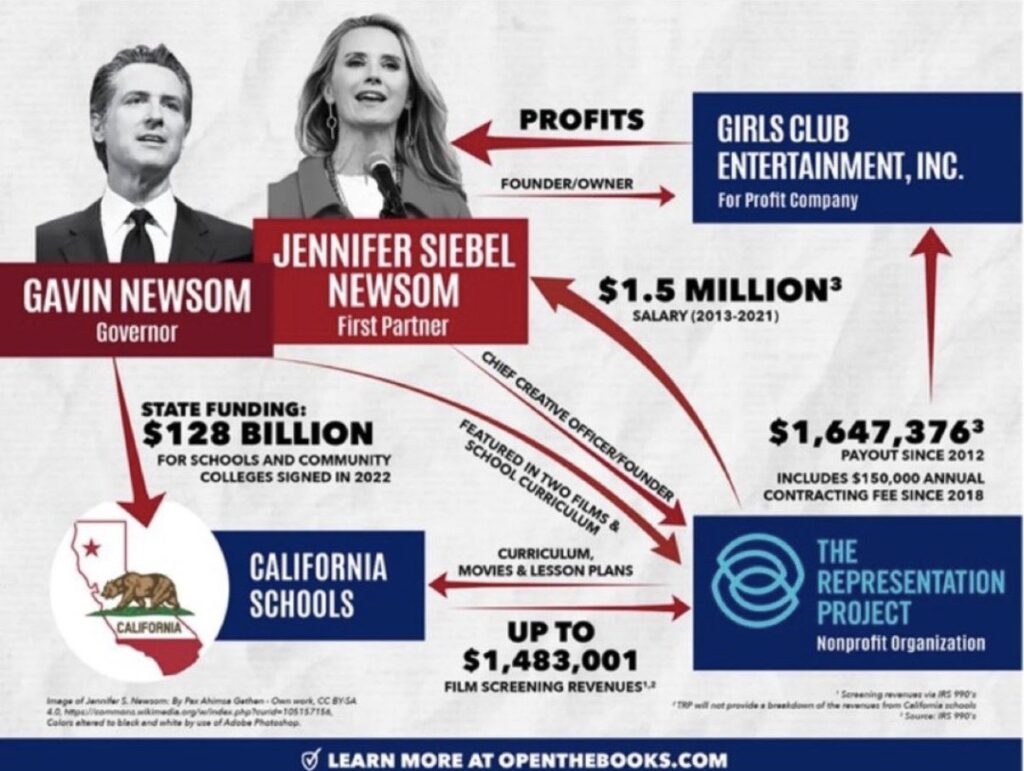
The structure is worth examining closely, because it is not especially complicated. Jennifer Siebel Newsom founded The Representation Project, a nonprofit, in 2011. She also owns Girls Club Entertainment, a for-profit production company. Between 2013 and 2021, the nonprofit paid her $1.5 million in salary. Since 2012, it has funneled an additional $1.6 million to her private production company — including $161,250 in 2024 alone, according to IRS 990 filings cited by the watchdog group OpenTheBooks.
The nonprofit’s product is a series of documentary films on gender equity and masculinity. Those films were then licensed to California public schools — at roughly $270 per district — and incorporated into official curriculum. According to OpenTheBooks data, film screening revenues reached up to $1.48 million. The Representation Project reported that its films and curricula were used in 1,000 California public schools as early as 2014, a number that later grew to at least 5,000 schools nationally. Her husband’s own Department of Education promoted her documentaries in official state guidelines.
The question no one in Sacramento wanted to ask: if a private citizen sold films to public schools through a nonprofit she controlled, while her husband ran the government that funded those schools, would anyone call that a conflict of interest?
Who Signed the Check — and Who Cashed It?
In 2022, Governor Gavin Newsom signed $128 billion in state funding for schools and community colleges. It was celebrated as a historic investment in California’s children. It was also signed by the same governor whose wife’s nonprofit was actively licensing curriculum and films to those same schools, collecting fees along the way.

That is not an allegation of crime. No charges have been filed, and Newsom has called the federal investigation politically motivated, framing it as part of what he describes as President Trump’s “hit list” for political opponents. But the conflict of interest embedded in this arrangement does not require criminal conduct to be worth scrutinizing. It requires only clear eyes.
“When the governor funds the schools, and the governor’s wife sells the curriculum, and the governor’s own education department recommends it — taxpayers are entitled to ask who this system was actually designed to serve.”
The financial web extends further. Several corporations that lobbied the Newsom administration — including Pacific Gas and Electric, AT&T, Kaiser Permanente, and Comcast — also donated to The Representation Project. PG&E, which admitted fault for multiple California wildfires, is listed as an associate producer on two of Siebel Newsom’s films. Kaiser Permanente holds state contracts in excess of $35 million. These donations are legal. But legality and accountability are not the same thing.
Are School Bond Campaigns Covering for This System?
$1.5 million in salary. The nonprofit that paid it was funded by corporations lobbying the same government that kept approving school bonds and curriculum mandates. Ask yourself: how much of the urgency behind “schools need more funding” is genuine — and how much is a machine that benefits from the money flowing in?
California has some of the highest per-pupil education spending among major states, and some of the worst academic outcomes. As of recent state assessments, 44 percent of California children cannot read at a proficient level, and 70 percent perform below par in math. Meanwhile, school districts were paying licensing fees for films on “toxic masculinity” — films produced by the governor’s wife, generating revenue for her nonprofit, funneling payments to her production company.
If the schools were truly underfunded, would the priority be buying documentary film licenses from a governor’s spouse?
Support Independent Local Journalism
TheTownHall.News is a non-profit reader-supported journalism. Just $5 helps us hire local reporters, investigate important issues, and hold public officials accountable across Alameda County. If you believe our community deserves strong, independent journalism, please consider donating $5 today to support our work.The bond measure model depends on voter trust. Californians are asked, repeatedly, to approve new debt — secured against future tax revenue — on the promise that the money will reach classrooms. But when funding flows through a system where politically connected nonprofits set curriculum, collect fees, and employ family members of elected officials, that trust is being exploited.
What Do Supporters of This Policy Actually Believe?
Defenders of The Representation Project and Siebel Newsom’s work argue that the films address real gaps in education around gender equity and media literacy — topics that, however contested, are legitimate areas of public discourse. They note that the documentary Miss Representation won awards and generated genuine public conversation about how women are portrayed in media. Supporters of the nonprofit model argue that behested payments — donations solicited by officials to charitable causes — are legal, widely used across California politics, and serve real public purposes.
These are fair points. A documentary can have merit and still represent a conflict of interest. A nonprofit can do good work and still warrant scrutiny when its primary funder is a network of companies seeking favorable treatment from the founder’s husband. The argument is not that the films are worthless — it is that the process by which they were embedded into public school curriculum, recommended by a state education department under the same administration, and funded indirectly by state school dollars, deserved far more independent oversight than it received.
The standard should not be “is it technically legal?” The standard should be “is this how public school money should be spent — and who decided?”
Is This the Accountability Moment We’ve Been Waiting For?
The federal investigation is the most significant development yet, but it did not emerge from institutional vigilance. It emerged from whistleblowers — private individuals who saw what official California declined to act on. Newsom’s former chief of staff, Dana Williamson, was indicted in November 2025 and pleaded guilty last month to conspiracy to commit bank fraud, wire fraud, filing a false tax return, and making false statements to a federal agent. The investigation into Siebel Newsom is separate, but the pattern it fits into is not.
This is what happens when accountability structures are eroded slowly, over years, until the only check left is a federal prosecutor in Sacramento working a whistleblower complaint. Parents who voted yes on school bonds deserved that accountability much earlier. They deserved elected officials who asked, plainly, whether it was appropriate for a governor’s wife to profit from state-recommended curriculum. They deserved a press corps that treated “the first partner’s nonprofit sells films to public schools” as the front-page story it was.
If California’s children were the real priority, someone would have asked these questions years ago — before the bonds passed, before the curriculum was approved, and before the money moved.
KEY QUESTIONS
- If California schools genuinely needed more funding, why was school budget money used to license films from a governor’s wife’s nonprofit?
- Who approved the decision to include The Representation Project’s curriculum in state guidelines — and did anyone flag the obvious conflict of interest?
- How many other states and school districts paid licensing fees to this nonprofit, and was any independent body ever asked to evaluate whether the material met an educational need?
The next time a school bond measure appears on your ballot, it will come with photographs of children, promises of new classrooms, and the familiar warning that without new revenue, education will suffer. Before you vote, it is worth asking what happened to the last hundred billion dollars — and whose wife got paid along the way.
What do you think — is it time for independent oversight of how school curriculum is procured? Share this and tell us.
Still have questions? Subscribe for daily accountability coverage at thetownhall.news. Think others need to hear this? Forward the article or share it on social media. Want to make your voice count? Contact your state representative and ask what curriculum approval process exists for nonprofit-produced educational material in your district.