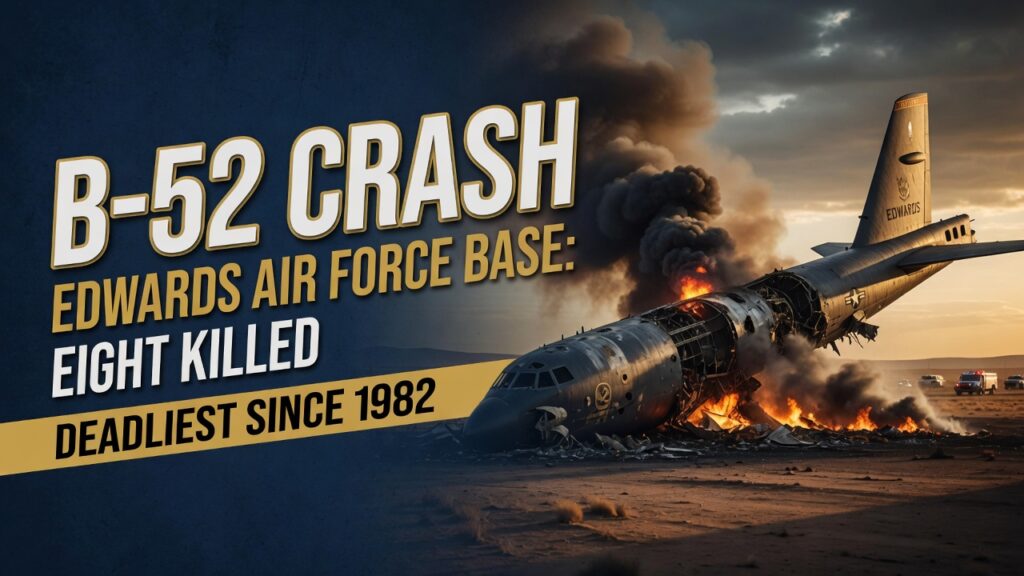
B-52 Crash at Edwards Air Force Base: Eight Killed in Deadliest Incident Since 1982
A routine test flight ended in fire and ash on Monday. Now eight families are left without answers — and the rest of us should be asking hard questions about what we owe the people who fly our oldest warplanes.
Eight people are dead. That number is not in dispute. What remains deeply, frustratingly unclear — and what the public deserves to understand — is how a “routine test mission” of one of America’s most storied aircraft could end in a fireball on a clear California morning with no warning and, apparently, no survivors. The B-52 Stratofortress that crashed Monday at Edwards Air Force Base was not some experimental prototype. It was a workhorse. A known quantity. And that is precisely why the silence around what went wrong demands scrutiny.
What Happened at Edwards Air Force Base?
The facts are stark. At approximately 11:20 a.m. on June 15, 2026, a Boeing B-52H Stratofortress designated 60-0061 lifted off from Edwards Air Force Base in California’s Mojave Desert — and never came back. The aircraft, assigned to the 412th Test Wing, was supporting the U.S. Air Force’s Radar Modernization Program, a multiyear effort to keep the B-52 fleet combat-relevant well into the 2050s. The plane crashed back onto the same 15,000-foot runway it had just departed, the compact wreckage indicating a sudden, near-vertical loss of altitude. A massive black plume of smoke rose above the desert and was visible for miles. Emergency crews responded immediately. There was nothing to save. Col. James Hayes, deputy commander of the 412th Test Wing, told reporters that same afternoon: “Today, Edwards Air Force Base experienced a horrible tragedy, and we lost eight great Americans. This crash is deemed to be unsurvivable.” He confirmed no cause had yet been identified and that a full investigation could take upward of six months.
Support Independent Local Journalism
TheTownHall.News is a non-profit reader-supported journalism. Just $5 helps us hire local reporters, investigate important issues, and hold public officials accountable across Alameda County. If you believe our community deserves strong, independent journalism, please consider donating $5 today to support our work.Who Were the Eight People Who Died?
On Wednesday, June 17, Edwards Air Force Base released the names of all eight victims. They were Col. (Select) Gregory Watson, 53, a weapon systems officer and Boeing employee serving as an Air Force reservist; Lt. Col. Gabriel Estrella, 40, a weapon systems officer with the Air Force Operational Test and Evaluation Center; retired Lt. Col. Miles Middleton, 50, a veteran of Afghanistan and Boeing test pilot from Tehachapi, California, survived by his wife and two children; Maj. Alexander Davis; Maj. Robert Dee; and Maj. Brad Hovey. Jeromy Smith, a civilian flight-test engineer for the Department of Defense, was also killed — his widow, Lauren Smith, confirmed the couple had welcomed a baby just four months ago. These were not anonymous uniforms. They were engineers, pilots, reservists, and contractors — people who showed up that Monday morning to advance a program designed to keep America’s bomber force functional for decades.
Eight people boarded a decades-old aircraft on a clear morning for what was logged as routine. They did not come home. That is not a statistic — it is a catastrophic institutional failure that demands real answers.
How Old Is Too Old? The B-52’s Longevity Problem
The B-52 Stratofortress has been in continuous service since the 1950s. The aircraft involved in Monday’s crash, tail number 60-0061, entered service in 1960 — meaning it is 66 years old. The Air Force’s plan, embedded in the Radar Modernization Program the crew was supporting, is to keep these aircraft flying until at least 2050. That would make some B-52s nearly a century old by the time they are retired.
“The question is not whether the B-52 is a remarkable aircraft — it is. The question is whether we are asking remarkable people to take unreasonable risks to keep it flying.”
Supporters of the modernization program argue, correctly, that the B-52’s airframe has proven extraordinarily durable and that successive upgrades have kept its avionics and weapons systems current. That argument carries weight. But durability is not the same as safety, and a 66-year-old aircraft undergoing a radar system retrofit — having flown to Edwards from Port San Antonio just months earlier after receiving new equipment — introduces a category of integration risk that deserves independent scrutiny, not bureaucratic reassurance. This is the first B-52 crash since 2016, when one went down at Andersen Air Force Base in Guam. No one was killed in that incident. Monday’s crash is the deadliest B-52 accident since 1982.

Is the Investigation Process Fast Enough to Matter?
44 years between the last deadly B-52 crash and this one. That number offers cold comfort to eight families now waiting for answers that, by official timelines, may not come for half a year.
The investigation process has three layers. An Interim Safety Investigation Board is first gathering facts — a process expected to take roughly 30 days. Those findings then transfer to a full Safety Investigation Board tasked with determining root cause. Finally, an Accident Investigation Board will determine what information can be released publicly and to next of kin. That final phase can take six months or more. Six months is a long time to ask a widow with a four-month-old baby to wait. It is also a long time to leave the broader question — whether other B-52s supporting the same radar modernization program pose similar risks — unanswered. The Air Force has not announced any suspension of the modernization program itself, only a temporary closure of Edwards’ airfield through at least Thursday, with test flight operations expected to resume early next week.
What Do Supporters of the Modernization Program Actually Believe?
The B-52 Radar Modernization Program is not a vanity project. Defense analysts and Air Force leadership argue that modernizing the existing fleet is dramatically more cost-effective than designing and procuring an entirely new long-range bomber — a point that is difficult to dispute when the alternative is a program that would run into the hundreds of billions of dollars. The B-52 has demonstrated an ability to be upgraded continuously over seven decades without fundamental structural compromise. Proponents note that test programs by their very nature involve elevated risk, and that the men and women who volunteer for test duty understand and accept that risk with professional clarity. These are fair points. The question is whether “accepted risk” is the same as “appropriate risk” — and whether the American public, which funds these programs, has been given an honest accounting of what the Radar Modernization Program’s integration challenges actually look like in practice. Accepting that test pilots and engineers knowingly take on danger does not release institutions from the obligation to minimize that danger and to explain, plainly, when something goes wrong.
Are the Families — and the Public — Getting the Transparency They Deserve?
The Air Force has followed standard protocol: next-of-kin notification before public identification of victims, a deputy commander at the podium within hours of the crash, a clear statement that the investigation is underway. By bureaucratic standards, the response has been competent. But competent process is not the same as genuine transparency. The cause of the crash has not been identified. The specific flight profile — the aircraft flew straight ahead and crashed on the same runway it departed — raises specific technical questions that the public record does not yet answer. Was the crash mechanical? Software-related, given the radar system integration? Crew incapacitation? Weather has been ruled out; the day was clear. The black box is being recovered. Until it is analyzed and the findings are released, families and the public are waiting on a timeline set not by urgency but by institutional procedure. Air Force Secretary Troy Meink expressed that he was “deeply saddened” by the crash. Chief of Staff Gen. Kenneth Wilsbach offered prayers for the families. These are appropriate responses. They are not sufficient ones.
The Accountability Moment the Military Cannot Afford to Miss
Personal responsibility is a value that cuts in every direction. The pilots and engineers who flew that mission took personal responsibility for their work, as they do every day. The institutions that assigned them to that aircraft — and that have been flying 60-year-old bombers on active test programs — bear a different kind of responsibility: the institutional kind, which does not end with a press briefing. The American public has a legitimate interest in knowing not just what killed these eight people, but whether the systems and oversight processes that govern aging military aircraft are adequate to the ambitions being placed on them. The Radar Modernization Program is designed to extract another 25-plus years of service from aircraft that are already older than most of the people who fly them. That goal may be achievable. But Monday’s crash is a reminder that achievable and risk-free are not synonyms, and that the people absorbing that risk have names, families, and four-month-old babies at home.
Support Independent Local Journalism
TheTownHall.News is a non-profit reader-supported journalism. Just $5 helps us hire local reporters, investigate important issues, and hold public officials accountable across Alameda County. If you believe our community deserves strong, independent journalism, please consider donating $5 today to support our work.The real question isn’t whether the B-52 can be modernized — it’s whether the institutions responsible for flying it are being honest about the cost of trying.
KEY QUESTIONS
- What specifically caused the B-52 to crash on the same runway it departed — and was the radar modernization equipment a contributing factor?
- Are other B-52 aircraft currently undergoing the same radar integration being grounded or subjected to additional safety reviews while the investigation proceeds?
- How does the Air Force’s six-month investigation timeline balance institutional thoroughness against the public’s right to timely answers — and the safety of crews flying similar missions in the interim?
What do you think — should the Air Force suspend the Radar Modernization Program pending investigation results? Share this article and tell us where you stand.
Still have questions? Stay informed — subscribe to The Town Hall for daily coverage of national security and defense accountability. Think this story deserves wider attention? Share it. Want to make your voice count? Contact your congressional representatives on the Armed Services Committee and ask what oversight actions are being taken in response to the Edwards crash.