
Are Parents Finally Winning the Fight for Their Children’s Education?
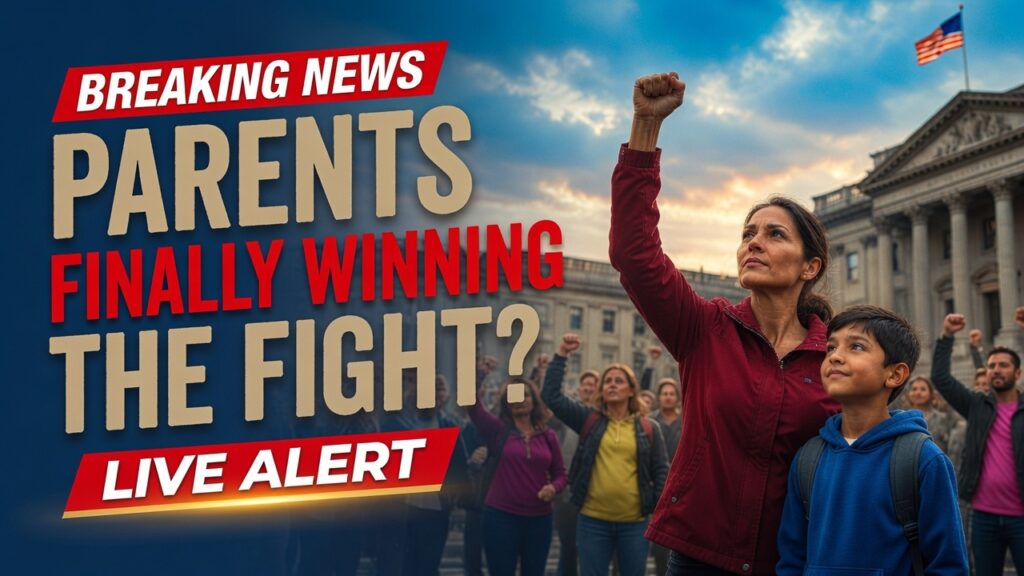
A landmark Supreme Court ruling says yes — and a February settlement just made it permanent. Here is what every parent in America needs to know.
For decades, the debate over who controls what children learn in public schools has simmered below the surface of American politics. Now it has reached a boiling point — and the nation’s highest court has weighed in.
In June 2025, the U.S. Supreme Court handed down a 6-3 ruling in Mahmoud v. Taylor, a case originating in Montgomery County, Maryland, that has redrawn the legal boundaries between public school authority and the religious rights of parents. The decision — authored by Justice Samuel Alito and joined by the five other conservative justices — held that a school district cannot compel elementary-age children to participate in curriculum that substantially burdens their parents’ free exercise of religion, without providing prior notice or the ability to opt out. In February 2026, the case reached a final settlement that locked those protections in place. The ripple effects are only beginning.
Support Independent Local Journalism
TheTownHall.News is a non-profit reader-supported journalism. Just $5 helps us hire local reporters, investigate important issues, and hold public officials accountable across Alameda County. If you believe our community deserves strong, independent journalism, please consider donating $5 today to support our work.What Exactly Did the Court Decide?
The facts of the case are straightforward. Beginning in the 2022–2023 school year, Montgomery County Public Schools introduced a set of LGBTQ+-inclusive storybooks into its English Language Arts curriculum for students from pre-kindergarten through fifth grade. Titles included Born Ready, about a transgender child, and Prince and Knight, in which a prince marries another man. Initially, the school district notified parents in advance and allowed them to excuse their children — a common accommodation consistent with the board’s own guidelines for religious diversity.
Then, in March 2023, the board abruptly reversed course. It eliminated the notice-and-opt-out policy entirely, offering no meaningful explanation beyond vague references to administrative burden and classroom disruption. Parents from Muslim, Roman Catholic, and Ukrainian Orthodox backgrounds sued, arguing the new policy forced their children to absorb content that directly contradicted their religious convictions — without any recourse.
Both a federal district court and the Fourth Circuit Court of Appeals sided with the school board. The Supreme Court disagreed, and did so emphatically.
Is This the Religious Freedom Ruling That Changes Everything?
The majority opinion applied strict constitutional scrutiny and found that the board’s no-opt-out policy placed an unconstitutional burden on the parents’ First Amendment rights. Justice Alito wrote that the policy “substantially interferes with the religious development of their children” — the same legal standard the Court has applied to protect religious minorities for generations.

The Court’s message was clear: access to public education cannot be conditioned on a family surrendering its religious convictions.
The ruling did not ban LGBTQ+-inclusive books from classrooms. It did not declare such content harmful or inappropriate. It required something far more modest — that parents be told in advance and given the ability to opt out, just as the district itself had once permitted. The board’s decision to strip away that accommodation, the Court found, had no sufficient justification under the Constitution.
“We reject this chilling vision of the power of the state to strip away the critical right of parents to guide the religious development of their children.” — Justice Samuel Alito, writing for the majority in Mahmoud v. Taylor
The three liberal justices — Sotomayor, Kagan, and Jackson — dissented sharply. Justice Sotomayor warned that the ruling would create “chaos” for public schools, arguing that “simply being exposed to beliefs contrary to your own” does not amount to a violation of the free exercise clause. The dissent raised real administrative concerns: in a religiously diverse country, nearly any lesson could theoretically trigger an opt-out request.
What Do Supporters of This Policy Actually Believe?
That is a fair question, and the answer deserves a direct engagement. Supporters of the school board’s position make several serious arguments.
First, they contend that LGBTQ+-inclusive curriculum serves a legitimate governmental interest — creating a welcoming environment for students from same-sex and gender-diverse families. These children exist in Montgomery County classrooms, and advocates argue that excluding their family structures from educational materials sends its own message: that they are invisible or shameful.
Support Independent Local Journalism
TheTownHall.News is a non-profit reader-supported journalism. Just $5 helps us hire local reporters, investigate important issues, and hold public officials accountable across Alameda County. If you believe our community deserves strong, independent journalism, please consider donating $5 today to support our work.Second, critics of the ruling worry about its scope. Legal scholars have noted that if any parent can opt a child out of any lesson deemed contrary to religious belief, the practical management of public schools becomes unworkable. The dissent pointed out that this logic could extend to science lessons, history units on civil rights, or even instruction given by female teachers in traditions where that raises doctrinal concerns.
These are not trivial objections. But they do not resolve the central constitutional problem the Court identified. The school board itself once provided opt-outs without incident. It chose to end that accommodation — not because it was legally required to, but because some administrators found it inconvenient. The Constitution, as the Court correctly noted, does not permit government institutions to burden religious exercise simply because accommodating it is administratively complex.
If a school board can unilaterally eliminate religious accommodations whenever it judges them “too burdensome,” then those protections are only as real as the bureaucracy’s goodwill — which is no protection at all.
What Happened After the Ruling?
The Supreme Court’s June 2025 decision sent the case back to lower courts with an injunction already in place requiring Montgomery County to restore notice and opt-out rights. That injunction held.
58 requests from 43 families to opt out of specific books were approved following the ruling — a figure that hardly suggests the “chaos” the dissent predicted. Schools continued to function. The books remained available to other students.
$1.5 million. That is how much Montgomery County’s school board agreed to pay in the February 2026 settlement — raising a straightforward question: why did district administrators push this litigation all the way to the Supreme Court when an opt-out policy had already been working?
The settlement also placed the school district under ongoing court supervision for compliance — meaning the legal fight, while settled, has a watchdog attached to it. The Mahmoud ruling has since been cited by the Supreme Court in Mirabelli v. Bonta (2026), a California case involving schools withholding information about students’ gender identity from parents, suggesting the Court intends to apply this framework broadly.
Are Other States and Districts Already Responding?
They are, though the picture is uneven. California’s Department of Education issued formal guidance acknowledging that school districts may need to develop their own notice-and-opt-out processes in light of Mahmoud. The guidance was careful to note that the ruling does not override California’s anti-discrimination protections for LGBTQ+ students — and that is accurate. But it does signal that even blue-state administrators understand the ruling carries binding force.
The question every school board in America now has to answer is one it should have been asking all along: are we treating parents as partners or as obstacles?
Civil liberties organizations including the ACLU have pledged to limit the ruling’s application, arguing it should be read narrowly as applying only to the specific parents and books at issue in Montgomery County. Legal experts across the spectrum expect future litigation to test those boundaries. For now, parents seeking religious accommodations in public schools have a Supreme Court precedent on their side — and school boards that ignore it do so at significant legal and financial risk.
What Do the Key Questions This Case Raises Tell Us About American Education?
The Mahmoud decision is not the end of this debate. It is, if anything, an inflection point. The deeper questions the case exposed have been building for years.
Who has final authority over the values a child absorbs in a public school classroom — elected school boards accountable to voters, or parents accountable to their children and their conscience? When does an institution cross the line from educating a child to displacing parental authority in matters of belief and identity? And what does it say about the current state of public education that a school board chose to spend years of litigation and $1.5 million of taxpayer money defending a policy it once voluntarily abandoned?
KEY QUESTIONS
- If a school board can eliminate religious opt-outs whenever it finds them inconvenient, what does that mean for the First Amendment rights of religious minority families?
- How far does the Mahmoud precedent extend — and which curriculum decisions will school boards face next in courts?
- Are taxpayers in Montgomery County satisfied that $1.5 million in public funds was spent defending a policy the district itself once considered workable?
The parents who brought Mahmoud v. Taylor to the Supreme Court were not asking for control over what other children learn. They were asking for the same modest accommodation the school district had already been providing — until it decided, without warning, that their religious beliefs were no longer worth the paperwork. The Court found that unacceptable. The settlement confirmed it.
The real question is not whether this ruling is a victory for parental rights. It is. The question worth sitting with is this: in a country built on the principle that government serves the people — not the other way around — why did it take a Supreme Court case to remind a school board of something it already knew?
What do you think — is this the accountability moment for public education that parents have been waiting for? Share this article and tell us.
Still have questions? Subscribe to The Town Hall for daily coverage of education, parental rights, and constitutional law. Think others need to hear this? Share the article and start the conversation. Want to make your voice count? Contact your local school board representative and ask where they stand on parental notification policies.