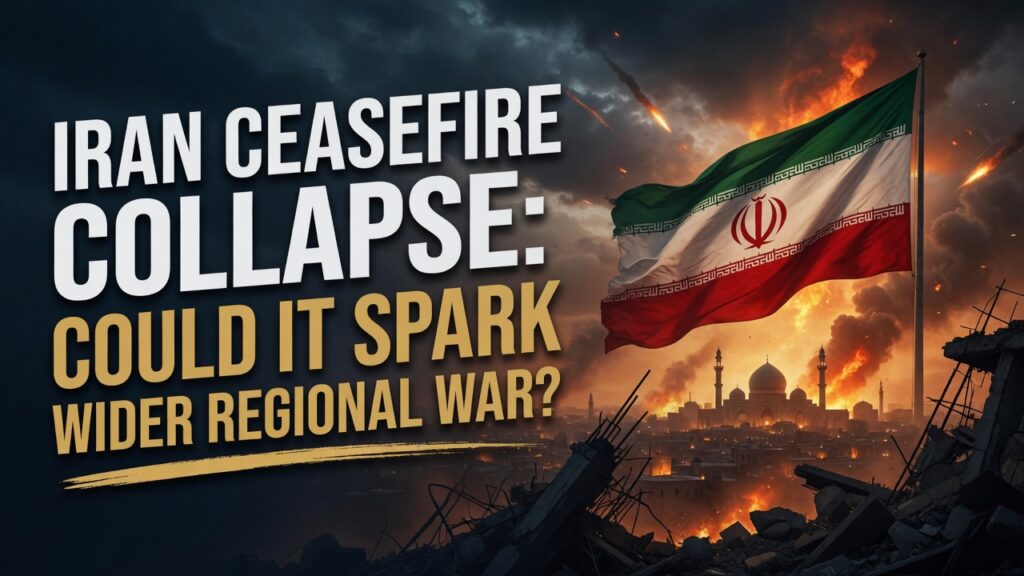
Iran Ceasefire Collapse: Could It Spark Wider Regional War?
As missile strikes hit a joint U.S.-Jordanian air base and Washington’s truce with Tehran unravels, Americans are left asking a simple question: who authorized round two of this war, and who is footing the bill?
The ceasefire with Iran did not survive the week.
On July 8, President Trump declared the truce over after Iranian forces attacked commercial vessels in the Strait of Hormuz, and within 24 hours U.S. Central Command reported striking roughly 90 Iranian military targets. Iran answered with drone and missile attacks on American-linked bases in Kuwait, Bahrain, Qatar, and Jordan, including a barrage aimed at Muwaffaq Salti Air Base, a facility jointly operated by U.S. and Jordanian forces near Azraq. For a country still absorbing the bill from the war’s first round, the question is no longer whether this conflict is over. It is who is deciding to keep it going, and whether anyone in Washington has to explain why.
What Actually Happened at Muwaffaq Salti?
According to Jordan’s military, air defenses intercepted eight missiles fired from Iran on July 9 alone. Iran’s Islamic Revolutionary Guard Corps claimed it had targeted the base directly, describing it as a facility housing U.S. forces. Open-source military analysts tracked at least five ballistic missiles launched from northwestern Iran toward the installation, and video circulating widely online showed visible air defense activity over Azraq that night. What remains unconfirmed is whether any missile actually reached the base. Jordan says its interceptors did their job. Iran claims otherwise. Neither government has released independent verification, and no international body has confirmed battle damage. That gap between competing claims is itself the story: American taxpayers help fund a forward-operating base sitting in the middle of an active missile exchange, and the public is being asked to take the word of two governments with obvious incentives to shade the truth in opposite directions.
Support Independent Local Journalism
TheTownHall.News is a non-profit reader-supported journalism. Just $5 helps us hire local reporters, investigate important issues, and hold public officials accountable across Alameda County. If you believe our community deserves strong, independent journalism, please consider donating $5 today to support our work.Why Did the Ceasefire Collapse So Fast?
The truce was never as solid as the headlines suggested. A two-week ceasefire took effect April 8, only to come under strain after Israel struck Lebanon and Iran refused to fully reopen the Strait of Hormuz. Talks in Islamabad collapsed in mid-April, prompting a U.S. naval blockade. A memorandum meant to formally end the war was signed at Versailles on June 17. Iran attacked commercial vessels in the strait on July 6 and 7, and Trump declared the ceasefire dead the next day. Each step has followed the same pattern: a deal is announced, tensions ease briefly, then a provocation resets the clock. Americans have been told this war is winding down for months. It keeps not winding down.
Who Is Paying the Price for This War?
The dollar figures involved are no longer abstract. Independent tracking of war-related expenditures put the cost to U.S. taxpayers at an estimated $113.3 billion as of mid-June, before the latest round of strikes even began. That figure does not include the ripple effects: oil price spikes, disrupted shipping, and a Strait of Hormuz that has gone from roughly 110 vessel transits a day before the war to just 13 in the most recent 24-hour period tracked.
$113.3 billion. The question no one in Washington has answered: who authorized spending that much on a war Congress never formally declared?
Every dollar spent striking Iran is a dollar not spent on the border, on infrastructure, or on paying down a debt the next generation will inherit.

Where Does Iran’s Leadership Stand Now?
Supreme Leader Ali Khamenei was killed in the opening strikes of this war on February 28. He was buried this week in Mashhad after days of funeral processions. His son and designated successor, Mojtaba Khamenei, was notably absent from the burial, his own father’s funeral, a decision analysts attribute to fears that any public appearance could expose him to assassination given the scale of Iran’s intelligence failures during the war.
If the man now running Iran’s nuclear and missile programs is too afraid to attend his own father’s funeral, who exactly is Washington negotiating with?
A regime that cannot guarantee its own leader’s safety is not a stable counterpart for diplomacy, and that instability should worry anyone hoping for a durable end to this conflict.
Is Washington Following the Rules of War Powers?
Congress never voted to authorize this war. The strikes that killed Khamenei in February, the ongoing bombing campaign, and the decision to declare the ceasefire over have all proceeded through executive action alone. That is not a partisan observation. It is a structural one, and it should trouble anyone who believes decisions to spend blood and treasure abroad belong to the people’s elected representatives, not a single office. Former House Speaker Nancy Pelosi accused the administration of dragging the country into an unauthorized new war after the July strikes resumed, calling it dangerous and illegal. Whether or not one agrees with her politics, the underlying question is a fair one: where is the vote?
What Do Supporters of This Policy Actually Believe?
Supporters of the administration’s approach make a real argument, and it deserves a real answer. They point out that Iran, not the United States, broke the ceasefire first by attacking commercial vessels in one of the world’s most critical waterways, a corridor that carries roughly a fifth of global oil consumption. They argue that a credible U.S. response protects global trade, defends American forces already stationed in the region, and prevents Iran from mistaking restraint for weakness. Officials have also emphasized that strikes have been deliberately paused between rounds specifically to give diplomacy a chance to work, rather than pursuing continuous, open-ended war.
Support Independent Local Journalism
TheTownHall.News is a non-profit reader-supported journalism. Just $5 helps us hire local reporters, investigate important issues, and hold public officials accountable across Alameda County. If you believe our community deserves strong, independent journalism, please consider donating $5 today to support our work.Even a justified response should come with a plan, a budget, and congressional buy-in, not another open-ended war funded through executive discretion alone.
These are legitimate points, and they deserve to be taken seriously rather than dismissed. But they do not answer the accountability question at the center of this story. A justified response and an unaccountable one are not mutually exclusive, and taxpayers deserve to know which one they are funding.
Qatari mediators are back in Tehran this week, and both sides say talks continue even as strikes do too. Iran’s chief negotiator says the country is prepared for what he called all-out defense if Washington breaks the agreement again. That is where things stand five months into a war that was supposed to have ended twice already. The real question isn’t whether Iran will test this ceasefire again, because it will. It’s whether the next round gets a vote in Congress, or whether America goes back to war the same way it left: without asking anyone at all.
Key Questions
- Did any missile actually strike Muwaffaq Salti Air Base, or did Jordan’s air defenses hold?
- Who in Washington authorized more than $113 billion in war spending without a congressional vote?
- With Mojtaba Khamenei avoiding public view, who is actually in charge of Iran’s response?
Still have questions about where this war is headed? Stay informed, subscribe for daily coverage. Think your neighbors need to see this? Share the article. Want your voice to count? Contact your congressional representative and ask directly whether they were briefed before this ceasefire collapsed.