
Iran Ceasefire Collapse Explained: Hormuz Standoff, Costs, and What Comes Next
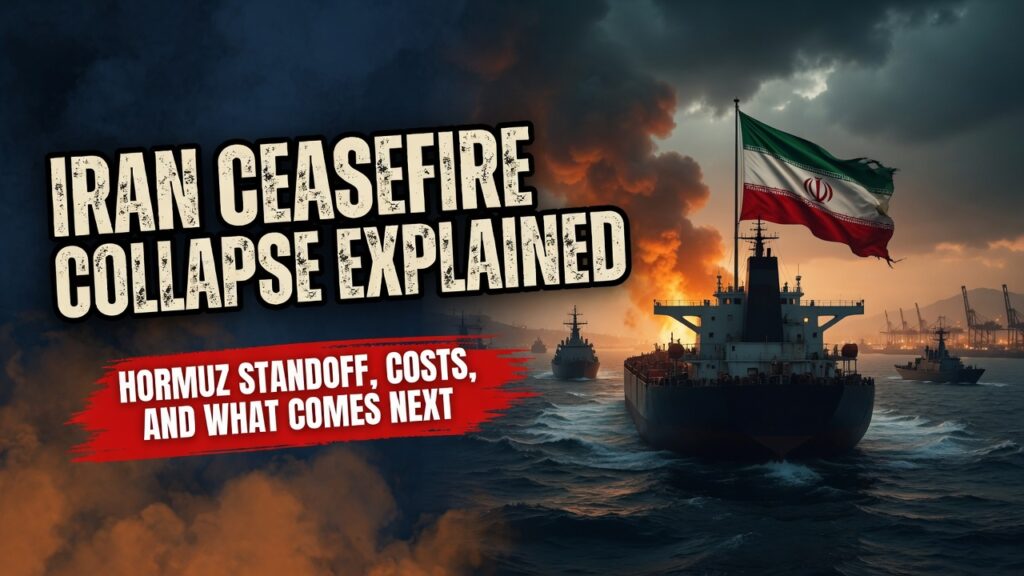
As the U.S.–Iran ceasefire unravels over the Strait of Hormuz, millions of Americans are asking the question Washington keeps dodging: who authorized an open-ended war — and who is going to pay for it?
The ceasefire with Iran is over. President Trump confirmed it on July 10, after Iranian forces fired on commercial vessels in the Strait of Hormuz and the United States answered with days of retaliatory strikes. Just three weeks earlier, both governments had signed a memorandum of understanding in Islamabad that was supposed to wind this war down. Instead, the agreement is collapsing in real time — and the American people are being asked to absorb the consequences of a conflict Congress never voted to authorize, governed by a deal the public has never been walked through.
This matters right now because the 60-day negotiating window established by the June 17 Islamabad Memorandum is already half spent. Mediators are scrambling to restart talks. Fresh sanctions landed on Tehran last Friday. And the world’s most important oil chokepoint remains, functionally, a contested war zone.
What Actually Happened to the Ceasefire?
The short answer: it was never as solid as advertised. The war began on February 28, when U.S. and Israeli forces launched coordinated strikes that killed Supreme Leader Ali Khamenei and dozens of senior officials. A conditional ceasefire took hold April 8, and major combat operations formally concluded May 5. On June 17, President Trump and Iranian President Masoud Pezeshkian signed the Islamabad Memorandum, establishing a 60-day period to negotiate final terms.
Then came July 6 and 7, when Iranian forces fired on three commercial vessels in the strait. The U.S. responded with days of strikes on Iranian targets, followed by new sanctions. By Friday, the president declared the ceasefire no longer in effect, even as he said talks would continue. Iran’s chief negotiator, Mohammad Bagher Ghalibaf, answered that his country was prepared for “all-out defense.” A ceasefire that cannot survive three weeks is not a peace — it is a pause between invoices.
Support Independent Local Journalism
TheTownHall.News is a non-profit reader-supported journalism. Just $5 helps us hire local reporters, investigate important issues, and hold public officials accountable across Alameda County. If you believe our community deserves strong, independent journalism, please consider donating $5 today to support our work.What Is Washington Not Telling You About the Hormuz Deal?
Here is the detail that deserves far more scrutiny than it has received: the Islamabad Memorandum does not actually say who controls the Strait of Hormuz. According to reporting on the document, it calls only for Iran to “make arrangements” for safe passage of commercial vessels and to work with Oman on the waterway’s future administration [CNN reporting on the MoU text]. It is ambiguous by design.
That ambiguity is now the entire crisis. Iran has repeatedly asserted the right to dictate shipping routes and collect on its claimed control, warning vessels to follow regime-approved protocols — and firing on those that don’t. Roughly 20 million barrels of oil, about a fifth of global seaborne crude, normally transit that strait every day [industry/analyst data]. When traffic slows to a trickle, the cost doesn’t stay in the Persian Gulf. It shows up in freight rates, insurance premiums, and eventually at every American gas pump.
Who Is Really Paying for This Policy?
Not the negotiators. U.S. Central Command says more than 20 American warships have been enforcing operations against Iran’s oil exports [CENTCOM statements] — a naval commitment of extraordinary scale and duration, sustained month after month with no public accounting of its price tag and no congressional appropriation debate specific to this war.
CENTCOM has said U.S. forces struck over 11,000 targets in Iran during the campaign [CENTCOM statement]. Munitions expended at that scale must be replaced. Deployments extended at that tempo must be funded. Every one of those line items lands, eventually, on the taxpayer — without a single up-or-down vote in Congress authorizing the conflict that generated them.
11,000 targets struck. Here’s the question nobody in Washington will answer: what did that cost you, and who signed off on it?
Where Was Congress When the War Began?
The administration justified the February strikes as self-defense under the UN Charter [House of Commons Library briefing]. Whatever one thinks of the strategic case — and there was a serious one, given Tehran’s nuclear ambitions and decades of proxy terrorism — the constitutional process was bypassed. The Constitution assigns the war power to Congress for a reason: it forces the government to make its case to the people before spending their money and risking their security.
This is not a partisan complaint. Conservatives who cheered when courts blocked executive overreach on domestic policy should apply the same principle abroad. Limited government does not come with a foreign policy exemption.
If the executive branch can wage a 40-day war, sign a peace deal, and then cancel it — all without a vote — what exactly is Congress for?
What Do Supporters of This Policy Actually Believe?
The administration’s defenders make a genuine argument worth engaging. They point out that Iran was the world’s leading state sponsor of terrorism, that its nuclear program had survived every diplomatic effort since the JCPOA’s collapse, and that the February campaign achieved in weeks what negotiations failed to achieve in years: Khamenei’s regime decapitated, Iran’s missile arsenal degraded by joint operations, and Tehran forced to the table. On the merits of capability destruction, the record largely supports them.
But battlefield success is not the question. The question is process and endgame. A war can be strategically defensible and still constitutionally deficient. And a “victory” that produces an ambiguous memorandum, a collapsing ceasefire, a contested strait, and an indefinite naval commitment has not actually ended anything — it has converted a war into a subscription. Supporters owe the public an answer on what “done” looks like, what it costs, and when Congress gets its say.

Is This the Accountability Moment We’ve Been Waiting For?
It should be. The ceasefire’s collapse is an opening for Congress to reassert itself: demand the full text and negotiating record of the Islamabad Memorandum, require a public cost accounting of the campaign and the ongoing naval operations, and debate an authorization — or a prohibition — on further offensive strikes. Transparency is not weakness. It is the difference between a republic that goes to war and a government that simply informs its citizens afterward.
If your representative can’t tell you what this war cost or what ends it, why are they still voting on your money?
Key Questions
- Who in Congress will demand the full text and cost accounting of the Islamabad Memorandum — and when?
- If Iran won’t guarantee safe passage through Hormuz, what is the administration’s actual endgame: renewed war, permanent blockade, or concession?
- What precedent does a 40-day undeclared war set for the next president — of either party?
What Happens If No One Speaks Up?
Then the pattern hardens into precedent. Future presidents of both parties will inherit the template: strike first, negotiate ambiguously, and treat Congress as an audience rather than a branch of government. Energy markets will price in permanent instability. And Americans will keep paying — at the pump, in the defense budget, in the erosion of constitutional order — for decisions they were never asked to approve.
The real question isn’t whether the Iran ceasefire can be salvaged. It’s whether the American people will demand a say before the next war starts without them.
What do you think — is it too late to force accountability, or is this the moment to demand it? Share this article and let us know.
Still have questions? Subscribe to The Town Hall News for daily coverage. Think others need to hear this? Share it. Want your voice to count? Contact your U.S. representative and senators and ask them to support a war powers vote and full public disclosure of the Islamabad Memorandum — the Capitol switchboard is (202) 224-3121.