Tate Brothers Arrested in Miami: What the Extradition Case Means
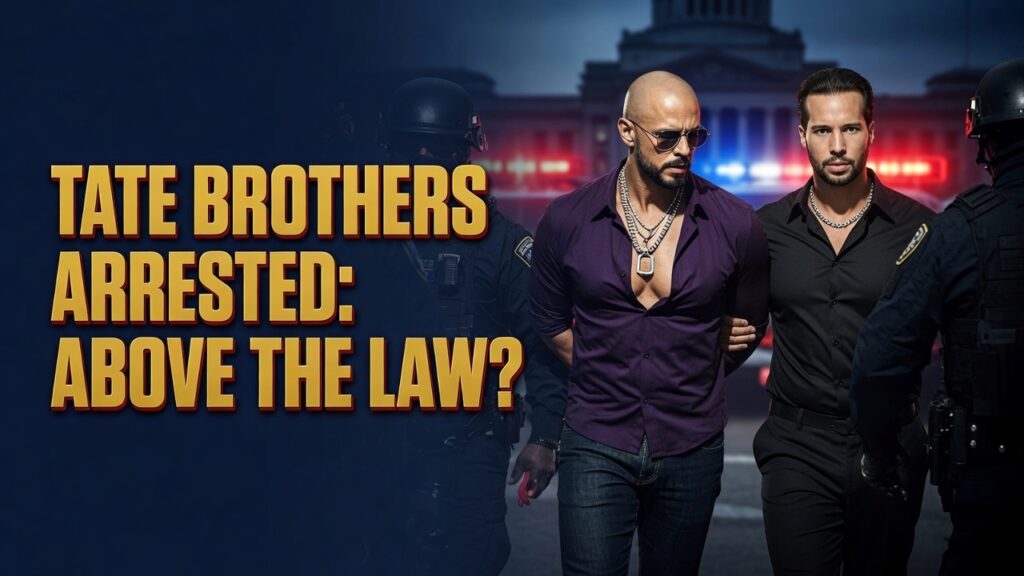
As a British extradition request lands the influencer brothers back in federal custody, Americans are asking: does the legal system still work regardless of fame — or does it just work slowly?
Tate brothers arrested. Two words. One sealed warrant.
For years, critics asked the same question: would the legal system ever catch up to Andrew and Tristan Tate, or would fame and reach keep buying delay? On Saturday, federal marshals in Miami gave a partial answer, taking the brothers into custody on a sealed U.S. warrant tied to a British extradition request alleging rape and sex trafficking between 2010 and 2017 [AP/NPR reporting].
Support Independent Local Journalism
TheTownHall.News is a non-profit reader-supported journalism. Just $5 helps us hire local reporters, investigate important issues, and hold public officials accountable across Alameda County. If you believe our community deserves strong, independent journalism, please consider donating $5 today to support our work.This matters now because it lands amid an unresolved Florida investigation, a stalled Romanian case, and a broader debate over whether wealth and reach can insulate anyone from consequences. The brothers, dual U.S.-U.K. citizens, built an empire partly on defiance of institutions. Saturday’s arrest tests whether that defiance still works.
Why Was This Arrest Different From the Others?
The Tate brothers have faced legal trouble before. Romanian authorities arrested them in December 2022 on allegations they ran a criminal ring that lured women into sexual exploitation. That case stalled amid what prosecutors described as procedural irregularities, and a travel ban was eventually lifted, allowing the brothers to fly to Fort Lauderdale in February 2025.
Saturday’s arrest is different because it did not originate with Florida or Romania. It came from British prosecutors, who announced they are seeking extradition on rape and trafficking charges tied to alleged conduct north of London, where the brothers grew up [AP/NPR reporting]. The U.S. Marshals Service said the brothers were taken into custody on a sealed warrant, a mechanism used to prevent flight risk before an arrest becomes public.
Who Is Really Driving This Case Forward?
If a Romanian case stalls and a Florida probe drags on for over a year, does a foreign extradition request finally force the accountability moment critics have demanded?

That is the pointed question hanging over this weekend’s developments. The Florida Attorney General’s Office opened its own criminal investigation into the brothers in March 2025, directing the Office of Statewide Prosecution to pursue search warrants and subpoenas. More than a year later, that investigation has not produced state charges. It took a British extradition request, not Tallahassee, to put the brothers back in federal custody.
For readers who value limited government paired with real accountability, this is not a contradiction. It’s the system working as designed: separate sovereign jurisdictions pursuing the same allegations through their own lawful channels, rather than one central authority acting alone.
What Happens at Their Court Appearance?
The brothers are expected to appear in Miami federal court early next week, according to a person familiar with the matter [AP/NPR reporting]. That hearing will address whether the sealed warrant holds and whether extradition proceedings move forward under the U.S.-U.K. extradition treaty, which requires American courts to independently evaluate the evidence before handing over an American citizen.
Extradition is not a rubber stamp. A U.S. magistrate judge must find that the alleged conduct would also be a crime under American law and that sufficient evidence supports the request. Andrew Tate’s attorney, Joseph McBride, has signaled the defense will fight the process, calling the British charges “filth and slander” meant to derail defamation suits the brothers filed in the United States.
More than 500 days. That is roughly how long Florida’s own criminal investigation into the brothers had been open, without a single state charge filed, before a British extradition request put them back in custody [Town Hall News calculation based on public record dates]. The question critics are now asking: does that gap reflect careful due diligence, or a domestic system too slow to act on its own evidence?
Support Independent Local Journalism
TheTownHall.News is a non-profit reader-supported journalism. Just $5 helps us hire local reporters, investigate important issues, and hold public officials accountable across Alameda County. If you believe our community deserves strong, independent journalism, please consider donating $5 today to support our work.Key Questions This Case Raises
- Will a U.S. magistrate judge find enough evidence to approve extradition, or will procedural challenges stall this case the way they stalled Romania’s?
- Why did it take a foreign government’s extradition request to produce an arrest, when Florida’s own investigation had been open for more than 500 days?
- If this case moves forward, what precedent does it set for how far a public platform can shield anyone from prosecution?
What Do Supporters of the Tate Brothers Actually Believe?
Is it fair to ask whether this is really about justice, or about silencing an outspoken, politically engaged public figure? Supporters of the Tate brothers make a specific and coherent argument, and it deserves a direct answer rather than dismissal.
Their case rests on three points: the original Romanian charges collapsed under procedural problems, which they say shows overreach rather than solid evidence; the brothers are vocal Trump supporters, and their attorney has framed the British charges as an attempt to derail pending U.S. defamation suits, raising a fair question about timing; and no U.S. jurisdiction, including Florida’s own year-long probe, has yet filed domestic charges.
These points deserve engagement, not dismissal. But the counterarguments matter more. Timing suspicion isn’t evidence of a false charge; British prosecutors answer to their own courts, not Washington. A stalled Romanian case reflects that country’s procedural irregularities, not an exoneration on the underlying allegations. And no state charges in Florida isn’t innocence; it’s an active investigation, not a closed one. The extradition process itself, requiring independent judicial review in a U.S. courtroom, is the safeguard against the political weaponization supporters fear.
Why Are So Many Americans Starting to Ask Harder Questions?
Should a massive online following ever be treated as a shield against the same legal process everyone else faces?
That is the question this case forces into the open. Andrew Tate built an audience of more than 10 million followers on X, even after being banned from YouTube, TikTok, and Instagram for violating hate speech policies [platform enforcement actions, publicly reported]. That reach shaped a narrative in which legal scrutiny was framed by supporters as persecution rather than process.
Saturday’s arrest suggests reach has limits. A sealed federal warrant does not care about follower counts. An extradition treaty between two allied democracies does not bend to a social media following. For readers who believe in equal application of the law regardless of platform or politics, that is precisely the point.
“Should fame and reach ever be enough to outrun a legal system that applies the same rules to everyone else?”
What Does This Mean for Parents and Families?
Beyond the legal mechanics, this case has resonated because of what the brothers built their platform on. Andrew Tate’s content has been widely criticized for messaging that many parents say shaped how their teenage sons talk about women and authority. Whatever the outcome of extradition proceedings, allegations this serious deserve resolution through the courts, not through platform algorithms or online debate.
If the legal system can finally reach a figure this large, this online, and this politically connected, what does that tell every other case still waiting for its day in court?
Is This the Accountability Moment Critics Have Been Waiting For?
Not yet. An arrest is not a conviction, and Andrew and Tristan Tate are entitled to the presumption of innocence and a full defense in an American courtroom. British prosecutors say the charges involve rape and trafficking; the brothers deny all of it. Both statements can be true in the sense that both sides get to make their case, and only a court can resolve which one prevails.
What it does confirm is that the process hasn’t stopped. Three separate legal systems, Romanian, Florida, and now British and federal American, are actively examining the same allegations years after they surfaced. Systems that work slowly are still working, provided they eventually produce an answer.
The Question That Remains
Will a Miami courtroom finally deliver the accountability that Romania, Florida, and years of online argument have failed to produce? Or will procedural fights delay this case the same way they delayed the last one?
The real question isn’t whether the Tate brothers will get their day in court. It’s whether that day will finally settle what years of headlines could not.
Still have questions about how this case develops? Stay informed. Subscribe for daily coverage as the extradition hearing unfolds. Think others need to see how the legal process is actually working here? Share this article. Want your voice heard on accountability and rule of law? Contact your state attorney general’s office or your congressional representative and ask where the Florida investigation into the Tate brothers currently stands.
What do you think? Is the system finally catching up, or is this just the next chapter in a case that never seems to end? Share this and let us know.