Graham-Netanyahu ICC Recordings: What the Tapes on Khan Show
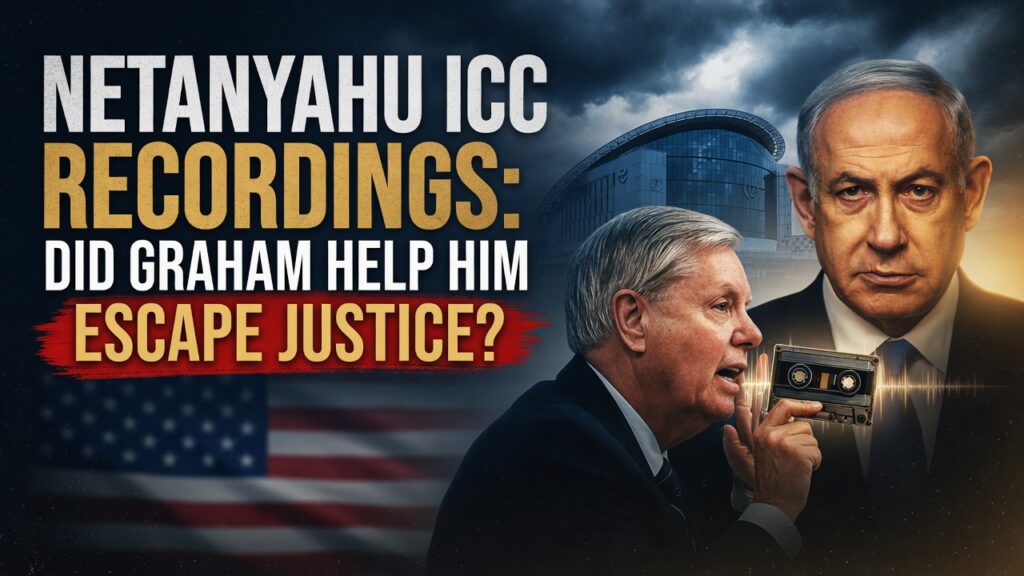
Netanyahu ICC Recordings: Did Graham Help Him Escape Justice?
As newly surfaced documentary footage puts a sitting U.S. senator’s private counsel to a foreign leader on the record, Americans are left asking a simple question: who exactly answers to whom in Washington?
A senator was caught on tape coaching a foreign leader. That single fact should trouble anyone who cares about accountability. The footage, filmed in October 2024 by documentary maker Alex Holder and first reported by The New York Times, captures the late Sen. Lindsey Graham (R-S.C.) advising Israeli Prime Minister Benjamin Netanyahu on how to organize congressional pressure against the International Criminal Court just weeks before the court issued an arrest warrant for Netanyahu over the Gaza war. The timing matters because it lands just days after the ICC removed its chief prosecutor, Karim Khan, from office following a misconduct investigation that the recordings themselves appear to reference.
Support Independent Local Journalism
TheTownHall.News is a non-profit reader-supported journalism. Just $5 helps us hire local reporters, investigate important issues, and hold public officials accountable across Alameda County. If you believe our community deserves strong, independent journalism, please consider donating $5 today to support our work.What Do the Recordings Actually Show?
In the footage, Graham is heard telling Netanyahu he could line up two Democratic senators, Richard Blumenthal of Connecticut and Ben Cardin of Maryland, to sign a bipartisan letter demanding an investigation into then-ICC Chief Prosecutor Karim Khan over sexual misconduct allegations [reported by The New York Times]. Graham instructed Netanyahu to personally call both senators and thank them for their support of Saudi-Israel normalization efforts, calculating that flattery would seal their cooperation. The strategy worked. On November 1, 2024, Blumenthal’s office confirmed both senators had signed the letter, just weeks before ICC judges issued arrest warrants against Netanyahu and then-Defense Minister Yoav Gallant.
A U.S. senator coaching a foreign leader on how to pressure his own Senate colleagues is not a footnote — it’s a story about who Congress actually works for.
Why Does the Timing Raise Questions?

Khan was removed from his ICC post on July 24, 2026, after a nearly two-year investigation into the same misconduct allegations that Graham and Netanyahu discussed using as leverage against him. The recordings do not prove the allegations against Khan were fabricated, and nothing in the footage establishes that the letter alone caused his removal. But the sequence — private coordination to cast doubt on a prosecutor, followed years later by that prosecutor’s actual removal — is the kind of pattern that demands scrutiny rather than assumption in either direction.
“Who exactly is representing whom — and who gets to find out only after the fact?”
Is This Standard Diplomacy or Something More?
Lawmakers routinely intervene on behalf of allies; that is not, by itself, scandalous. The question is whether that intervention crossed from advocacy into orchestrated interference with an international judicial process examining alleged war crimes. Graham was candid on tape about the trade-off, joking that Netanyahu should compensate him for “all this.” Whether that was gallows humor or an acknowledgment of quid pro quo dynamics is exactly the kind of question congressional ethics oversight exists to answer.
The footage itself was never meant for public release. Alex Holder had spent roughly three years filming Graham for a planned documentary on his relationships with Donald Trump and Netanyahu before the project was shelved and the material surfaced through news reporting instead. That origin matters: this wasn’t a leak engineered by a whistleblower inside government, nor an official disclosure through any oversight channel. It was raw access that happened to capture a conversation lawmakers would otherwise have had no obligation to reveal at all.
$0. That’s how much public disclosure Americans got about this arrangement before a documentary crew’s footage surfaced it two years later — so who else in Congress is doing the same thing, unrecorded?
Support Independent Local Journalism
TheTownHall.News is a non-profit reader-supported journalism. Just $5 helps us hire local reporters, investigate important issues, and hold public officials accountable across Alameda County. If you believe our community deserves strong, independent journalism, please consider donating $5 today to support our work.Who Is Actually Accountable Here?
Congress has legitimate oversight authority over foreign policy, and senators are entitled to advocate for allies. But that authority comes with an obligation of transparency to the voters those senators represent. If a senator can privately script pressure campaigns against international courts on behalf of a foreign government, shouldn’t the public know before the cameras happen to catch it? No formal ethics inquiry into Graham’s conduct has been announced, and because he died before the footage surfaced, any congressional accountability process now falls to how the Senate chooses to review the matter going forward — not to him personally.
What Do Supporters of This Approach Actually Believe?
Defenders of Graham’s approach make a coherent argument: Israel is a close American ally facing an ICC process that Washington itself has criticized as politically compromised, and lawmakers are within their rights to defend an ally’s interests using ordinary political tools like letters and phone calls. Secretary of State Marco Rubio has publicly said the administration intends to challenge the ICC’s authority directly, reflecting a broader bipartisan skepticism in Washington toward the court’s jurisdiction over non-member states. From this view, Graham wasn’t undermining justice — he was pushing back against an international body many in Congress view as overreaching.
That argument has real force when it comes to disagreeing with the ICC’s jurisdiction on the merits. It has far less force when the tool of choice is a private, coordinated effort to discredit the individual prosecutor running the case, timed to a formal misconduct process, rather than an open legislative debate about the court’s authority. Advocacy conducted in public, through hearings, floor speeches, or formal legislation, is accountable to voters. Advocacy scripted in a private call, that surfaces only because a documentary crew happened to be rolling, is not — and the distinction is the whole point of this story.
It is also worth stating plainly what the recordings do not show. They do not establish that the sexual misconduct allegations against Karim Khan were themselves invented or coordinated by Graham and Netanyahu; those allegations were investigated separately over nearly two years before the ICC’s own oversight body acted. What the tape documents is a strategy to amplify and exploit an existing controversy for political leverage — a distinction that matters for anyone tempted to read this story as proof of a broader plot rather than as evidence of a specific, documented lobbying effort.
Are Our Institutions Even Built to Catch This?
Congressional ethics rules were not designed with informal, off-the-record coaching sessions in mind, and that is precisely the gap this episode exposes. If it takes an independent filmmaker’s unreleased footage to surface how a senator maneuvers on behalf of a foreign leader, the existing disclosure framework isn’t doing its job. That’s not a partisan complaint; it applies equally to any senator, of either party, doing the same thing for any foreign government.
Would this story have ever surfaced without a documentary crew that happened to be filming? That question alone should worry anyone who believes oversight shouldn’t depend on luck.
What Happens Next?
The Senate returns from its August recess to a stack of unresolved business, and this episode is unlikely to top that list unless voters and watchdog groups push it there. South Carolina’s special primary to fill Graham’s seat is scheduled for August 11, which means his successor will inherit a seat now tied, fairly or not, to this story. Whoever takes it should expect to be asked where they stand on congressional transparency in foreign policy dealings.
The real question isn’t whether senators should ever advocate for allies — it’s whether they should be allowed to do it in the dark. Accountability only works when the public can see the deal being made, not just the vote at the end of it.
Key Questions
- Did this private pressure campaign influence Khan’s eventual removal, or is the timing coincidental?
- What disclosure rules, if any, should govern a senator’s private communications with foreign heads of state?
- Should the Senate open a formal review of the conduct these recordings document, even posthumously?
Still have questions about how your representatives conduct foreign policy on your behalf? Stay informed — subscribe for daily accountability coverage. Think others need to see this? Share the article. Want your voice to count? Contact your senators and ask whether they support formal disclosure requirements for lawmaker communications with foreign officials regarding international legal proceedings.