Is the SPLC Indictment Finally Headed to Trial This Fall?
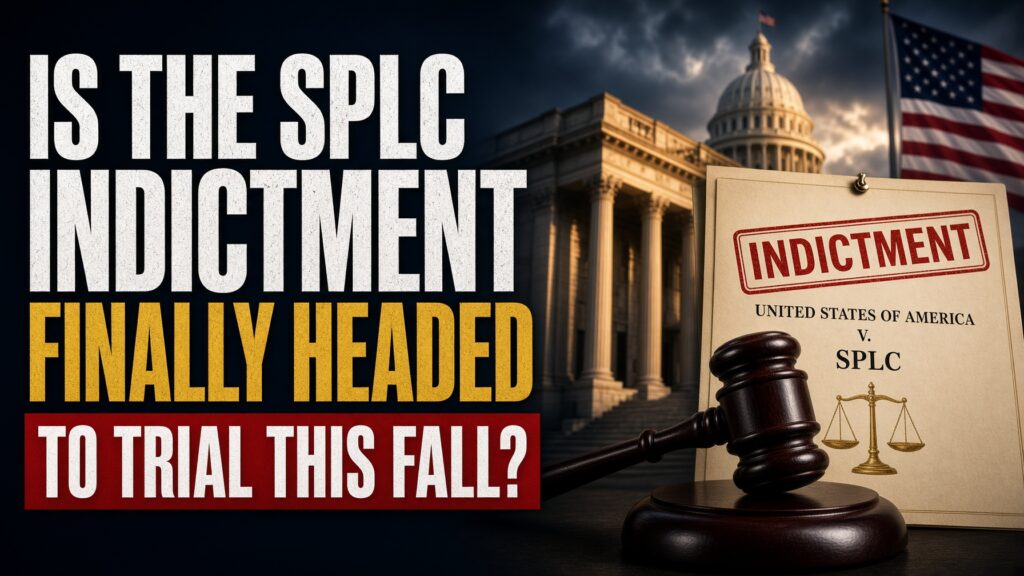
As a federal judge refuses to let the Southern Poverty Law Center walk away from its own indictment, millions of donors are asking a simple question: who was really funding whom?
A federal judge just said no. That single ruling may decide whether one of America’s most powerful advocacy nonprofits ever answers for its donors’ money in open court.
The decision landed on August 7, when U.S. District Judge Emily C. Marks rejected the Southern Poverty Law Center’s bid to dismiss its own criminal indictment. The SPLC had argued the case was political payback. The judge disagreed, and now a trial date in October is standing.
What Did the Grand Jury Actually Charge?
The numbers are specific, and they are serious. A federal grand jury in the Middle District of Alabama returned an 11-count indictment against the SPLC in April, charging six counts of wire fraud, four counts of making false statements to a federally insured bank, and one count of conspiracy to commit concealment money laundering [federal DOJ press release, USAO Middle District of Alabama].
Prosecutors say the SPLC opened bank accounts tied to a series of fictitious entities to move donor money without donors ever knowing where it went. In June, the Justice Department obtained a superseding indictment that kept the same 11 counts but added new detail drawn from the organization’s own tax filings [CBS News].
If a nonprofit built its brand on fighting hate, should it get a pass for allegedly funding it?
The SPLC has pleaded not guilty on every count and calls the prosecution politically motivated.
Why Did the Judge Just Reject SPLC’s Dismissal Bid?
This is the part of the story most Americans have not heard yet. The SPLC’s lawyers asked Judge Marks to throw out the case entirely, arguing it was a vindictive prosecution ordered by the administration because of the organization’s criticism of the president and its “Hate Map” project [States United Democracy Center].
Judge Marks was not persuaded. In her August 7 order, she wrote that the SPLC had failed to offer evidence of prosecutorial animus and that federal courts are not the proper forum for airing political grievances [court reporting, The Blaze/RedState]. She also denied the organization’s request for discovery into the government’s motives, keeping the Justice Department’s internal deliberations sealed for now.
That order matters far beyond one nonprofit’s legal strategy. It sets a marker for how far advocacy groups can go in trying to reframe a criminal fraud case as a political conspiracy.
Support Independent Local Journalism
TheTownHall.News is a non-profit reader-supported journalism. Just $5 helps us hire local reporters, investigate important issues, and hold public officials accountable across Alameda County. If you believe our community deserves strong, independent journalism, please consider donating $5 today to support our work.Where Did the Donor Money Actually Go?
According to the indictment, the SPLC ran a covert informant program dating back to the 1980s, paying individuals affiliated with violent extremist groups, including a former Ku Klux Klan Imperial Wizard, for information [DOJ press release]. Prosecutors allege that between 2014 and 2023, more than $3 million in donor funds moved through shell accounts to people connected to those same groups.
$3 million. The question the SPLC has yet to fully answer in court: how much of that reached people it publicly claimed to be fighting?
FBI Director Kash Patel told reporters the organization set up shell companies around the country specifically to keep banks from tracing the money back to the SPLC itself [Alabama Reflector]. Acting Attorney General Todd Blanche put it more bluntly, saying the organization was manufacturing the extremism it purports to expose by paying sources to stoke racial hatred [Alabama Reflector].
“The SPLC is manufacturing racism to justify its existence.”
That is not a talking point from a cable news panel. That is the sitting Acting Attorney General of the United States, describing a 55-year-old civil rights institution under federal indictment.
Who Is Really Accountable for This Kind of Nonprofit Spending?
This case is not really about one organization’s informant program. It is about whether any nonprofit, regardless of its politics, gets to operate outside the transparency donors are entitled to expect.
Should donors have the right to know exactly who their money funds, even when the recipients are the extremists the charity claims to oppose? That question does not disappear no matter which side wins in October.
The SPLC has raised hundreds of millions of dollars over decades on the promise that it dismantles hate groups. If prosecutors prove even part of what they allege, the case becomes a warning for every large advocacy nonprofit operating with minimal outside oversight.
What Do Supporters of This Policy Actually Believe?
SPLC’s defenders make a genuine argument worth engaging honestly: is it fair to prosecute an organization for running informants the same way the FBI itself does? SPLC’s attorneys say the informant program prevented violence, stopped criminal activity, and fed intelligence to law enforcement for decades, including information shared ahead of the 2017 Charlottesville rally [NBC News].
That argument deserves a direct answer. Running informants is not, on its own, illegal, and civil rights organizations have used similar tactics for decades. But the indictment does not charge the SPLC for having informants. It charges the organization with allegedly hiding those payments from donors and banks through fictitious entities, and allegedly telling supporters their money was fighting extremism while some of it allegedly reached extremists directly.
Whistleblower allegations, cited in a May letter from House Judiciary Democrats, claim DOJ leadership pressured Alabama prosecutors to move quickly despite internal concerns [MS NOW]. That is a legitimate oversight question, and it deserves scrutiny separate from the underlying fraud allegations. Political pressure on a prosecution and the strength of a fraud case are not the same question, and Judge Marks’s ruling suggests the evidentiary record, so far, has not shown the vindictiveness SPLC alleges.

What Happens Next?
Barring further motions or a plea agreement, the case moves to an October trial in Montgomery, the same city where the SPLC first built its national reputation by bankrupting the United Klans of America in 1987 [Yellowhammer News]. The Justice Department has also filed forfeiture actions seeking to recover the alleged proceeds of the fraud.
An indictment is an allegation, not a conviction, and the SPLC remains presumed innocent unless proven guilty. But with a federal judge now declining to dismiss the case and a trial date holding firm, the SPLC’s legal options are narrowing.
Key Questions This Case Still Needs to Answer:
- Did SPLC donors know their contributions were reaching people affiliated with the extremist groups the organization publicly opposed?
- Was the Justice Department’s decision to prosecute driven by evidence of fraud, by politics, or by both?
- If a major civil rights nonprofit is found to have deceived its own donors, what oversight should apply to advocacy organizations going forward?
Is This the Accountability Moment Donors Have Been Waiting For?
Whatever the outcome in October, this case will not be the last word on nonprofit accountability. It may be the first real test of how far a well-funded advocacy organization can go before federal fraud law catches up with it.
The real question isn’t whether the SPLC broke the law, it’s whether donors ever get a straight answer.
Still have questions about how this case unfolds? Stay informed — subscribe for daily coverage.
Think your neighbors need to see this? Share the article.
Want your voice to count? Contact your member of Congress and ask whether nonprofit donor-disclosure rules need reform.