Supreme Court Mail Ballot Ruling: What It Actually Allows?
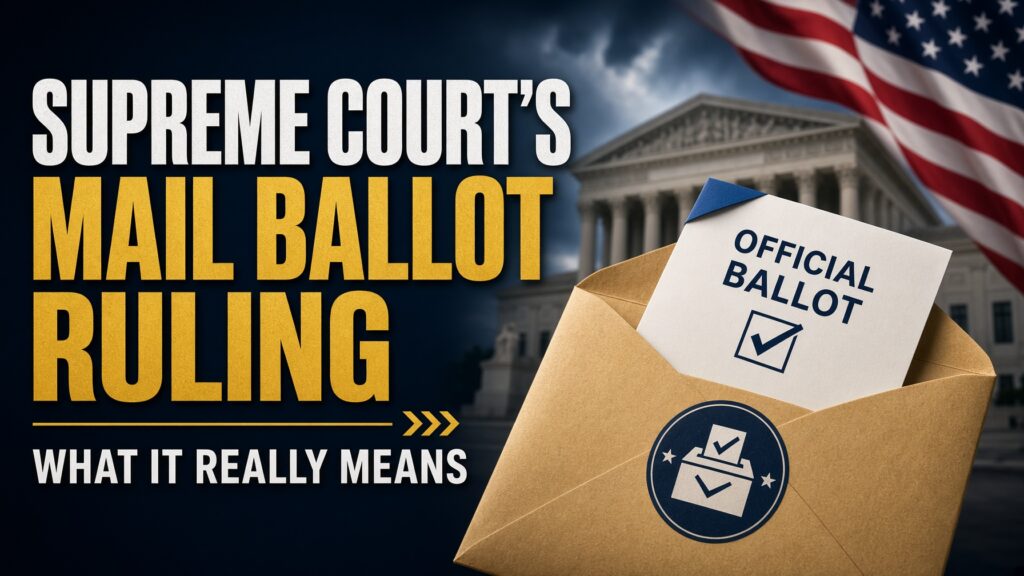
As the Supreme Court clears the way for parts of President Trump’s mail ballot order, Americans are asking a sharper question: is this about election integrity, or just about who gets to decide the rules?
The Supreme Court just handed the White House a win. But is it the win headlines are claiming?
On Monday, the justices ruled 6-3 to lift a lower court injunction that had blocked key parts of President Trump’s March executive order on mail-in voting [wire reporting: AP/CBS/NBC/ABC]. The timing matters. Ballots begin going out to voters in several states in early September, just as the legal fight over how those ballots get verified remains unresolved.
Is This a Final Ruling — Or Just Round One?
The order is not a decision on the merits. The Court itself said as much, noting the administration’s implementation “will necessarily” still face scrutiny — “on that score, time will tell” [Supreme Court order language, reported by NBC News].
What the ruling actually does is narrower than “victory” headlines suggest. The justices found that a coalition of 23 mostly Democratic-led states lacked standing to block the order before federal agencies had even finalized how they would carry it out [reported by NBC News, NPR]. That is a procedural determination, not a constitutional one.
The Supreme Court didn’t say Trump’s mail ballot order is legal. It said the states jumped the gun in trying to stop it.
Support Independent Local Journalism
TheTownHall.News is a non-profit reader-supported journalism. Just $5 helps us hire local reporters, investigate important issues, and hold public officials accountable across Alameda County. If you believe our community deserves strong, independent journalism, please consider donating $5 today to support our work.What Does the Executive Order Actually Require?
President Trump’s order, signed in March, directs the Department of Homeland Security to compile citizenship-based voter lists using federal databases [White House fact sheet]. It also directs the U.S. Postal Service to build a ballot-design and reporting system tied to those lists.
Following the ruling, the Postal Service and Department of Justice signaled they would move to implement the revised rules [reported by Fox News]. The Postal Service’s final rule, issued days before the ruling, lays out required design elements for federal mail ballot envelopes and requires state election officials to submit voter data to a federal portal.
Importantly, the Postal Service has stated it will not itself determine voter eligibility or refuse to transmit ballots from senders not on a state list [Solicitor General John Sauer, reported by ABC News]. That detail complicates the narrative that this ruling immediately blocks any ballots from reaching voters.
Who Is Really Deciding How Elections Are Run?
That’s the constitutional question underneath all of this. States and Congress, not the executive branch, have historically held authority over how federal elections are administered. The Trump administration argues federal coordination is necessary to prevent noncitizen voting and secure the integrity of the mail ballot process.
Critics counter that consolidating voter data under federal agencies shifts control away from the states that run elections day to day. That tension — between federal oversight and state authority — is exactly what the underlying lawsuit is about, and this ruling did not resolve it.
“This internal directive does not regulate the States’ voter registration processes.” — from the Supreme Court’s unsigned order
What Do the Numbers Actually Tell Us?
- That’s how many states, plus Washington, D.C., sued to block the executive order before it could take effect. The question those states now have to answer: what happens when the next legal challenge arrives after implementation, not before it?
Is the Most Controversial Piece of the Order Even in Effect Yet?
No — and this is the detail missing from most viral social posts about the ruling. The provision requiring USPS to actually verify voter eligibility and withhold ballots from anyone not on a government-approved list remains blocked in a separate, ongoing legal case [reported by ABC News]. Monday’s ruling cleared the way for DHS list-compilation, ballot-design rulemaking, and prioritized enforcement against state officials who issue ballots to ineligible voters — but not the eligibility-verification piece itself.
A separate federal judge has also blocked a related proof-of-citizenship requirement tied to the same executive order, in a case brought by the DNC, LULAC, and the League of Women Voters [federal court filing, reported via Yahoo News/Reuters]. In other words: this fight is happening on multiple fronts at once, and Monday’s ruling settled only one piece of it.
Should voters trust a patchwork of court rulings to protect their ballot before a midterm election just weeks away?
What Do Supporters of This Policy Actually Believe?
Supporters of the executive order argue the federal government has a legitimate interest in making sure only eligible, verified voters receive ballots — and that mail voting, expanded dramatically since 2020, has outpaced the safeguards meant to secure it. They point to the sheer scale of mail balloting nationwide as reason enough for stronger federal coordination on voter list accuracy.
That argument has real weight. Voter rolls are notoriously difficult for states to keep current as people move, die, or become ineligible. A single, federally coordinated citizenship check could, in theory, reduce errors that individual state systems miss.
But critics raise a fair rebuttal: research has consistently found noncitizen voting in federal elections to be exceptionally rare, and voting rights groups argue a national list would become outdated almost as quickly as state lists are today [voting rights groups, reported by Axios]. The debate isn’t whether election integrity matters — both sides agree it does. It’s whether federal control over ballot lists is the right tool, or whether it shifts power away from the states the Constitution assigns that responsibility to.

Why Does This Matter for California Voters Specifically?
California’s universal mail-in voting system means any federal rule change to ballot design, verification data, or postal handling touches millions of voters here directly. Alameda County and other California jurisdictions have already faced scrutiny over ballot handling transparency in recent election cycles. A federal rule reshaping how ballots are coded and reported adds another layer state election officials will have to navigate — with implementation timelines now compressed by the September ballot mailing date.
If federal rules and state election systems are on a collision course weeks before ballots go out, who is actually accountable when something goes wrong?
Key Questions This Ruling Raises
- Will the Supreme Court eventually rule on the constitutional merits — and when?
- Can the Postal Service and DHS build the required systems before ballots ship in September without disrupting delivery?
- What happens to voters in the 23 states that sued if a future ruling reverses course after ballots are already in the mail?
Has the Supreme Court Actually Settled Anything?
Not really — and that’s the uncomfortable truth beneath the celebratory headlines. What it settled is a procedural question about timing and standing. What remains unsettled is everything voters actually care about: whether the order is constitutional, whether it will function smoothly under a tight deadline, and whether the states get another chance to challenge it once implementation begins.
The real question isn’t whether the Supreme Court sided with the administration on Monday — it did. It’s whether “sided with” and “settled the issue” mean the same thing here. They don’t.
What do you think — should courts weigh policy disputes like this before implementation, or only after real-world harm can be shown? Share this article and let us know.
Still have questions about how this affects your ballot this fall? Subscribe to The Town Hall News for ongoing coverage as this case develops. Want your voice heard directly? Contact your state’s Secretary of State office to ask how your state is responding to the ruling.