Trump Administration Plans 200,000 Asylum Visa Revocations: What to Know
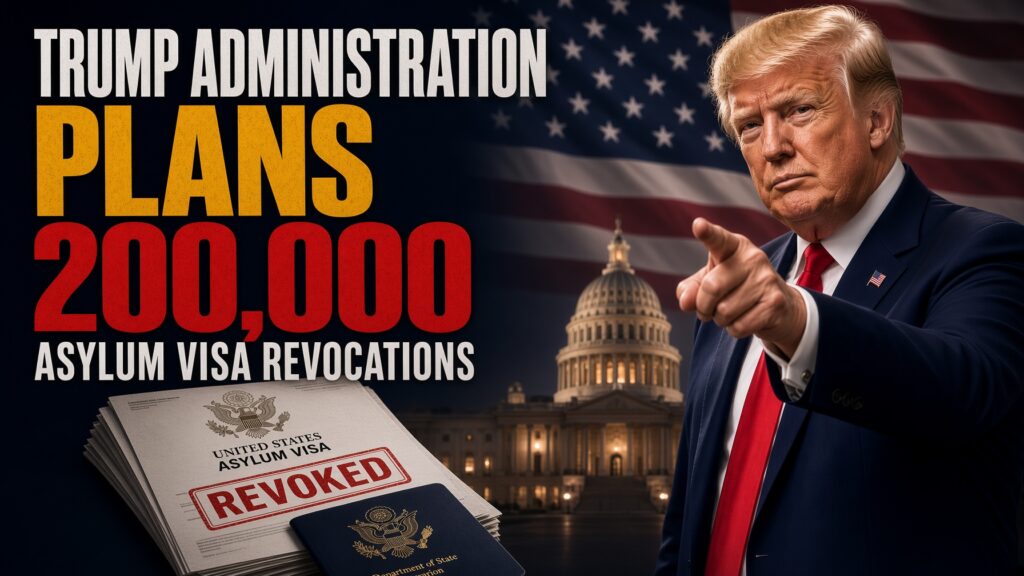
As the State Department moves to cancel up to 200,000 business and tourism visas tied to asylum claims, Americans are asking a simple question: who has been enforcing the rules, and why did it take this long?
Two hundred thousand visas. That is the number the federal government is now preparing to erase. The Trump administration confirmed this week that it is coordinating with the Department of Homeland Security to revoke B1 and B2 visas issued between 2016 and 2026 to foreigners who later filed for asylum, according to internal documents and officials cited by the Associated Press.
Why does this matter right now? Because it would be the single largest mass visa revocation in American history, and it strikes directly at a loophole immigration hawks have complained about for years: travelers entering the country as short-term visitors, then filing for asylum once inside to remain indefinitely.
Support Independent Local Journalism
TheTownHall.News is a non-profit reader-supported journalism. Just $5 helps us hire local reporters, investigate important issues, and hold public officials accountable across Alameda County. If you believe our community deserves strong, independent journalism, please consider donating $5 today to support our work.What Exactly Is the Government Doing?
The plan targets nonimmigrant visas, not asylum claims themselves. B1 visas cover business travel; B2 visas cover tourism, family visits, and medical care. Applicants for both are required to demonstrate an intent to return home. When someone instead files for asylum after arriving, the administration argues, that original promise was broken.
State Department spokesman Tommy Pigott framed the effort plainly: officials are working with DHS “to identify and revoke the nonimmigrant visas of foreigners who have come to the United States claiming to be short-term visitors, but then file for asylum to stay here permanently.” He would not commit to a final number, saying revocations “will be done on a rolling basis” as the process continues. [government source: State Department]
Revocation does not mean automatic deportation. Officials have clarified that affected individuals would lose their status as business or tourism travelers, but pending asylum cases continue moving through the system. That distinction matters, and any accurate account of this story has to include it.
Who Is Really Paying for This Loophole?
Every visa issued under a false premise is a promise broken to the American taxpayer — so why is anyone surprised enforcement finally caught up?

For years, immigration authorities have processed asylum claims filed by people who entered on visas explicitly meant for short visits. Each case requires court time, agency staffing, and years of federal resources before a claim is resolved one way or the other. Backlogs in immigration courts have stretched into years, a burden shouldered by the public regardless of how any individual case is eventually decided.
This is not a new concern. It has been a known enforcement gap for years, one both parties have acknowledged without producing a fix. What is new is the scale of this response.
What Do the Numbers Actually Tell Us?
175,000. That is roughly how many visas the State Department says it has revoked since President Trump returned to office in January 2026, for reasons ranging from criminal convictions to national security concerns. [federal data: State Department] The question critics and supporters alike should be asking: does adding 200,000 more, specifically tied to asylum filings, represent a targeted fix to a documented loophole, or a blunt instrument that risks catching people with legitimate claims in its net?
Separately, roughly 80,000 non-immigrant visas were revoked this year for offenses including DUIs, assault, and theft, according to a senior State Department official. Those figures sit outside this new action, but they show an administration treating visa enforcement as an ongoing priority, not a one-time gesture.
Is This the Rule of Law Working — or Overreach?
Supporters of stronger immigration enforcement have long argued that visa categories mean nothing if they are not actually enforced. A tourist visa that quietly becomes a permanent pathway undermines the integrity of every visa category and every consular officer who approves an application in good faith. From that view, this action is not punitive. It is corrective.
Support Independent Local Journalism
TheTownHall.News is a non-profit reader-supported journalism. Just $5 helps us hire local reporters, investigate important issues, and hold public officials accountable across Alameda County. If you believe our community deserves strong, independent journalism, please consider donating $5 today to support our work.Christopher Landau, a senior State Department official, said publicly that asylum should not be used to bypass immigration law. That is the administration’s central argument: the visa system depends on applicants telling the truth about their intentions.
Critics counter that seeking asylum after arrival is not inherently fraudulent. U.S. law allows individuals already inside the country to file asylum claims regardless of the visa category they entered under, since circumstances at home can change after a visitor has already left.
What Do Supporters of This Policy Actually Believe?
Do defenders of stronger enforcement actually believe every asylum filer is gaming the system? Not quite — but they believe the current structure makes it too easy for bad-faith actors to exploit a process meant for the truly persecuted, and that the honest majority of applicants deserve a system that can tell the difference.
The administration’s position rests on a narrower claim: that visa categories carry legal obligations, and a pattern of conversions at scale justifies a systematic review rather than case-by-case guesswork. Officials have not claimed every one of the 200,000 filings is fraudulent — the stated goal is enforcement of existing rules, not a blanket judgment on motives.
That distinction is worth testing in court, where legal challenges are all but certain. Due process protections for asylum seekers are well established, and a revocation process that sweeps too broadly, or too fast, will likely face immediate litigation.
Is a visa system that no one enforces really a system of laws at all — or just a suggestion?
What Happens If No One Follows Through?
If a visa promise can be broken without consequence, what exactly does “nonimmigrant visa” mean anymore?
This is the deeper question beneath the headline number. Enforcement gaps do not stay static. When a loophole goes unaddressed for years, it does not just persist — it becomes an incentive, one that shapes how future applicants and visa officers behave.
If this rolling revocation effort proceeds as described, it becomes a clear test of whether the administration can translate stated priorities into durable, court-tested policy. If it stalls in litigation, as previous immigration actions have, the loophole remains exactly where it started.
Are Our Institutions Still Capable of Enforcing Their Own Rules?
Two hundred thousand visas are on the line — and the courts, not Congress, may decide whether enforcement actually happens.
A federal judge already struck down a separate Trump administration visa-suspension policy affecting dozens of countries just days before this announcement — a reminder that ambitious enforcement actions do not automatically survive judicial review. The administration will need to show its process is individualized enough to withstand scrutiny while still pursuing accountability at scale.
For readers who care about limited government functioning as intended, the tension is real. Enforcing existing law is not the same as expanding government power — but a rolling revocation executed without transparency about individual case review invites exactly the judicial pushback that slows enforcement down.
Key Questions This Story Raises
- Will the State Department release case-by-case justification for each revocation, or act on the full 200,000 as a single administrative sweep?
- How will courts weigh due process protections for pending asylum claims against the government’s enforcement authority over nonimmigrant visas?
- Does this action address the underlying loophole, or simply delay resolution for hundreds of thousands of pending cases already backlogged in immigration courts?
What Do You Take Away From This?
The real question is not whether the government has the authority to revoke a visa obtained under false pretenses. It clearly does. The real question is whether an enforcement action this large, moving this fast, can be executed fairly enough to survive the legal challenges already forming — and whether it actually fixes the loophole, or just delays the reckoning.
Is this the accountability moment years of enforcement gaps have been building toward, or the opening chapter of another prolonged court fight? Either way, the answer will shape how the next asylum applicant, and the next visa officer, understand what a promise to the United States government is actually worth.
Still have questions about how this story develops? Stay informed — subscribe to The Town Hall News for daily coverage. Think others need to see this? Share the article. Want your voice heard on immigration enforcement? Contact your member of Congress and ask where they stand on closing the visa-to-asylum loophole before the next filing deadline.