Trump NATO Withdrawal Threat: What Congress Actually Allows
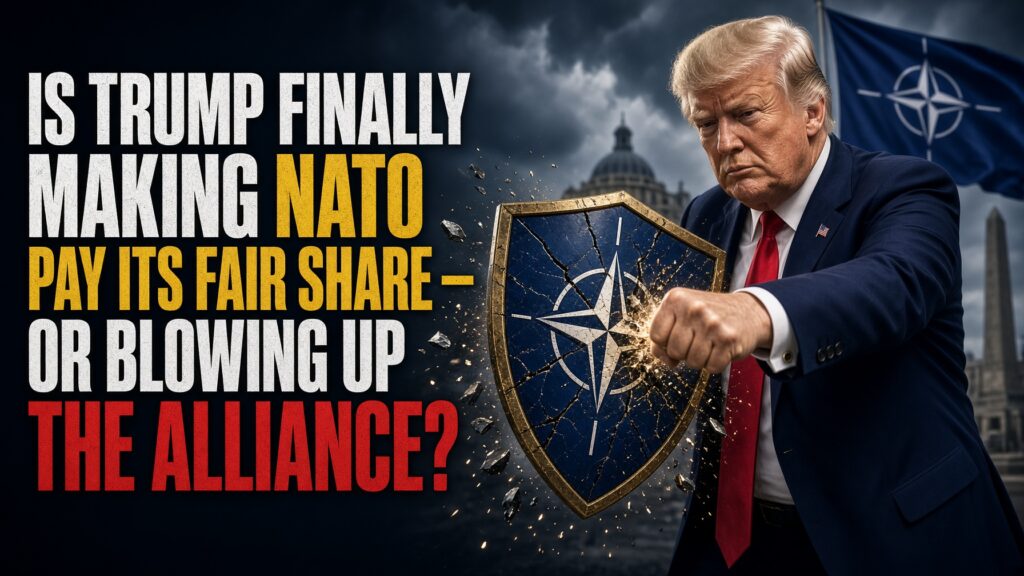
As Trump calls NATO a “one-way street” and threatens to walk away entirely, Americans are left asking who has really been paying for Europe’s defense — and whether Congress will let any president make that decision alone.
Trump says NATO “failed” a test. He isn’t backing down from that claim.
The dispute erupted after European allies declined to join the U.S. and Israel’s military campaign against Iran earlier this year. Countries including Spain and Italy restricted U.S. access to bases and airspace, and Poland declined to send Patriot air defense systems to the region. That refusal reopened a decades-old American grievance: that NATO has functioned as a one-way commitment, with U.S. taxpayers footing a disproportionate share of Europe’s defense while allies get a say in whether America’s own wars get support.
Support Independent Local Journalism
TheTownHall.News is a non-profit reader-supported journalism. Just $5 helps us hire local reporters, investigate important issues, and hold public officials accountable across Alameda County. If you believe our community deserves strong, independent journalism, please consider donating $5 today to support our work.What Exactly Has Trump Said About Leaving NATO?
Trump has not signed any order or filed any formal withdrawal notice. What he has done is escalate his rhetoric sharply. He told The Telegraph that U.S. membership in NATO was “beyond reconsideration,” and told Reuters separately that he was “absolutely” considering a full withdrawal. White House Press Secretary Karoline Leavitt delivered the administration’s sharpest line yet, saying NATO allies “were tested, and they failed,” and adding that it was “sad” the alliance “turned their backs on the American people” after decades of U.S. funding.
That is forceful language from a sitting president about a 77-year-old alliance. It is not, as some corners of social media have claimed, an announcement that the U.S. has left NATO. No such action has occurred.
Why Is Trump Threatening This Now?
The immediate trigger was the Iran war. When the U.S. asked NATO allies to contribute forces or open bases in support of the campaign, most declined, offering only defensive assistance. Secretary of State Marco Rubio has been blunt about what that refusal means for Washington’s calculus, saying that if the U.S. can’t use NATO bases when it needs them, the arrangement isn’t “a very good arrangement” and will have to be reexamined once the conflict ends.
If an ally won’t lift a finger when America asks for help, why should American taxpayers keep footing the bill for that ally’s defense? That is the plain question underneath the diplomatic language, and it’s one that resonates well beyond this administration. Presidents from both parties have complained for years that too many NATO members failed to meet the alliance’s own defense-spending targets while relying on the U.S. military umbrella.

Can a President Actually Pull the U.S. Out of NATO Alone?
No — and this is the part of the story that matters most for anyone worried about executive overreach. Congress passed a law in 2023, specifically anticipating this scenario, that requires either a two-thirds Senate vote or an act of Congress before any president can unilaterally withdraw the United States from NATO. Senate Minority Leader Chuck Schumer has already stated flatly that the Senate “will not vote to leave NATO,” and Republican Senator Thom Tillis, who leads the bipartisan Senate NATO Observer Group, called it “factually not true” that Trump can withdraw without Congress.
That’s a meaningful constitutional check, and it should reassure anyone concerned about a single executive branch officeholder unilaterally reshaping a 32-nation military alliance. But experts note the law only prevents a formal exit — it doesn’t require the president to fund NATO operations, staff key command posts, or show up to summits.
Is a law that stops a formal exit really a safeguard if a president can hollow out the alliance from the inside anyway?
What Could Trump Actually Do Without Congress?
This is where the story gets more concrete, and more consequential, than a simple yes-or-no on withdrawal. The Wall Street Journal reported that the administration is weighing a plan to relocate some of the roughly 84,000 American troops currently stationed in Europe out of countries it considers unhelpful — reportedly including Spain and Germany — and toward nations seen as more supportive, such as Poland, Lithuania, Romania, and Greece.
A former Pentagon official who oversaw NATO policy, Jim Townsend, said Trump could also simply “downgrade” U.S. participation — skipping summits, declining to staff the traditionally American-held post of Supreme Allied Commander Europe, or having the defense secretary skip ministerial meetings. Senator Jack Reed acknowledged that while Congress has blocked a formal withdrawal, a president grasping “many different levers” could still diminish America’s role “significantly.”
84,000. That’s how many American troops are currently stationed across Europe under NATO’s umbrella — the question no ally wants answered is how many of them Washington keeps paying to protect countries that won’t reciprocate.
Support Independent Local Journalism
TheTownHall.News is a non-profit reader-supported journalism. Just $5 helps us hire local reporters, investigate important issues, and hold public officials accountable across Alameda County. If you believe our community deserves strong, independent journalism, please consider donating $5 today to support our work.Who Is Actually Watching Out for Taxpayers Here?
For fiscal conservatives, this fight isn’t really about anyone’s loyalty to an alliance flag. It’s about accountability for how tens of billions of dollars in annual U.S. defense commitments get allocated, and whether that spending buys actual reciprocity or just goodwill photo ops at summits. NATO members formally agreed in 2025 to accelerate their own defense-spending timelines under pressure from the Trump administration — a real, verifiable concession that came before this latest flare-up over Iran.
An alliance built on shared defense shouldn’t require America to ask twice when it’s the one asking for help. That’s a fair standard, and it’s one NATO’s own leadership has struggled to publicly rebut. NATO Secretary-General Mark Rutte, after meeting with Trump, described the encounter as “frank and open” and acknowledged the president’s “disappointment,” while insisting European allies had offered logistics and base access support even if they stopped short of combat participation.
What Do Defenders of NATO Actually Believe?
NATO’s defenders make an argument worth taking seriously rather than dismissing as reflexive establishment thinking. They argue the alliance has directly served U.S. interests for nearly eight decades, deterring Russian aggression in Europe without American soldiers fighting a land war there, and that European bases and intelligence-sharing arrangements have supported American operations well beyond Europe’s borders. They also point out that NATO allies formally invoked Article 5 only once in the alliance’s history — in support of the United States after September 11th.
That history is real, and it deserves acknowledgment. But it doesn’t answer the specific complaint at the center of this dispute: whether an alliance built on mutual defense obligations can survive if support only flows in one direction when Washington actually asks for it. Both things can be true — NATO has real, historical value to U.S. security, and it can still be functioning as an unbalanced arrangement that needs correction, not preservation at any cost.
Is This Really About NATO, or About Who Controls Foreign Policy?
Strip away the alliance politics, and the deeper question is about the separation of powers itself. Congress built a legal guardrail in 2023 specifically to stop unilateral treaty withdrawal. That guardrail is holding. What it cannot stop is a president using perfectly legal tools — troop deployments, budget priorities, diplomatic attendance — to reshape America’s posture without ever needing a vote.
Key Questions This Story Raises:
- If NATO allies won’t support American military action when asked, what obligation does the U.S. have to keep funding their defense at current levels?
- Does the 2023 law meaningfully constrain a president’s ability to weaken NATO, or does it only block the most extreme, formal version of withdrawal?
- Should Congress hold hearings on troop-relocation plans that could reshape U.S. military posture in Europe without a formal vote?
So is Trump finally forcing a decades-overdue reckoning on burden-sharing, or setting in motion a fracture that leaves America’s oldest alliance permanently weakened? The honest answer is that both outcomes are still on the table. The real question isn’t whether NATO allies felt the pressure — it’s whether Washington uses this moment to demand real reciprocity, or simply lets the relationship erode by inertia.
Still have questions about where this standoff is headed? Stay informed — subscribe for daily coverage of foreign policy and government accountability. Think others need to see what’s actually happening here? Share this article. Want your voice to count? Contact your member of Congress and ask whether they support requiring a public accounting of NATO troop-relocation plans before any changes take effect.