Berkeley Homeless Camp Ruling: What the New Order Actually Does
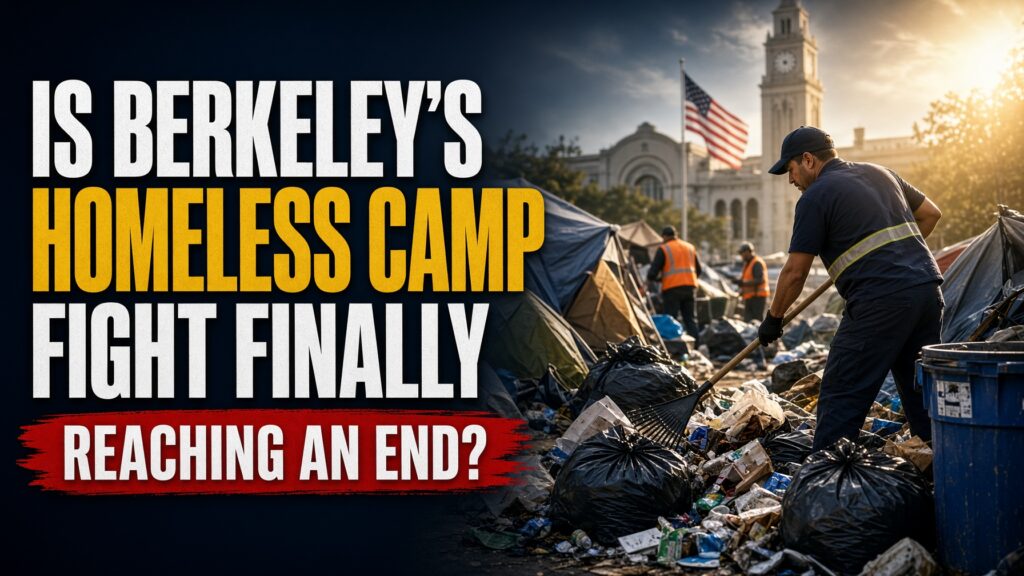
A fire marshal called it a hazard. Public health officials linked it to a disease outbreak. Nearly two years and a dozen court orders later, Berkeley is asking: who is actually in charge of this encampment?
Fifty-five fire calls in one year. That’s not a rounding error — it’s a pattern.
The Eighth and Harrison Street encampment in West Berkeley has been the subject of a running legal battle since early 2025, and a viral social media post this week claimed a federal judge had granted the “Berkeley Homeless Union” permanent protection from ever being cleared. That claim overstates what actually happened. The real ruling, issued August 20 by U.S. District Judge Edward Chen, is narrower — and arguably more revealing about how long a declared public health emergency can sit unresolved inside the federal court system.
Support Independent Local Journalism
TheTownHall.News is a non-profit reader-supported journalism. Just $5 helps us hire local reporters, investigate important issues, and hold public officials accountable across Alameda County. If you believe our community deserves strong, independent journalism, please consider donating $5 today to support our work.What Did the City Actually Declare About This Encampment?
Berkeley’s fire marshal formally declared the Eighth and Harrison encampment a fire hazard and a public nuisance in late July, following what city attorneys described in court filings as “multiple nearly catastrophic fires.” The Berkeley Fire Department has responded to 55 calls for service in the corridor so far this year alone.
The health concerns run parallel to the fire concerns. Public health workers found leptospirosis-carrying bacteria in rats at the encampment in January, and the city’s public health officer has said the outbreak will keep spreading unless the rat infestation is addressed directly. Leptospirosis is typically associated with low-income tropical regions, not American cities — its presence here is itself part of the story.
Did a Judge Really Grant Permanent Protection From Clearing?
No. A viral post claimed a judge permanently blocked Berkeley from clearing this camp — the actual ruling lets the city move forward with closure on September 8. Judge Chen’s August 20 order does grant the Berkeley Homeless Union certain permanent protections, but those protections are narrow: vehicles being used as shelter cannot be impounded unless the city first proves they pose a concrete safety threat, and residents with documented disabilities are entitled to individualized accommodations before being displaced.
Those are real, binding legal requirements. They are not a shield against closure itself. The city has already posted notice that the encampment will close on September 8, and Chen’s order lays out the conditions Berkeley must follow to do it lawfully.

How Long Has This Legal Fight Actually Been Going On?
The dispute traces back to a lawsuit the Berkeley Homeless Union filed in February 2025, after the group says the city began intensifying encampment displacement efforts. Since then, the case has produced a temporary restraining order, a preliminary injunction, a 74-page summary judgment order, a demand that city officials personally walk the streets with union representatives to find alternate campsites, and now a permanent injunction — with a jury trial on the broader civil rights claims still scheduled for October.
Eighteen months of litigation over one encampment — and the fire marshal’s hazard declaration is still standing. Berkeley has also filed two separate appeals with the Ninth Circuit Court of Appeals, arguing the union lacks standing to sue and that Chen’s “serial extensions” of earlier injunctions violate binding appellate precedent. Those appeals remain unresolved.
Who Is Actually Accountable While the Clock Keeps Running?
This is where the case moves from a legal curiosity to a genuine accountability question. Berkeley’s own fire marshal and public health officer have identified specific, documented hazards — not vague complaints, but a formal hazard declaration and a confirmed disease-causing bacterium in local rats. City attorneys have said in court that residents nearby report open flames at the camp daily and rats active at night.
Yet the process for resolving even an emergency-level declaration has stretched across years of federal court calendars and three separate lawsuits. If a fire marshal’s hazard declaration and a confirmed disease outbreak aren’t enough to move quickly, what would be? The ADA requirements Chen has enforced are legitimate legal obligations — the city cannot simply disregard disabled residents’ needs. But legitimate legal process and indefinite delay are not the same thing, and Berkeley residents near the corridor have had to accept the difference for going on two years.
Is it accountability when every institution involved insists it is following the rules, and the fire hazard is still there a year later?
- That’s the number of fire department calls to one four-block encampment this year — the question no one has fully answered is how many more it will take before the underlying hazard is actually resolved.
What Do Supporters of the Court’s Approach Actually Believe?
Homeless advocates and disability rights attorneys make an argument worth taking seriously: without court oversight, cities have a documented history of clearing encampments in ways that destroy irreplaceable property, ignore disabled residents’ legitimate needs, and push people into more dangerous, less visible conditions. Under the ADA, agencies must conduct individualized assessments before displacing residents with disabilities — that is federal law, not judicial overreach.
Support Independent Local Journalism
TheTownHall.News is a non-profit reader-supported journalism. Just $5 helps us hire local reporters, investigate important issues, and hold public officials accountable across Alameda County. If you believe our community deserves strong, independent journalism, please consider donating $5 today to support our work.That argument has real legal force. Chen’s rulings have cited specific ADA violations, including a finding that a 3-by-3-foot sidewalk storage limit doesn’t reasonably accommodate residents who need larger equipment. But that does not fully answer why a formally declared fire hazard and an active disease outbreak took a year and a half — and counting — to reach a point where the city can even proceed with closure. Both things can be true: the ADA process was necessary, and the pace of that process has real, documented public health costs attached to it.
What Happens Now That the City Has a Green Light?
Berkeley has posted notice that the Eighth and Harrison encampment will close September 8, operating under Chen’s new framework of vehicle and disability protections. Whether the city fully complies — and whether the Homeless Union agrees it has — will likely determine whether this closure holds or triggers another emergency motion.
The pattern here extends beyond one encampment. Homeless Union organizers say the group represents members living across at least a dozen encampments citywide, meaning the legal framework built in this case will likely shape how Berkeley handles similar closures for years to come.
Key Questions This Story Raises:
- If a fire marshal’s hazard declaration and a confirmed disease outbreak took eighteen months to reach an enforceable closure order, how would Berkeley respond to a genuine emergency?
- Does a legal framework built around one encampment’s litigation now effectively govern how the city handles a dozen others?
- Who bears responsibility if the September 8 closure is delayed again by a new emergency motion?
So is Berkeley’s homeless camp fight finally reaching an end, or is September 8 just the next date on a calendar that keeps getting pushed back? The fire marshal’s hazard declaration hasn’t changed. The disease risk hasn’t changed. The real question is whether anyone will hold Berkeley accountable if it fails to walk the path the court just gave it.
Still have questions about how this case unfolds? Stay informed — subscribe for daily coverage of Berkeley and Alameda County accountability issues. Think your neighbors need to see what’s really in this ruling? Share this article. Want your voice to count? Attend Berkeley’s next city council meeting or contact your councilmember and ask what specific steps the city is taking to meet the September 8 deadline.