
National Popular Vote Compact: Where It Stands After the Midterms
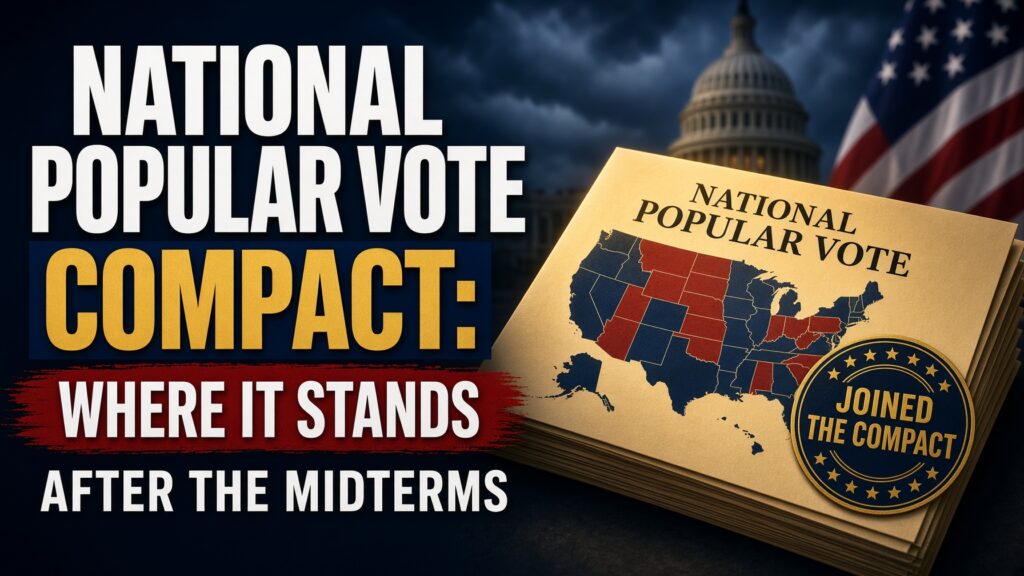
After a sweeping midterm night, five swing states hold the votes that could activate a plan to bypass the Electoral College and the decision would rest with legislators, not voters. Could 48 electoral votes change how America elects its president?
That question is now hanging over statehouses.
Democrats won the governorship and both legislative chambers in Michigan, Nevada, Pennsylvania and Wisconsin on Tuesday, according to the Associated Press, and Arizona may follow [AP via NBC News; Stateline]. None of those states belongs to the National Popular Vote Interstate Compact, a pact that activates only once its members control 270 electoral votes. Together, the five hold the votes it still lacks.
Support Independent Local Journalism
TheTownHall.News is a non-profit reader-supported journalism. Just $5 helps us hire local reporters, investigate important issues, and hold public officials accountable across Alameda County. If you believe our community deserves strong, independent journalism, please consider donating $5 today to support our work.What Did Tuesday’s Election Actually Change?
Control of state government, in the states that matter most. Wisconsin Democrats flipped both legislative chambers and kept the governor’s office, giving them full control for the first time in 16 years [Wisconsin Examiner]. Pennsylvania Democrats flipped the state Senate, their first full control since 1993 [AP via NBC News]. In Michigan they flipped the House, and in Nevada they held the legislature while flipping the governorship [AP via NBC News]. Arizona is less settled. Gov. Katie Hobbs won re-election, and unofficial results show Democrats poised to control the legislature for the first time in 60 years [Stateline, unofficial results]. Those numbers are not final. These are the same battlegrounds that routinely decide presidential races, which is why both parties are watching what lawmakers do next.
How Close Is the Compact to Taking Effect?
Closer than it has ever been. The compact has been enacted by 18 states and the District of Columbia, which together hold 222 of the 270 electoral votes needed [National Popular Vote]. Virginia became the newest member in April. Once active, every member state would award all of its electoral votes to the national popular-vote winner, no matter how its own voters cast ballots. Forty-eight electoral votes now separate the National Popular Vote Compact from activation, and five swing states hold the key. 283. That is the combined total if Arizona, Michigan, Nevada, Pennsylvania and Wisconsin all joined the 222 already committed [arithmetic from National Popular Vote data]. Would voters in those states accept a system that could send their electors to a candidate they voted against? Even without Arizona, the other four add up to 50 votes, enough to cross the line.
Why Isn’t This a Done Deal?
Because winning an election and passing a bill are different things. Michigan Democrats held full control in 2023 and 2024 and never enacted the compact [Axios]. Nevada’s previous Democratic governor vetoed it in 2019, warning it could diminish the state’s role in presidential contests [Nevada Current]. Virginia shows how quickly it can move: Gov. Abigail Spanberger signed the bill in April, making the state the 18th member [NPR]. But reporting reviewed for this article found no public commitment from any incoming governor in the five targeted states to sign it. Time matters, too. Supporters note that the compact must be in place by July 20, 2028 to govern the next presidential race, so lawmakers would need to move in the coming legislative sessions [compact text, per supporters]. Swing-state legislators also face a political calculation: is it wise to give up the attention and influence that come with being a battleground?
Is the Compact Constitutional?
Supporters say yes. Article II, they argue, gives each state broad authority over how it awards electors [NPR]. Critics are not persuaded. Notre Dame law professor Derek Muller has argued the compact could require congressional approval [Axios]. Patrick Valencia, Iowa’s deputy solicitor general, has written that it sidesteps constitutionally required procedures while technically keeping the Electoral College in place [NPR]. Even a supporter expects a fight. A senior consultant to National Popular Vote told NPR that a court challenge is likely if the compact reaches 270 [NPR]. That makes “irrelevant forever” premature. Activation would invite immediate litigation, and a law passed by one legislature can be repealed by a later one.

Is it reform if the easiest path is the one with the fewest checks?
What Do Supporters of the Compact Actually Believe?
They believe the current system leaves most Americans on the sidelines. Alyssa Cass, a strategist for National Popular Vote, argues that four in five Americans live in states that are safely red or safely blue, so their presidential votes carry little weight [NPR]. Polling backs part of the case. Pew found a majority of Americans prefer a popular vote, though the divide is wide: about eight in ten Democrats versus 46% of Republicans, in a survey taken before Trump’s 2024 win [Pew Research Center via NPR]. Some supporters are Republicans. Patrick Rosenstiel, a self-described conservative Republican working with National Popular Vote, rejects the idea that the Electoral College helps the GOP [NPR]. Had the compact been active in 2024, Trump, who won the popular vote, would have collected its member states’ electors [Washington Examiner]. Those arguments deserve a real answer. Equal weight for every vote is a principled goal, not a partisan one. But method matters. A constitutional amendment requires ratification by three-fourths of the states [Article V]. Supporters call the compact an easier lift [WLRN], and that is the concern: easier means fewer checks. Critics also warn that campaigns would concentrate on the largest population centers rather than building coalitions across regions [Washington Examiner]. Supporters call it an easier lift than a constitutional amendment. That is exactly why it deserves harder questions.
What Should Voters Demand Before Their State Signs?
Transparency first. A change of this size deserves full public hearings, recorded votes and a plain statement from every lawmaker. Ask your legislators three things: do you support it, why, and will voters get a direct say where state law allows? Personal responsibility starts with showing up before the vote, not after. This will be settled in statehouses, not in viral clips. Claims that the Electoral College is already finished run ahead of the facts: the compact is not active, the 48-vote gap depends on legislatures that have not yet acted, and the legal questions are unresolved. Voters on every side of this issue are entitled to see that debate held in the open, with the arguments on the table before any bill is signed. If a compact can reroute a state’s electors without a constitutional amendment, shouldn’t voters get a say first? Key Questions This Story Raises:
- Will the new Democratic-led governments in Michigan, Nevada, Pennsylvania, Wisconsin and Arizona take up the compact in 2027, or let the deadline pass?
- Should a change this large be decided by legislators alone, or put directly to voters?
- If the compact reaches 270, can it survive court challenges without congressional consent? So is the Electoral College really doomed, or is this another reform that sounds simple until the details arrive? The math may add up. The public debate is only beginning. The real question isn’t whether the compact can reach 270 — it’s whether voters in those states will be asked before it does. What do you think — should voters get a direct say before their state joins? Share this and let us know. Still have questions? Stay informed — subscribe for daily coverage of elections and accountability. Think others need to see this? Share the article. Want your voice to count? Look up your state senator and representative on your state legislature’s website and ask for their position on the compact, in writing, before the 2027 session begins.