
Migrant Caravan Walks North on a Rumor: Is the Border Open?
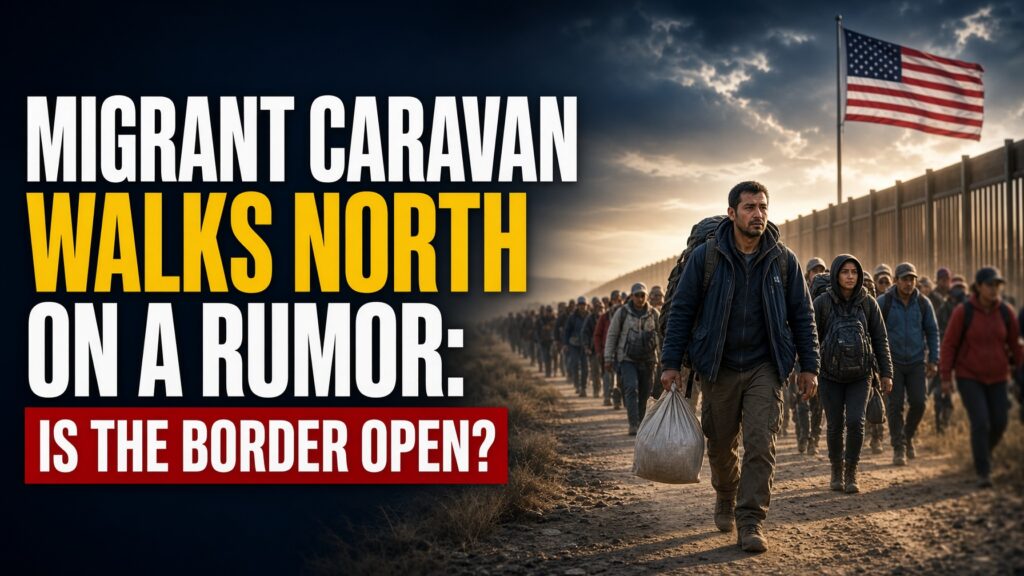
As more than a thousand people march through Mexico on a false hope, millions of Americans are asking: who sent the signal, and who pays when it fails?
Over a thousand people are walking toward a border that is closed. They left Tapachula, Mexico, on Tuesday convinced that last week’s midterm results changed U.S. policy. They did not. On Thursday, President Trump threatened to double tariffs on Mexico immediately unless it stops them, turning a rumor on a southern highway into a trade dispute between neighbors [wire-confirmed: Reuters/AFP via Al Jazeera; TNND].
What Is Driving This Migrant Caravan Right Now?
The caravan, calling itself “God With Us,” left Tapachula on November 10. Reuters-sourced reporting counts more than a thousand people, and a Chiapas state government source put the figure near 1,500, many of them families carrying small children. Most come from Central America, and their first goal is Mexico City, more than 1,000 kilometers away [Reuters/AFP via Al Jazeera]. Their motive is stated openly. Democrats won both chambers of Congress last week, and marchers interviewed by Telemundo said they had heard that a changed Congress means the border must open [Telemundo]. A Nicaraguan man deported from the U.S. months ago told reporters he believes Democrats will help people like him [Reuters/AFP]. That belief is the whole story.
Support Independent Local Journalism
TheTownHall.News is a non-profit reader-supported journalism. Just $5 helps us hire local reporters, investigate important issues, and hold public officials accountable across Alameda County. If you believe our community deserves strong, independent journalism, please consider donating $5 today to support our work.Nobody in this caravan is walking because of a policy that exists. They are walking because of one they imagine.
Does Congress Actually Control the Border?
No. Immigration attorney Kathia Quirós told Telemundo that border enforcement rests with the White House, not the Capitol, and that the chance of undocumented arrivals being admitted is zero [Telemundo]. The new Congress does not take office until January, and Democratic leaders have signaled their priorities are the cost of living and investigating Trump administration officials [Telemundo]. Where immigration changes have been floated, they concern people already in the country, such as Dreamers and former TPS holders. Even those would not apply to new arrivals [Telemundo]. Fairness requires one more fact. Mr. Trump himself said recently that his deportation policy may have been “too harsh” toward long-settled people without criminal records [Telemundo]. That remark concerned existing residents, not new crossings, but mixed signals travel faster than clarifications. Clear messaging is a form of border security.
Who Pays When a Rumor Becomes a Journey?
The marchers pay first. Tapachula is a transit point where thousands are stranded with few jobs, little healthcare and limited schooling [AFP via Al Jazeera]. Leaving on a rumor means weeks of walking, with children, toward an outcome the attorney quoted by Telemundo describes plainly: detention, processing and, for the vast majority, a deportation order [Telemundo]. Mexico pays next. President Claudia Sheinbaum said there would be no acts of repression and that Mexico is looking to return the migrants to their home countries [Jerusalem Post]. Authorities also blocked a second group of about 100 near the Guatemalan border, detaining roughly 40 [AFP]. Then come American households. Mr. Trump’s tariff threat arrived without a timeline or details on how an increase would be imposed [TNND]. When a rumor travels faster than the facts, who pays for it: the migrants, Mexico, or the American consumer?
What Do the Numbers Actually Tell Us?
Three. That is how many caravans have tried to cross Mexico since September [AFP]. The question no one promoting open-border hope answers: if the first two dissolved before leaving Chiapas, why did this one walk out unopposed? The earlier two were broken up, and their members were offered temporary stay permits [AFP]. This one crossed from Guatemala without resistance and was marching within days, while a smaller group was intercepted [AFP]. Researcher Ivan Porraz of the College of the Southern Border offered a blunt forecast: “As long as Trump remains president, the deportations will not stop” [AFP]. Telemundo adds that other recent caravans never reached the northern border, ending up in southern or central Mexico instead, and that Mexican authorities have long broken such groups up before they approach the U.S. line [Telemundo]. The precedent is not ambiguous. In other words, the people on this road have been given every reason, by officials and experts alike, to expect the same result as the groups before them. The rumor simply outran the record.
What Do Defenders of the Caravan Actually Believe?
Advocates make a serious case, and it deserves a fair hearing. They argue that these are mostly families stranded in southern Mexico, seeking protection from detention and a path to legal status, not people exploiting a loophole. They add that tariffs are a blunt instrument: critics contend the costs fall largely on importers and consumers, and that Mexico already deploys its National Guard against these groups. Those points deserve weight. The hardship in Tapachula is real, and the reasons people leave home are not imaginary. But compassion and enforcement are not opposites. Telling people the truth about a closed border is kinder than letting false hope do the recruiting. The legitimate debate is over the tool, not the goal. Even supporters of tariffs should ask whether a trade threat is the most effective way to persuade Mexico, which has dissolved caravans before, to act. Enforcement at the source arguably protects migrants and taxpayers better than enforcement at the Rio Grande.

The Enforcement Test Facing Mexico
Mexico has handled these groups before. This time, though, the caravan slipped out of Tapachula, and Sheinbaum has promised no repression while also seeking to send migrants home [Jerusalem Post]. Those goals are hard to reconcile with a tariff threat that carries no deadline. Washington is applying pressure on several fronts. In late October, the State Department announced visa restrictions on more than 15 people accused of organizing or facilitating caravans [Newsweek]. Homeland Security chief Markwayne Mullin has said deportations will continue [Telemundo]. The message from the executive branch is consistent. Politics is entering the picture too. Mr. Trump wrote that a “perceived loss” by Republicans in the midterms had emboldened the migrants, and said he was putting Texas’s incoming Democratic governor on notice about the issue [Al Jazeera]. Whether a governor-elect who has not yet taken office can shape federal border enforcement is an open question, but the signal is clear: the administration intends to treat the caravan as a test of its credibility. The question is whether that message is audible in Tapachula.
Key Questions This Story Raises:
- Who is responsible for the belief that the midterms opened the border, and what is being done to correct it?
- Can Mexico stop a caravan of this size without the confrontations its leaders have promised to avoid?
- Is a tariff threat the right tool to stop migration, or does it risk costs that land on American households?
So is the border open? On the facts, no, and every official and expert quoted in this story says so. The harder question is why so many people believed otherwise, and what it will take to reach the next group before it starts walking. If officials on both sides agree the border is closed, who is making sure the people on that highway hear it? Still have questions about the border? Stay informed — subscribe for daily coverage. Think others need to hear this? Share this article and tell us: is a tariff threat the right response? Want your voice to count? Find your member of Congress at house.gov or senate.gov and ask for a public statement on what immigration enforcement will look like when the new Congress is seated in January.