ATF Warrantless Surveillance Ends as Webloc Contract Is Canceled
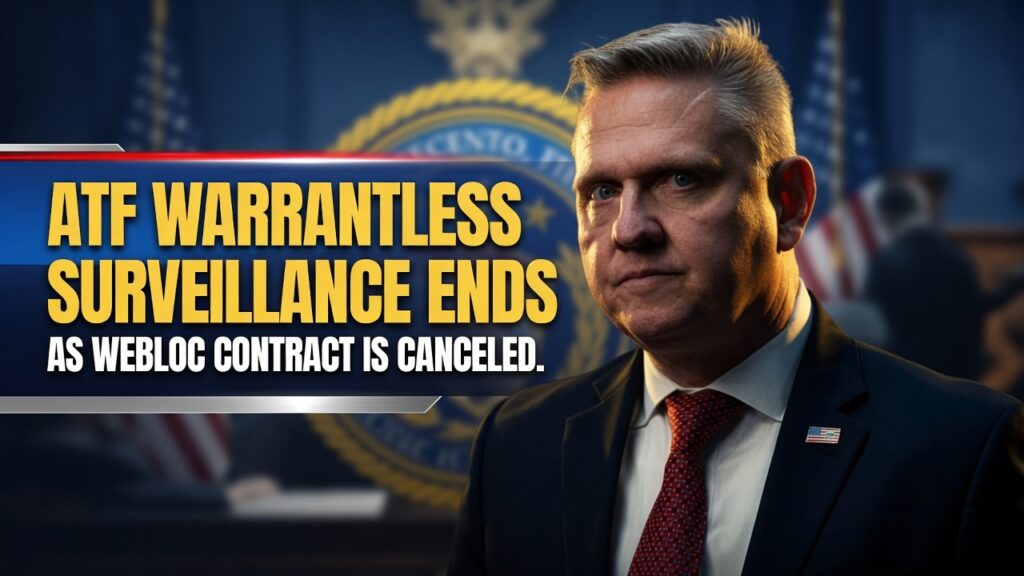
For years, a federal gun-enforcement agency quietly bought Americans’ phone-location data without a warrant. Now that it’s been caught and forced to back down, one question remains: who’s still doing it?
Your phone was being watched. Not by hackers — by a federal agency, without a warrant and without your knowledge. That is the uncomfortable takeaway from a June 2026 disclosure that the Bureau of Alcohol, Tobacco, Firearms and Explosives had been quietly purchasing bulk cell-phone location data and using it to run hundreds of searches on Americans.
Why does this matter right now? Because on June 26, 2026, under bipartisan congressional pressure, ATF confirmed it had canceled the contract for the tool behind those searches. The agency called it a “pilot.” The records tell a fuller story — one that should concern anyone who believes government power needs a warrant, a limit, and a witness.
Why Should You Care What ATF Does With Your Phone?
Because the data in question is the same data that follows you everywhere. Apps you download — weather, games, shopping — quietly harvest your location and feed it into a sprawling “ad tech” marketplace. Ordinarily that fuels targeted advertising. But that same stream can be purchased by government agencies to map where a device has been, and when. The tool ATF used, called Webloc, draws on exactly this commercial location data, letting investigators identify which phones were in a given place at a given time — without ever asking a judge. That is the crux of the concern. When the government buys what it would otherwise need a warrant to seize, the Fourth Amendment’s protection against unreasonable searches starts to look optional.
Support Independent Local Journalism
TheTownHall.News is a non-profit reader-supported journalism. Just $5 helps us hire local reporters, investigate important issues, and hold public officials accountable across Alameda County. If you believe our community deserves strong, independent journalism, please consider donating $5 today to support our work.How Did Congress Actually Find Out?
It started with a question. Under questioning from Rep. Michael Cloud, a Texas Republican, ATF Director Robert Cekada acknowledged in a May 2026 congressional hearing that the agency had been buying geolocation data on Americans’ cell phones. Cloud pressed further, and his office — together with that of Sen. Ron Wyden, an Oregon Democrat and longtime critic of government data purchases — was briefed by ATF. What they learned was striking: the agency had conducted more than 300 warrantless searches using the tool, including more than 200 tied to active ATF cases. This was not a dormant capability. It was operational, and already woven into live investigations before any meaningful oversight caught up to it. WGAU
What Is Webloc — and Who Really Sells It?
Here the details matter, because precision is what separates accountability journalism from outrage. Webloc is not a company — it is a surveillance product, and it is made by a vendor called Penlink. The tool was originally built by an Israeli firm called Cobwebs before that company was acquired and merged into Penlink. Its data comes from consumer apps and advertising networks — the ordinary machinery of the mobile economy, repurposed for law enforcement. Penlink defended the relationship, saying it was proud of its long-standing work with ATF against violent crime involving firearms, explosives, and arson. And ATF is far from the only customer. According to research from the University of Toronto’s Citizen Lab, Webloc’s users have included the U.S. military, Immigration and Customs Enforcement, local police departments, and even foreign agencies such as El Salvador’s national police and Hungarian intelligence. This is an industry, not an isolated contract. WGAU + 2
More than 300 times, a federal agency tracked Americans’ phones with no warrant. If it happened in your town, would anyone have told you?
The Loophole the Supreme Court Never Closed
The legal gap at the center of this story is real, and its critics are bipartisan. In 2018, the U.S. Supreme Court ruled in Carpenter v. United States that police need a warrant to obtain a suspect’s historical location records from a cell carrier. But the Court has never addressed the growing practice of buying similar location data commercially. That silence created a workaround: what agencies cannot compel from a phone company, some have simply purchased from a data broker. Wyden has warned about this for years, calling such purchases an unacceptable end-run around the Fourth Amendment. The concern is structural, not partisan — whether constitutional limits can survive contact with the modern data economy. WGAUWGAU

If the government can buy what it isn’t allowed to seize, is the Fourth Amendment still a limit — or just a suggestion?
A Republican and a Democrat agreed on one thing: buying your location data to skip a warrant is an end-run around the Constitution.
Is the Threat Actually Over?
Not entirely — and this is the part that deserves your attention. ATF canceling one pilot contract does not repeal the practice across the federal government. Reporting indicates the FBI and Department of Homeland Security continue to purchase commercial location data, and legislation to require judicial oversight before such purchases remains uncertain. One case shows how close the guardrails came to failing: in a suspected arson investigation at a U.S. defense contractor’s facility, both a prosecutor and a judge objected to the use of Webloc data, and ATF was ultimately forced to obtain a traditional court order for cell-tower records instead. The system corrected — but only because someone inside it pushed back. Remove that pressure, and the pull toward the faster, warrantless option does not disappear. Gadget ReviewABC News
300-plus warrantless searches. The question Washington keeps dodging: how many other agencies are still doing it?
What Do Supporters of This Surveillance Actually Believe?
It is worth engaging the other side honestly. Defenders of commercial-data tools argue they are a legitimate, efficient investigative resource: the information is already collected and sold on the open market, users technically consent through app terms, and no phone company is being compelled to hand over anything. In fast-moving cases involving arson, trafficking, or violent gun crime, they say, quickly narrowing a suspect pool can save lives, and demanding a warrant for every commercially available data point would grind legitimate investigations to a halt. That argument is not frivolous. But it runs into a hard problem: consent buried in an app’s fine print is not consent to government tracking, and “already for sale” is not a constitutional standard. The Fourth Amendment does not ask whether a search is convenient. It asks whether it is reasonable — and whether a neutral judge signed off. When the answer is no, efficiency is not a defense; it is exactly what the warrant requirement exists to check.
Key Questions This Raises
Support Independent Local Journalism
TheTownHall.News is a non-profit reader-supported journalism. Just $5 helps us hire local reporters, investigate important issues, and hold public officials accountable across Alameda County. If you believe our community deserves strong, independent journalism, please consider donating $5 today to support our work.- If a court order was required for cell-tower data, why was buying the same location data on the open market treated as fair game?
- How many of the 300-plus searches swept up Americans who were never charged with anything?
- With the FBI, DHS, and ICE reportedly still buying commercial location data, what stops ATF from quietly restarting once the headlines fade?
What Happens After the Headlines Fade?
So here is the question worth carrying forward. ATF got caught, and ATF backed down — but the machinery that made warrantless tracking possible is still running elsewhere in the government, still legal, still largely invisible. The win here belongs less to any party than to oversight itself: a Republican and a Democrat asking the same pointed questions until an agency finally answered. That is the system working as designed. The real question isn’t whether this particular program is over — it’s whether anyone will be watching closely enough to stop the next one before it runs 300 searches of its own.
What do you think — was this real accountability, or just a program that got caught? Share this and let us know.
Want to make your voice count? This is a live policy fight. You can submit a public comment on federal surveillance rulemakings at Regulations.gov, and contact your representatives through congress.gov to ask where they stand on requiring a warrant before agencies buy Americans’ location data. Still have questions? Subscribe for daily accountability coverage — and if you think others need to see this, pass it on.