Trump Mail-In Ballot Executive Order Blocked by Federal Judges Ahead of 2026 Midterms
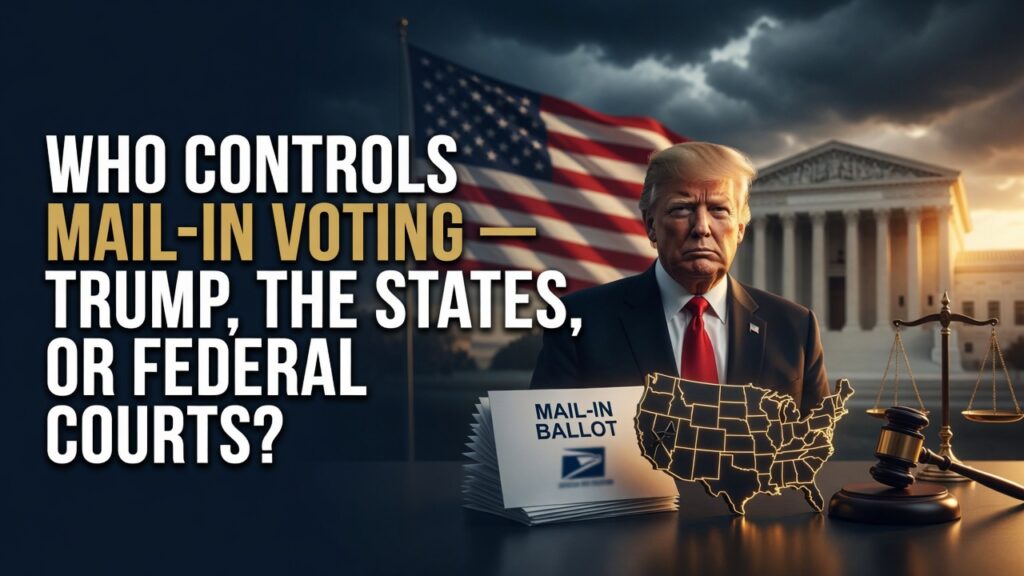
Two federal judges have now blocked key provisions of President Trump’s election integrity order — and with November just months away, the constitutional battle over who runs American elections is reaching a breaking point.
The right to vote is among the most sacred civic acts in a democracy. But who decides how that vote is cast, verified, and delivered is becoming one of the most contested legal questions of the 2026 election cycle.
In late June and early July, two separate federal judges blocked significant provisions of President Trump’s March 31, 2026 executive order titled “Ensuring Citizenship Verification and Integrity in Federal Elections” — halting a plan that would have required states to submit lists of mail-in voters to the U.S. Postal Service before any ballots could be transmitted. With November midterms approaching and Republicans fighting to hold both chambers of Congress, the legal battle is moving at a speed rarely seen in election law.
Support Independent Local Journalism
TheTownHall.News is a non-profit reader-supported journalism. Just $5 helps us hire local reporters, investigate important issues, and hold public officials accountable across Alameda County. If you believe our community deserves strong, independent journalism, please consider donating $5 today to support our work.What Did Trump’s Order Actually Require?
The executive order directed the Department of Homeland Security to compile “State Citizenship Lists” drawn from federal databases and transmit them to state election officials before each federal election cycle. Separately, the order directed the Postmaster General to initiate rulemaking that would prohibit USPS from transmitting mail-in or absentee ballots from any individual unless those individuals had been enrolled on a state-specific list submitted to the agency. White HouseWhite House
White House staff secretary Will Scharf framed the order as a means to ensure that each state’s election officials receive a comprehensive view of who the eligible voters in their jurisdiction actually are, allowing them to verify that everyone voting is legally able to do so. Supporters argued the measure was straightforward election hygiene — know who’s eligible before you mail the ballot. Votebeat
If states can’t even confirm who is eligible to vote by mail before ballots go out, can anyone honestly call that a secure election?
How Did the Courts Rule — and Why?
U.S. District Judge Emmet Sullivan, sitting in Washington, D.C., blocked the USPS from carrying out its proposed rules nationwide, finding that the agency’s proposal violated a 2021 settlement agreement with the NAACP — a settlement that required USPS to prioritize monitoring and timely delivery of election mail through 2028. CNN

Sullivan’s ruling came just days after a separate decision out of Boston. U.S. District Judge Indira Talwani found that Trump’s directives to USPS and DHS exceeded his authority under the Constitution, which gives state legislatures and Congress — not the president — the power to set the rules for federal elections. Talwani wrote in a 37-page opinion that “the Constitution does not grant the President any specific powers over elections” and that USPS has no legal authority to control mail-in voting. NPRNPR
The Trump administration appealed Talwani’s ruling to the First Circuit Court of Appeals and said it is still proceeding with efforts to set up the new system for states not covered by her injunction. Votebeat
The core question before the courts isn’t whether election integrity matters — everyone agrees it does. The question is whether the president has unilateral authority to restructure the mechanics of how Americans vote without an act of Congress.
What Do Supporters of This Policy Actually Believe?
Defenders of the executive order make a case grounded in genuine concern. Non-citizen voting in federal elections, while rare according to multiple reviews, is not technically impossible under current patchwork state systems. Trump has said he issued this order to stop illegal voting by non-U.S. citizens in federal elections, and the White House framed it as building a “comprehensive view” of eligible voters using federal data from DHS and the Social Security Administration. Votebeat
Supporters further argue that requiring a verified voter list before mailing ballots is simply good government — the kind of pre-verification taxpayers should expect. They contend that USPS rested its proposed rulemaking on its existing authority under Title 39 and treated ballot mail as a postal-standards issue with national election-integrity consequences — not as an unprecedented power grab. WLT Report
The counterargument, upheld by both courts, is constitutional rather than political. The USPS has historically functioned as a carrier of election mail — it delivers ballots but has never before played a role in determining which voters are eligible to send or receive them. Critics also note a practical problem: in every state and territory, the deadline for absentee and mail ballot applications falls after the order’s 60-day list submission cutoff — meaning no state could submit a complete and accurate list of eligible mail voters 60 days out because that list does not yet exist at that point. Bipartisan Policy CenterBipartisan Policy Center
Support Independent Local Journalism
TheTownHall.News is a non-profit reader-supported journalism. Just $5 helps us hire local reporters, investigate important issues, and hold public officials accountable across Alameda County. If you believe our community deserves strong, independent journalism, please consider donating $5 today to support our work.That logistical collision — not political opposition — is what both judges found fatal to the order as written.
What Do the Numbers Actually Tell Us About Mail-In Voting Risk?
All 50 states already have secure processes in place to verify mail ballots at both the application and ballot-return stages, ranging from signature comparison to requiring ID numbers or photocopies, to requiring a witness or notary signature. States are not operating without guardrails. Voting Rights Lab
Tens of millions of Americans vote by mail each election cycle — a number that has grown substantially since 2020.
The question is whether a federally administered eligibility list, built on databases that courts have acknowledged may be incomplete, would improve that system or introduce new errors. Judge Talwani wrote that the State Citizenship Lists detailed in the order will “necessarily be incomplete” due to the legal restrictions of the Privacy Act and the practical limitations of federal records that don’t always track name or residence changes accurately. Lawfare
An incomplete federal list used as a gatekeeper for ballot delivery is not a stronger election — it is a different kind of risk.
Is This a Separation of Powers Fight More Than an Election Fight?
Both rulings point in the same constitutional direction: the president does not have unilateral authority to overhaul federal election mechanics. Judge Talwani sided with a coalition of Democratic-led states in ruling that Trump had exceeded his authority in trying to overhaul procedures for elections, which since the republic’s founding in 1789 have been run by states and local governments. U.S. News & World Report
On April 3, New York Attorney General Letitia James, joined by 22 other attorneys general and Pennsylvania’s governor, filed suit to block the order, arguing it unlawfully interferes with state election systems, restricts mail-in voting, threatens election officials with prosecution, and improperly shifts control of elections from states and Congress to the federal executive. National Association of Counties
That last concern deserves serious attention regardless of which party is in power. A precedent that allows any sitting president — Democrat or Republican — to restructure mail-in voting by executive order rather than by legislation is a precedent that cuts both ways. If Congress believes uniform national standards for mail-in ballot verification are needed, that is precisely the kind of policy Congress exists to pass.
If the Constitution grants states and Congress the authority to run federal elections, should a single executive order be enough to override a century of established practice — no matter who signs it?
What Happens Next Before November?
The Trump administration is seeking to quickly lift the rulings, arguing that the courts’ actions will effectively prevent the government from putting new voting restrictions in place before the November election. The appeals are moving on parallel tracks through the First Circuit and the D.C. Circuit. Votebeat
On June 24, a federal appeals panel also ruled against a Department of Justice effort to access Michigan’s sensitive voter rolls, and a separate federal judge permanently barred the administration from implementing key provisions of an earlier executive order on voting. The legal losses are accumulating rapidly. NPR
Whether the Supreme Court steps in before November remains the defining open question. The administration has made clear it views the midterms as the stakes — and the timeline is unforgiving.
Key Questions
- If the president cannot restructure mail-in voting by executive order, what legislation would need to pass Congress to achieve the same election integrity goals — and does the political will exist?
- Are federal databases accurate and complete enough to serve as a reliable gatekeeper for who receives a mail-in ballot, or would implementation create more disenfranchisement than it prevents?
- With appeals moving on parallel tracks and the Supreme Court as a potential final arbiter, will election law be settled before November — or will states and counties be left administering an election in legal limbo?
The real question at the center of this fight isn’t whether elections should be secure — they should be. The question is whether the path to security runs through executive orders, litigation, and federal databases — or through Congress, transparent rulemaking, and the state election systems that have administered American democracy for 237 years.
The courts have weighed in twice. The administration is appealing. And November is coming regardless of the outcome.
What do you think — should election integrity reform come through legislation or executive action? Share this article and join the conversation.
Still have questions? Subscribe to The Town Hall News for daily coverage of federal and California election law. Think this matters to your community? Share it with someone who votes by mail. Want to make your voice count on election security policy? Contact your U.S. representative through house.gov/representatives/find-your-representative and let them know where you stand on uniform federal election standards.