

Boeing Moves 787 Engineering to South Carolina — Washington Workers Left Behind After Billions in Tax Breaks
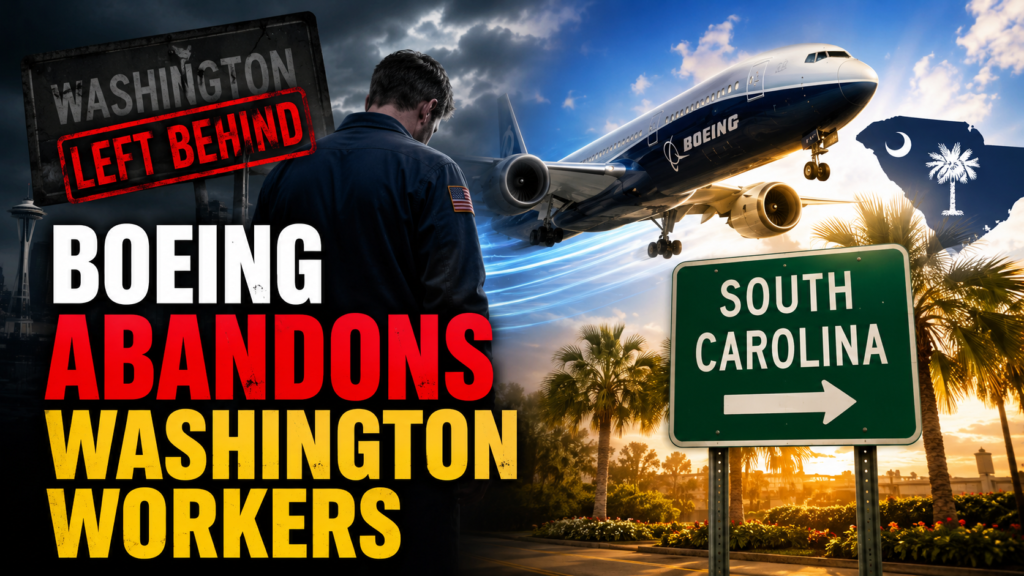
Washington state handed Boeing the largest corporate tax break in U.S. history. Now the last engineering jobs tied to the 787 Dreamliner are packing up and heading south — and the workers who built America’s most iconic aircraft are being left to wonder why.
The deal was supposed to protect Washington jobs. It didn’t.
In 2013, Washington lawmakers voted to extend Boeing the largest corporate tax incentive package in American history — an estimated $8.7 billion — to keep aerospace manufacturing rooted in the Puget Sound region where Boeing has operated since 1916. More than a decade later, that investment is looking less like economic strategy and more like a one-sided handshake. In early February 2026, Boeing confirmed it would consolidate the remaining engineering work for its 787 Dreamliner program in North Charleston, South Carolina — taking approximately 300 more jobs out of Washington state in the process.
Support Independent Local Journalism
TheTownHall.News is a non-profit reader-supported journalism. Just $5 helps us hire local reporters, investigate important issues, and hold public officials accountable across Alameda County. If you believe our community deserves strong, independent journalism, please consider donating $5 today to support our work.What Did Washington Taxpayers Actually Buy?
Washington’s $8.7 billion tax incentive package was sold to residents as a guarantee: Boeing stays, jobs stay, prosperity stays. The promise carried real emotional weight in a state where generations of families built their livelihoods around the company, from the 737 assembly lines in Renton to the sprawling widebody factory in Everett that once produced record numbers of 787s.
But the math no longer adds up. According to reporting by Reuters and confirmed by the Society of Professional Engineering Employees in Aerospace (SPEEA), Washington’s Boeing workforce shrank by approximately 2,500 workers in 2025 alone. At the same time, Boeing’s South Carolina headcount grew by roughly 10 percent, reaching 9,059 employees — making it the only state in the country where Boeing added significant numbers of workers last year. The tax deal did not include enforceable job guarantees. Washington handed Boeing billions, and Boeing handed South Carolina the growth.
$8.7 billion. That is what Washington taxpayers offered Boeing to stay. The question no one in Olympia wants to answer: what did they get in return?
Are Workers Being Told the Whole Story?
The most damaging detail in the February 2026 announcement is not just what Boeing decided — it is how they decided it. SPEEA Executive Director Ray Goforth revealed that Boeing management met with the union on January 29th and explicitly told representatives that no decisions affecting union members were expected in the foreseeable future. The very next morning, Boeing notified employees directly that the remaining 787 engineering work would be relocated to South Carolina.

“The failure of the company to honor its contractual obligation to notify us of such decisions is profoundly disappointing,” Goforth stated publicly. “Worse yet, the company has not yet answered basic questions about timing and process of the move.”
Boeing told union leaders no job-affecting decisions were coming — then announced 300 jobs leaving Washington the very next day. If that is not a breach of trust, what is?
The union currently represents approximately 17,000 Boeing employees in Washington, Oregon, California, and Utah. Their contracts with Boeing expire in October 2026. Negotiations on a new deal are expected to begin later this year — negotiations that now begin in the shadow of a major, unilateral move the union had no warning about.
What Do Supporters of This Strategy Actually Believe?
Boeing and its defenders make a reasonable economic argument, and it deserves a fair hearing. The company is emerging from a brutal stretch: a 57-day machinist strike in 2024, more than $8 billion in financial losses in a single year, compounding quality control crises, and a global slowdown in widebody jet demand that gutted production schedules. From a pure business standpoint, consolidating the 787 program under one roof in North Charleston — where the company has already invested more than $1 billion in infrastructure upgrades and plans to ramp production to 10 jets per month in 2026 — is a logical operational move. South Carolina’s non-union environment also lowers labor costs at a time when Boeing is fighting to rebuild its balance sheet.
Boeing has also promised to hire additional engineers in the Puget Sound area to support the 737 MAX program, and has announced a planned fourth MAX assembly line in Everett. The company argues that engineers belong alongside the programs they support, and that Washington’s aerospace future remains tied to the 737 — still the most popular commercial jet in the world.
Support Independent Local Journalism
TheTownHall.News is a non-profit reader-supported journalism. Just $5 helps us hire local reporters, investigate important issues, and hold public officials accountable across Alameda County. If you believe our community deserves strong, independent journalism, please consider donating $5 today to support our work.But here is where the argument breaks down. Washington taxpayers did not write an $8.7 billion check for “some jobs.” They wrote it to preserve the aerospace ecosystem Boeing built over more than a century. Moving the crown jewel of Boeing’s widebody portfolio — engineering and all — to a non-union state right before contract negotiations is not just a business decision. It is a signal. And workers are reading it clearly.
Is the Union Era in Washington Aerospace Coming to an End?
The timing of this move cannot be separated from its labor context. Boeing’s contract with SPEEA’s Puget Sound workforce expires in October 2026. The relocation of 787 engineering work to South Carolina — a state with no Boeing union presence — arrives as what the union itself describes as a shadow cast over upcoming negotiations.
“Our members have very legitimate concerns about their future with the company and how long they can expect to earn a paycheck in their current roles.” — SPEEA Executive Director Ray Goforth, February 2026
This is not Boeing’s first use of geographic leverage at the bargaining table. The initial decision to begin shifting 787 assembly to South Carolina came shortly after a 2008 Machinists strike that halted 787 production for 57 days. The pattern is not hard to identify: labor action leads to geographic diversification, which leads to leverage, which leads to more leverage. Washington’s aerospace workers are not imagining the trend. They are living it.
Boeing has migrated 787 work to South Carolina for roughly 20 years. Washington workers are not facing a sudden threat — they are facing the final chapter of a long, quiet exit.
What Happens to a State When Its Industrial Identity Leaves?
Boeing did not just build airplanes in Washington. It built communities. The company’s roots in the state trace back to a converted boathouse on Seattle’s Lake Union in 1916. The factory in Everett — the largest building by volume in the world when it opened — became a landmark of American industrial capacity. Generations of machinists, engineers, and technicians built careers, homes, and families around Boeing’s presence.
The 787 Dreamliner was launched in Everett in 2004. Every early aircraft rolled out of that building. Now, not a single Dreamliner is assembled there, and as of early 2026, not a single engineer designing one will remain in Washington when the transition is complete. The 737 MAX program offers a partial backstop, but it is not the same. Washington’s claim to being the aerospace capital of the world has quietly become something narrower, and the people who built that reputation are watching it contract in real time.
The state’s response has been muted. Washington officials and union leaders have pressed Boeing for answers, but no concrete legislative accountability mechanism exists to claw back any portion of the $8.7 billion in tax relief extended to a company that has steadily, deliberately moved its most valuable work elsewhere.
Key Questions This Story Raises
- Who is accountable? Washington lawmakers extended $8.7 billion in tax incentives without enforceable job retention requirements. Which officials signed off — and why has no one revisited the terms?
- What recourse do workers have? With SPEEA contracts expiring in October 2026 and Boeing holding geographic leverage, what protections exist for the 17,000 union members whose futures are now uncertain?
- Is the 737 program enough? Boeing promises Washington’s aerospace future is tied to the 737 MAX. But with the 787 gone and the 777X still in development limbo, can one program sustain the state’s aerospace identity long-term?
The real question for Washington state is not whether Boeing will continue to shift work south. The evidence is clear: it already has. The question is whether the workers, lawmakers, and taxpayers who built this company’s century-long success will demand accountability before the last chapter is written — or simply watch it happen and wonder where the jobs went.
Civic action: Contact your Washington state representative and ask whether the $8.7 billion Boeing tax incentive package included enforceable job retention provisions — and what, if anything, the state intends to do now. Find your representative at leg.wa.gov.
Think others need to hear this? Share this article and ask your network: when corporations take billions in public incentives, what does accountability actually look like?
Want to stay ahead of this story? Subscribe for daily coverage of the issues that affect your community, your livelihood, and your wallet.