THREE DATA CENTERS? THE ROOM THOUGHT THERE WAS ONE – Part 2/3
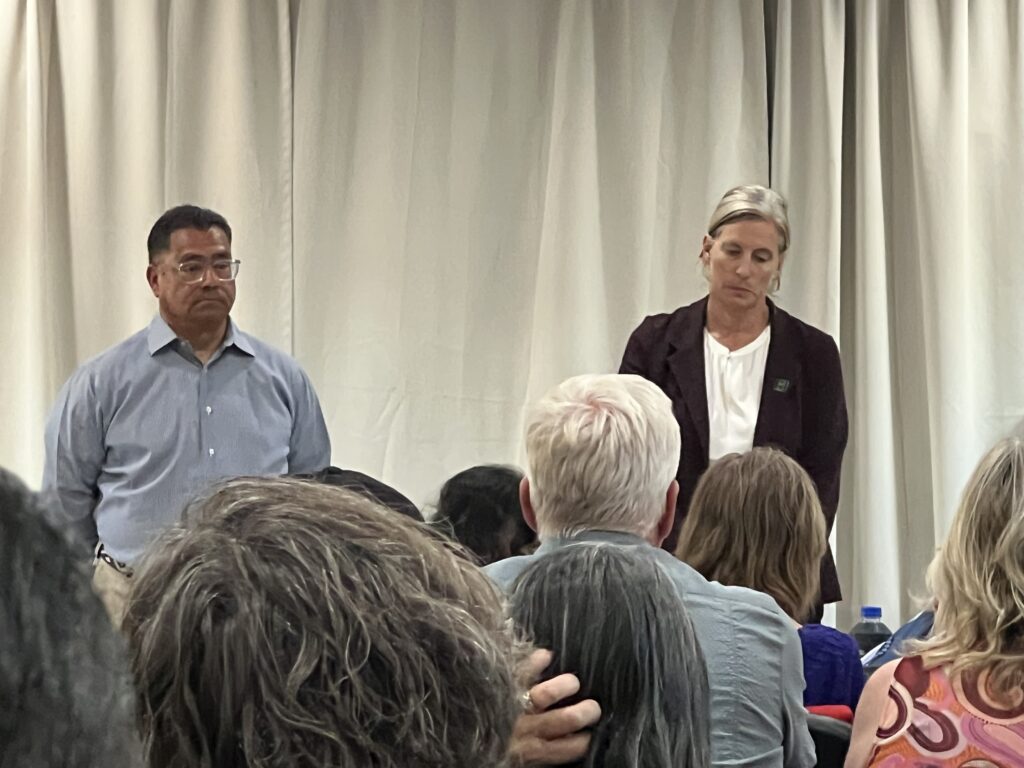
What began as a town hall became a shouting match as Hayward residents challenged Mayor Mark Salinas and the city manager over data centers, environmental risks and what the public knew before permits were issued.
It didn’t take long for the temperature inside the Community Church of Emanuel to rise.
By the time the discussion turned to Hayward’s data centers, Mayor Mark Salinas and the city manager were no longer simply answering questions. They were arguing with residents. Voices rose. Answers were interrupted. People shouted from across the room. Profanity flew. Some residents demanded everyone quiet down so officials could answer, only for the answers themselves to trigger another eruption.
Support Independent Local Journalism
TheTownHall.News is a non-profit reader-supported journalism. Just $5 helps us hire local reporters, investigate important issues, and hold public officials accountable across Alameda County. If you believe our community deserves strong, independent journalism, please consider donating $5 today to support our work.Then came the insults.
“Crazy mayor.”
“You are just highly ignorant.”
One attendee called the city manager “Pinocchio.”

Another accused City Hall of trying to “bullshit us.”
A resident accused Salinas of “telling us lies.” Another said City Hall had “failed us.”
And from somewhere in the increasingly furious room came an even more politically dangerous suggestion:
Recall the mayor.
Salinas eventually warned the crowd that if the interruptions continued, “I’m gonna end the meeting.”
Support Independent Local Journalism
TheTownHall.News is a non-profit reader-supported journalism. Just $5 helps us hire local reporters, investigate important issues, and hold public officials accountable across Alameda County. If you believe our community deserves strong, independent journalism, please consider donating $5 today to support our work.“Go ahead,” someone answered.
This was no longer a polite town hall.
It had become an angry confrontation between the people running Hayward and residents who believed those officials had failed to protect them.
Then the crowd learned something else.
They thought they were fighting one data center.
Salinas said there were three.
‘SO YOU APPROVED THREE DATA CENTERS, AND NOT ONE’
The revelation came in the middle of the increasingly combative exchange.
Residents had arrived focused on the data center that had galvanized neighborhood opposition. Then Salinas acknowledged multiple facilities.
The audience caught it immediately.
“So you approved three data centers, and not one.”
But even that wasn’t the whole story.
Hayward’s own records now identify four modern data centers operating or under construction: Amazon SF09, Amazon SF011, Hayward Exchange @ 92 and STACK SVY03A. The first two were approved by the City in 2010 and 2015; the Planning Commission approved Hayward Exchange @ 92 in 2021 and STACK in 2025. (City of Hayward)
That raises an uncomfortable question City Hall should have to answer:
How could the mayor and other City leaders appear uncertain about how many data centers were operating or being built in Hayward when the City itself had approved four of them over the years?
Not every approval required a vote of the full City Council. Hayward’s own account says older data centers could be approved administratively, while the two newer projects went through the Planning Commission. In April 2026, the Council changed the rules so future data centers require a City Council public hearing. (City of Hayward)
But that technical distinction may provide little comfort to residents.
City Hall approved them.
City Hall kept the records.
City Hall issued the permits.
And yet residents at Tuesday’s meeting appeared to be learning the scope of Hayward’s data-center development while arguing about it with their mayor.
‘NOT TRUE’
It wasn’t the first time that evening residents had openly challenged Salinas.
Earlier, the mayor had turned to illegal fireworks.
Salinas pointed to a park in the Tahoe-Morningside area as evidence that enforcement was working.
“At that park, there was virtually zero fireworks,” Salinas said.
The answer came instantly.
“Not true.”
Salinas pushed back, saying City reports showed otherwise. He said Hayward measured progress through calls for service and citations.
A resident wanted evidence.
“What are the numbers?”
Salinas said he had them and would report them.
The exchange established the pattern for the night.
The mayor cited reports.
Residents cited what they said they were seeing with their own eyes.
And they weren’t afraid to challenge him.
THEN THEY FOUGHT OVER THE DEAD
The same thing happened when Salinas turned to dangerous roads.
He referred to two people dying during a roughly 10-day period.
A woman interrupted.
“It was three people.”
Salinas responded that he had been discussing two specific fatalities.
“Three is too many,” he eventually acknowledged.
Again, the crowd had challenged the mayor’s numbers.
Fireworks?
“Not true.”
Traffic deaths?
The audience corrected him.
Data centers?
Residents thought they were fighting one, Salinas spoke of three, and City records now list four modern facilities. (City of Hayward)
By then, City Hall wasn’t giving a presentation.
It was being cross-examined.
‘BUT YOU DON’T KNOW, BUT YOU SIGNED OFF ON IT’
Then came the questions that turned frustration into anger.
What happens to the water?
When do the backup generators operate?
What happens if pollution is discovered?
What renewable-energy sources actually power the facility?
Who monitors compliance?
Who is responsible if something goes wrong?
The city manager attempted to explain the environmental review.
Residents interrupted.
He tried again.
They challenged him again.
At one point, he protested that he couldn’t explain an answer while people were interrupting him.
But residents weren’t interested merely in hearing that environmental documents existed.
They wanted officials to know what those documents meant.
When answers became uncertain, somebody struck:
“But you don’t know, but you signed off on it.”
Another resident followed:
“If you haven’t determined that already, how did you approve it then?”
Then came the taunt.
“Pinocchio.”
The room erupted again.
‘WHAT ABOUT WE, THE PEOPLE?’
City officials returned repeatedly to process.
Environmental review.
Mitigation.
Permits.
Regulators.
Property rights.
Public meetings.
Appeal periods.
Residents increasingly heard explanations as excuses.
Finally someone shouted:
“What about we, the people?”
Then:
“Don’t you represent the people here? If the majority of people don’t want it, don’t you listen to them?”
Salinas said the Council would listen.
There would be additional consideration.
Public comment.
A possible moratorium.
But residents immediately spotted the problem.
That would deal with future data centers.
They were talking about the one being built now.
“That’s about future data centers, not existing data centers.”
City Hall had an answer for tomorrow.
The people wanted one for today.
WERE THE PEOPLE SUPPOSED TO WATCH CITY HALL?
Then came perhaps the most politically damaging exchange.
Salinas repeatedly encouraged residents to subscribe to The Stack, the City’s electronic newsletter.
Meetings were public, he explained.
Notices were available.
“All meetings are noticed, all meetings are public.”
The crowd pushed back.
“No one knew about it.”
Another resident answered:
“You don’t promote certain things the way you promote other things.”
Then someone said aloud what others appeared to believe City Hall was suggesting:
“You’re telling us that we should have been looking for it.”
That turned the argument upside down.
Residents had come asking why government hadn’t done more to inform them.
Now they believed government was explaining where they should have looked.
The average parent doesn’t employ a planning department.
The City does.
The average homeowner doesn’t employ engineers, inspectors, environmental consultants and a city manager.
The City does.
People elect a mayor and council because ordinary residents cannot spend every evening digging through municipal agendas, planning applications and environmental documents.
To people already furious at City Hall, the explanation sounded less like transparency and more like blame.
‘YOU FAILED US’
Then it became personal.
One resident spoke about her son’s school.
“My son’s school was the Impact Academy. It’s 1.2 miles.”
She turned toward Salinas.
“You’re representing us.”
Then:
“And you failed us. The children, the future.”
Another resident reminded City officials why voters had put them there:
“We voted you here to protect us.”
She accused officials of making a “highly uneducated decision against the community.”
Then she asked:
“Do you understand the gravity of this?”
This was no longer an argument about megawatts.
Residents were questioning the judgment of the people running Hayward.
THE ROOM BOILS OVER
By now, restraint was disappearing.
People shouted over answers.
Others shouted at them to stop shouting.
A taxpayer demanded that Salinas be allowed to speak.
Profanity came from the crowd.
Officials tried to regain control.
One attendee accused City Hall of trying to:
“bullshit us.”
Another accused the mayor of “telling us lies.”
Someone called for a recall.
Those are accusations and demands from angry residents, not findings by this newspaper.
But they demonstrate how far the meeting had deteriorated.
This wasn’t grumbling at the back of a council chamber.
People were saying it directly to the mayor and city manager, only feet away.
Finally Salinas snapped.
“I’m gonna tell you right now. If you continue to do this, I’m gonna end the meeting.”
“Go ahead,” somebody answered.
Others demanded he stay.
“We want to hear what he has to say.”
When Salinas eventually announced that they were over time, another voice fired back:
“How convenient.”
THEN PEOPLE STARTED LOOKING TO TOM WONG
There was another politician in the room.
And increasingly, residents began saying his name without being prompted.
Tom Wong, Salinas’s challenger for mayor, listened as residents battled City Hall over what could and could not be done.
While officials explained limitations created by permits, approvals and property rights, Wong offered a fundamentally different response:
Look for a way to fight.
Environmental challenges.
Permit conditions.
Regulatory enforcement.
Moratoriums.
Every lawful mechanism still available.
“I’ll try everything,” Wong said.
Whether any particular legal strategy could stop an already permitted project remains to be determined.
But people appeared to respond to something more basic.
City Hall was explaining why something couldn’t be done.
Wong was saying he would find out whether it could.
One attendee pointed toward him:
“Tom Wong says he can stop it.”
Another answered:
“That’s right.”
Then came an unsolicited endorsement:
“That is why you have to vote for Tom Wong.”
After the meeting, people approached Wong.
They wanted his information.
They wanted him at other neighborhood meetings.
Some offered to help.
A Skywest resident wanted to connect him with homeowners fighting their own development battle.
One person told him:
“I’ll help you pass out some of the flyers.”
Another explained the attraction more colorfully:
“You fight like hell.”
It wasn’t a scientific poll.
It wasn’t everybody in the room.
But it was something an incumbent should never ignore:
People who came angry at City Hall were leaving interested in the man challenging it.
THE MEETING ENDED. THE FIGHT DIDN’T.
The data center brought people into the room.
By the time they walked out, the argument had become something larger.
Trust. Judgment. Accountability.
Residents had challenged the mayor over fireworks.
They challenged his traffic numbers.
They discovered Hayward had more data centers than many apparently realized.
They challenged the city manager over environmental answers.
They accused City Hall of blaming residents for not knowing sooner.
And eventually they began talking about replacing the mayor.
City Hall spent the evening explaining decisions already made and limitations it says now exist.
Wong offered the crowd three words:
“I’ll try everything.”
That doesn’t make him mayor.
It does make November considerably more interesting.
Because the question coming out of Tuesday night’s angry town hall is no longer simply whether Hayward should have approved another data center.
It is whether residents still trust the people who did.
And if they don’t, they now have somewhere else to look.
Tom Wong.
NEXT — PART THREE: THE PEOPLE’S CHOICE
The anger is real. The alternative is now standing in front of them. Part Three asks the question that will ultimately be decided by Hayward voters: Is Tom Wong ready to take the keys to City Hall?