THE MAYOR NOBODY HAD TO BEAT – PART ONE OF THREE
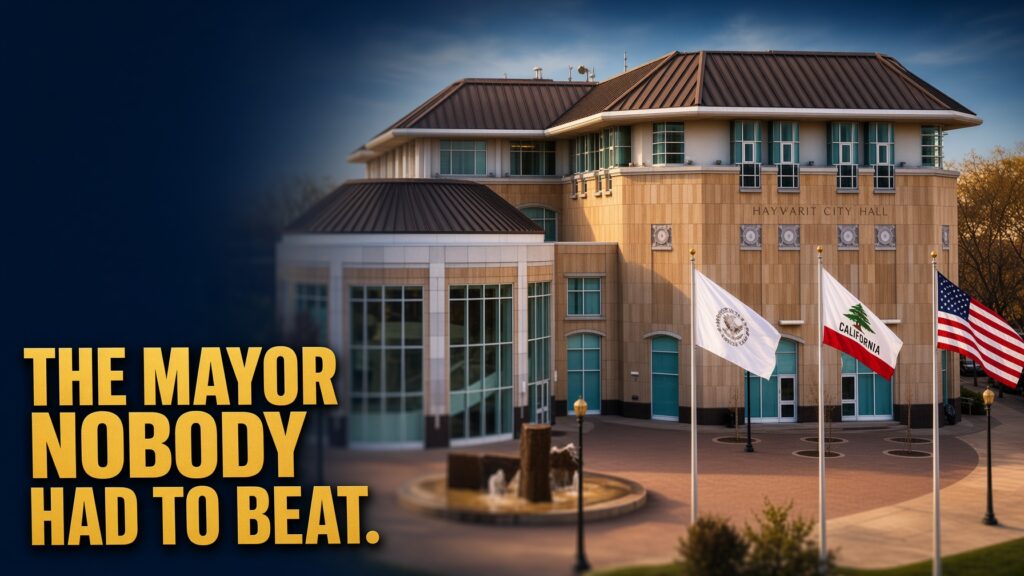
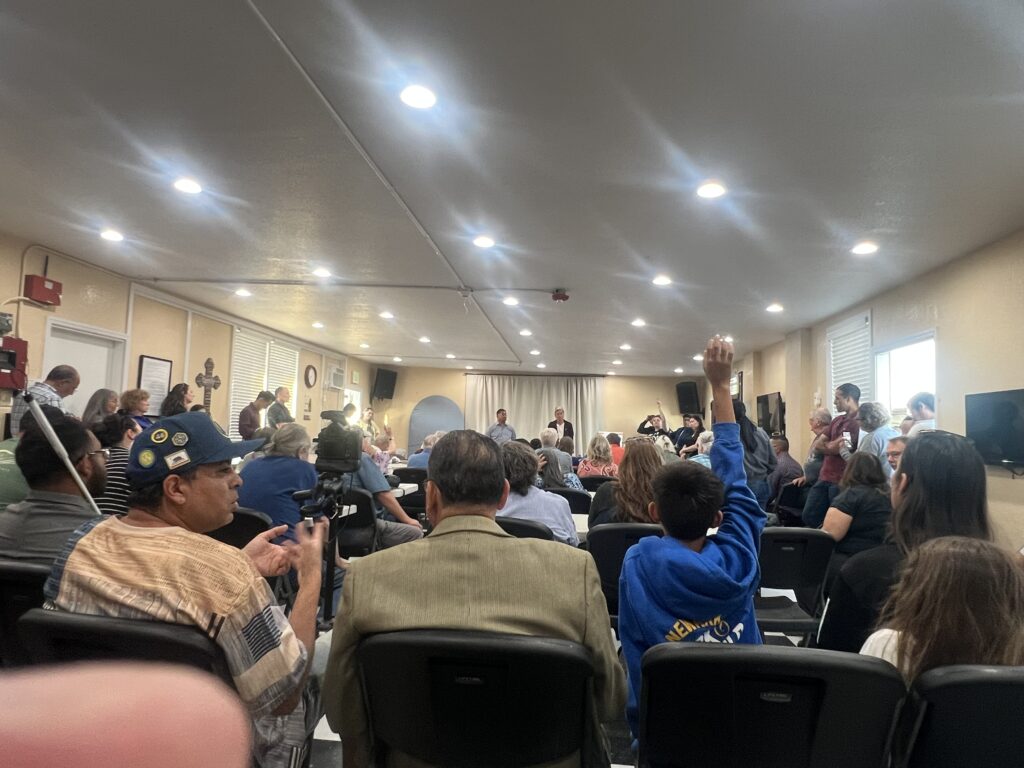
Mark Salinas walked into Hayward’s mayor’s office without an opponent four years ago. On Tuesday night, he walked into a church full of residents demanding to know what happened to their city.
HAYWARD — Four years ago, Mark Salinas found himself staring at an unusual political opportunity.
Nobody was running for mayor.
Salinas, already a familiar figure at City Hall after years on the City Council, entered the race near the end of the filing period. When the filing window closed, there was nobody standing opposite him.
Support Independent Local Journalism
TheTownHall.News is a non-profit reader-supported journalism. Just $5 helps us hire local reporters, investigate important issues, and hold public officials accountable across Alameda County. If you believe our community deserves strong, independent journalism, please consider donating $5 today to support our work.No opponent.
No mayoral debate.
No rival campaign picking apart his record.
No competing candidate asking Hayward voters whether City Hall was headed in the right direction.

Salinas was the lone candidate for mayor on Hayward’s 2022 ballot.
He became mayor.
Four years later, the political landscape looks considerably different.
On Tuesday evening, Aug. 11, inside the Community Church of Emanuel, Salinas stood before a room of Hayward residents to talk about his city’s accomplishments.
He came bearing good news.
Support Independent Local Journalism
TheTownHall.News is a non-profit reader-supported journalism. Just $5 helps us hire local reporters, investigate important issues, and hold public officials accountable across Alameda County. If you believe our community deserves strong, independent journalism, please consider donating $5 today to support our work.The residents came bearing questions.
And before the evening was finished, some of them were openly questioning whether the government Salinas leads had failed the people it was supposed to protect.
One resident put it in four words:
“And you failed us.”
That was only the beginning.
THE MAYOR CAME WITH A REPORT CARD
Salinas opened the evening like a man prepared to defend a record.
Crime was down, he said.
“Overall, there’s been a 31% reduction in crime,” Salinas told the audience.
In some categories, he said, reductions reached 42 and 44 percent.
“For as long as I’ve been on the council,” Salinas said, “I think this has probably been one of the sharpest reduction patterns I’ve seen.”
There were other accomplishments to discuss.
Fireworks enforcement.
Railroad-crossing improvements.
Bike lanes.
Free bus passes for students.
The downtown loop.
A proposed increase in Hayward’s business-license tax.
It might have made for a pleasant evening at City Hall.
But this wasn’t City Hall.
And the people hadn’t come simply to hear the mayor’s report card.
They had brought one of their own.
THE FIRST CRACK
It appeared during what should have been one of Salinas’s easier subjects: illegal fireworks.
The mayor told residents the city had made progress.
He pointed toward a neighborhood he knew personally and described what officials believed was a dramatic improvement at a park that had previously been troublesome.
“At that park, there was virtually zero fireworks,” Salinas said.
From the audience came an immediate reply:
“Not true.”
Salinas referred to city reports.
A resident wanted something more concrete.
“How do you measure it?”
Calls for service and citations, the mayor answered.
Then came another question:
“What are the numbers?”
Salinas said he had them and would report them.
It was a small exchange compared with what followed, but it revealed the divide that would dominate the night.
The administration spoke in reports.
Residents spoke from what they said they saw and experienced.
And increasingly, they weren’t convinced the two matched.
THEN SOMEBODY SAID “DATA CENTER”
Eventually Salinas reached the subject everyone seemed to be waiting for.
The data center.
The atmosphere changed almost instantly.
Questions began coming from different corners of the room.
Residents wanted to know about diesel generators.
Electricity.
Water.
Noise.
Air quality.
Pollution.
Schools.
Environmental review.
Public notice.
And, above all, who had allowed the project to get this far.
One resident spoke about a school just over a mile away.
“My son’s school was the Impact Academy,” the resident said. “It’s 1.2 miles.”
Then came the verdict:
“Not okay.”
Another voice turned directly toward Salinas.
“You’re representing us.”
Then:
“And you failed us. The children, the future.”
The evening had ceased to be a mayoral presentation.
It had become an accounting.
CITY HALL MEETS ITS CUSTOMERS
City Manager Michael Lawson and city staff attempted to explain the environmental-review process.
Officials said environmental issues had been studied, including biological impacts, hazardous materials, air quality, water and noise.
Residents weren’t satisfied.
One demanded to know about the financial impact on ordinary households.
“What about the impact on our wallet?”
Another asked what many in the room appeared to consider the fundamental question:
“What about we, the people?”
Then the question became sharper.
“Don’t you represent the people here? If the majority of people don’t want it, don’t you listen to them?”
That is not an engineering question.
It isn’t a zoning question.
It isn’t even principally a question about data centers.
It is a question about government.
Who makes the decisions?
Who gets told?
Who gets heard?
And what happens when the public finally objects after government says the machinery has already moved too far?
Those questions would consume the remainder of the night.
‘NO ONE KNEW ABOUT IT’
Salinas repeatedly encouraged residents to subscribe to the City’s electronic newsletter, The Stack.
“All meetings are noticed, all meetings are public,” he said.
The room wasn’t buying it.
“No one knew about it,” an attendee said.
Another resident offered a more precise criticism:
“Yeah, but you don’t promote certain things the way you promote other things.”
That distinction became central to the argument.
City Hall’s position was essentially that the process had been public.
The residents’ position was that the public hadn’t meaningfully known about it.
Those are not necessarily contradictory statements.
A government meeting can be legally noticed and still pass almost unnoticed by the people who will eventually live with its consequences.
By Tuesday night, however, the residents had noticed.
And they were making up for lost time.
THE QUESTION CITY HALL COULDN’T ESCAPE
A Hayward resident eventually stood and reduced the controversy to one sentence.
“Can you stop this or are you refusing to stop it?”
The room came alive.
“Stop it, Mayor,” somebody shouted.
Another attendee demanded that the permit be canceled.
City officials explained that approvals had been granted and permits issued. Property rights, they said, limited the City’s ability simply to reverse course.
That produced the inevitable response:
“You’re saying legally you cannot?”
Officials maintained that the City could not simply take away permits already granted.
That answer created a much larger problem.
If City Hall couldn’t stop it now, residents wanted to know why officials hadn’t stopped it earlier.
One person put the contradiction brutally:
“But you don’t know, but you signed off on it.”
Another asked:
“If you haven’t determined that already, how did you approve it then?”
There was the story.
Not merely whether a data center should be built.
But whether the people entrusted with governing Hayward understood what they were approving before the point at which they said they could no longer stop it.
ENTER TOM WONG
Standing among the crowd was another man with an interest in the answer.
Tom Wong is running for mayor.
And unlike Salinas’s path to the office four years ago, this year’s contest gives voters an alternative.
During the meeting, residents themselves began invoking Wong’s name.
“These gentlemen over here, Tom Wong, says he can stop it,” one attendee said.
Another voice answered:
“That’s right.”
Later, amid another heated exchange, someone in the audience declared:
“That is why you have to vote for Tom Wong.”
Wong told residents he would examine every available avenue to challenge the project.
“I’ll try everything,” he said, referring to environmental law, moratoriums, permits and other possible legal options.
That is a campaign promise, and whether those mechanisms could actually stop an already permitted project requires legal scrutiny.
But politically, the contrast was becoming unmistakable.
The incumbent administration was explaining why its options were limited.
The challenger was promising to look for options City Hall said it didn’t have.
For a room already angry with government, that difference mattered.
FOUR YEARS AGO, THERE WAS NO CHOICE
The irony is difficult to miss.
When Salinas sought the mayor’s office four years ago, Hayward voters weren’t presented with a competing candidate for mayor.
They are now.
And Tuesday’s town hall offered a preview of what that contest may become.
Salinas has a record to defend.
Wong has that record to attack.
The administration says projects went through established processes.
Residents are asking whether those processes protected them.
City Hall points toward studies.
Residents point toward their children.
Officials say permits have already been issued.
The challenger says every legal avenue should still be examined.
And somewhere between those positions sits the Hayward voter.
The person who didn’t have a competitive mayoral race four years ago.
The person who does now.
Tuesday night’s meeting began with statistics.
It ended with something far more dangerous to an incumbent:
Doubt.
One resident said she had supported the people now governing Hayward.
After listening to the evening’s answers, she offered a remarkably simple assessment:
“I feel like I made a bad decision.”
For an incumbent mayor heading toward Election Day, there may be no six words more troubling than those.
And for the first time in four years, Hayward voters have somebody else standing on the other side of the ballot.
NEXT — PART TWO: “YOU APPROVED IT. NOW YOU SAY YOU CAN’T STOP IT?”
TheTownHall.news follows the paper trail behind Hayward’s data-center controversy: the environmental review, public notice, permits, water and power questions, City Hall’s answers, and the furious residents who say officials acted before the community understood what was coming.