29,000 Lightning Strikes Exposed Britain’s Infrastructure Failure and a $700 Million Lesson
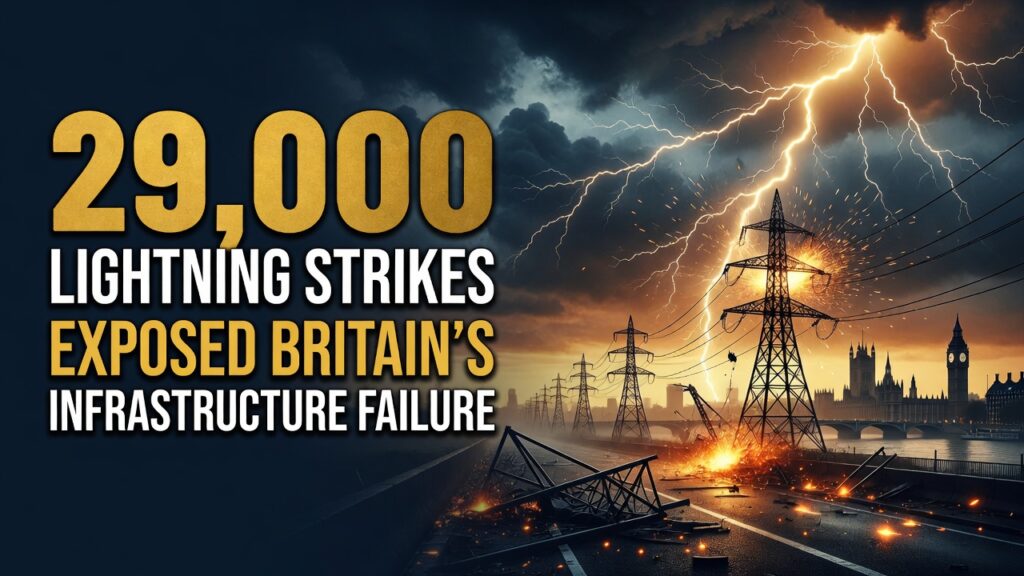
The storms came with 29,000 lightning strikes. The real story is what crumbled underneath them.
In the 24 hours ending 9am on Tuesday, June 24, the Met Office logged exactly 29,074 lightning strikes across England. Every single one over English soil. More than 18,500 of them hammered Somerset alone. London’s Fire Brigade answered 400 emergency calls in a single night. Two homes burned from lightning strikes. Bristol Airport went dark. Glastonbury lost power.
Then the real heat arrived — and Britain’s institutions folded one by one.
Support Independent Local Journalism
TheTownHall.News is a non-profit reader-supported journalism. Just $5 helps us hire local reporters, investigate important issues, and hold public officials accountable across Alameda County. If you believe our community deserves strong, independent journalism, please consider donating $5 today to support our work.Did Britain Just Discover Its Infrastructure Was Built for a Climate That No Longer Exists?
The thunderstorms weren’t a freak accident. They were the atmospheric pressure valve on a heat dome that had been building for days — a vast high-pressure system parked over western Europe, trapping solar energy, superheating the ground, and pushing warm, moisture-saturated air skyward until the skies cracked.
By Wednesday morning, the Met Office had issued a Red Warning for Extreme Heat — covering a corridor from London to Swansea, Somerset to Birmingham. These warnings are reserved for events that pose a danger to life. It was the first Red heat warning in years.
Then they issued another one Thursday.
Then another Friday.

Three consecutive Red heat warnings for extreme heat — a first in the entire history of the UK’s weather warning system.
And the temperatures to match: on June 24, the June temperature record fell. It fell again June 25. Again June 26, when Santon Downham in Suffolk reached 37.3°C — shattering a record that had stood since 1957. The previous June benchmark of 35.6°C was obliterated by nearly two full degrees.
What Caused 29,000 Lightning Strikes in One Night?
The physics aren’t complicated, but the scale is extraordinary.
Southern England spent Monday baking in temperatures climbing through the high twenties and low thirties. That surface heat transferred massive energy into the lower atmosphere. Warm, moisture-heavy air rose rapidly, cooled, condensed into towering cumulonimbus clouds reaching several kilometres into the sky — the kind of storm architecture more commonly seen over the Gulf of Mexico than the English Channel.
Inside those clouds, colliding ice crystals and water droplets built up enormous electrical charge. When the voltage differential between cloud and ground became too great, it discharged. Twenty-nine thousand times.
Support Independent Local Journalism
TheTownHall.News is a non-profit reader-supported journalism. Just $5 helps us hire local reporters, investigate important issues, and hold public officials accountable across Alameda County. If you believe our community deserves strong, independent journalism, please consider donating $5 today to support our work.Meteorologists say these storms now resemble what Florida and Singapore experience routinely. The UK has been warned about intensifying summer weather events for the better part of two decades. The question isn’t whether officials knew it was coming.
How Did Britain’s Institutions Actually Perform?
Poorly. And the receipts are public.
The London Fire Brigade activated Operation Willow Beck — its emergency flood protocol — to triage life-threatening calls. Lightning ignited house fires in London and Emersons Green, Bristol. Power went out across Glastonbury, Shepton Mallet, and parts of Bristol. Up to 35mm of rain fell in Somerset in hours, overwhelming drainage systems and triggering flood alerts near Glastonbury. Bristol Airport suspended flights due to an Air Traffic Control system failure linked to the storm.
Schools closed or sent children home early for multiple days across England and Wales. The UK Health Security Agency declared a Red health alert across six English regions, warning of “a risk to life for even the healthy population.” The RNLI issued public warnings about cold water shock. Hospitals strained under the demand.
By Friday, the overnight low in Gosport, Hampshire, hadn’t dropped below 20°C — a tropical night, in England, in June. Eight other locations matched it.
This is the second record-breaking heatwave of 2026 alone. The first, in May, killed at least 19 people in water-related incidents and broke records at Kew Gardens with 35.1°C. The June heatwave exceeded that mark by more than two degrees. Britain broke records in both May and June of the same year — something that last happened in 1911.
Who Is Actually Accountable Here?
Britain has had 20 years of warnings, climate adaptation budgets, and infrastructure reviews. So why did a single night of storms knock out an airport, flood a city, and overwhelm the Fire Brigade?
The UK government has spent billions on climate adaptation commitments. The Environment Agency has published flood risk strategies. Successive administrations — Conservative and Labour alike — have pledged infrastructure resilience. Bristol Airport is a major regional hub. London’s drainage network dates in large parts to the Victorian era and has seen cosmetic upgrades at best.
29,000 lightning strikes exposed what those commitments actually built: very little.
Researchers at the University of Reading noted that unlike previous heatwaves, elevated humidity in this event made conditions physiologically more dangerous — the body’s primary cooling mechanism becomes less effective when the air is already saturated. That’s not a new finding. It’s been in the scientific literature for years. The question is whether anyone in Whitehall was reading it and building accordingly.
The Met Office says these conditions are now producing storms comparable to subtropical regions. If that’s the new baseline, the gap between what Britain’s infrastructure can handle and what the weather now delivers is not a climate science problem. It’s a governance failure.
Counterargument: Is This Just an Unusually Bad Summer?
Critics of the infrastructure failure framing will argue that no government can build for a once-in-a-century event. Drainage systems, power grids, and airports are engineered for statistical norms, not outliers. Three consecutive June records is an extreme tail event; designing for it would be prohibitively expensive.
Fair point — to a degree. But here’s what’s harder to argue away: this is the second major heat emergency in six weeks. The May heatwave killed 19 people. June broke records three days running. The all-time UK temperature record of 40.3°C was set just four summers ago, in July 2022 — and this June came within three degrees of it. At what point does “outlier” become “new operating condition,” and at what point do officials have to answer for why the infrastructure hasn’t kept pace?
“Unprecedented” is only a defense once.
Key Questions
- Why did Bristol Airport’s Air Traffic Control fail during a storm the Met Office had forecast days in advance? Who is accountable for that infrastructure gap?
- London’s drainage system is largely Victorian. Who approved the budget cycles that left it there? How many flood events does it take before that changes?
- The UK Health Security Agency issued a Red health alert across six regions. How many of those regions had functioning cooling centers, public health infrastructure, and hospital surge capacity?
- This is the second record heatwave of 2026. What is the government’s formal plan for the third?
The storms have passed. The heat is easing as of this weekend. The records set this week are permanent. The infrastructure that failed is still the same infrastructure that will face the next event.
Britain has been warned about this for 20 years. When does someone have to answer for what they built — or didn’t?