Gaza Ceasefire Strike on Funeral: What Reports Confirm?
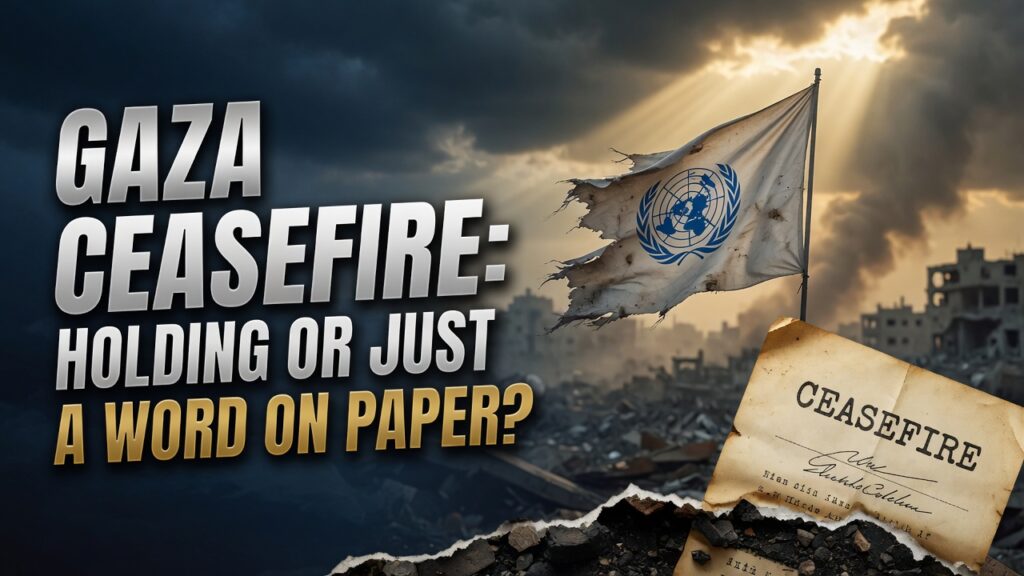
As Israeli strikes continue nearly ten months after a ceasefire was signed, a growing number of observers are asking a blunt question — what does the word “ceasefire” even mean if people keep dying under it?
A funeral in Gaza turned into a mass casualty scene this week. On Friday, July 17, 2026, an Israeli strike hit a crowd of mourners gathered at a funeral in the Nuseirat refugee camp in central Gaza, killing at least seven people and wounding 22 more, according to Al-Awda Hospital. The strike lands nine months after Israel and Hamas signed a ceasefire meant to end a two-year war, and it raises a question that has been building for months: does that agreement actually mean anything?
What Actually Happened in Nuseirat?
The mourners had gathered to bury a Palestinian killed earlier that same day, in a separate strike the Israeli military said targeted a Hamas militant. Hours later, while the funeral procession was underway, a second Israeli strike hit the gathering itself. Al-Awda Hospital confirmed seven dead and 22 wounded from that strike alone.
Asked about the attack, the Israeli military said it had targeted a cell belonging to Palestinian Islamic Jihad, a militant group that operates alongside Hamas in Gaza. The military added it was aware of claims that several uninvolved individuals were harmed — an acknowledgment, without a full accounting, that civilians may have been among the dead. Hamas called the strike “a heinous crime.” Neither side has released a verified, independent breakdown of exactly who was killed. That gap, between a strike carried out in real time and an accounting that may never fully arrive, is where accountability tends to disappear.
Why Are Strikes Still Happening Under a “Ceasefire”?
If a ceasefire doesn’t stop the killing, is it really a ceasefire at all?
That is the question Gaza’s death toll keeps forcing back into view. Israel and Hamas reached their truce in October 2025, and the heaviest, front-line fighting genuinely has stopped. But near-daily strikes have not. Gaza’s Health Ministry — an agency whose casualty figures wire reporting describes as generally viewed as reliable by U.N. agencies and independent monitors, even though it operates under Hamas-led governance — says at least 1,123 Palestinians have been killed in the territory since the ceasefire took effect.
Israel says its strikes are targeted responses to ongoing violations. Militants have continued shooting attacks on Israeli troops stationed in Gaza, and four Israeli soldiers have reportedly been killed since October. In some areas near Deir al-Balah, residents say Israeli forces have used drones to broadcast evacuation warnings, pushing families out of their homes even though the guns are supposed to be quiet under the truce.
Support Independent Local Journalism
TheTownHall.News is a non-profit reader-supported journalism. Just $5 helps us hire local reporters, investigate important issues, and hold public officials accountable across Alameda County. If you believe our community deserves strong, independent journalism, please consider donating $5 today to support our work.1,123. That is the number of Palestinians reported killed in Gaza since a ceasefire was supposed to end the killing. The question nobody enforcing that agreement seems eager to answer: at what point does the word “ceasefire” require a new definition?
Who Is Actually Being Held Accountable Here?
This is where the story stops being about one strike and starts being about a structural failure. The Israeli military acknowledged that civilians may have been harmed, but acknowledgment is not investigation, and a statement is not an accounting. Hamas does not typically disclose its own combatant losses, which leaves outside observers comparing incomplete numbers from both sides of a truce that neither side is fully transparent about enforcing.
If the rules of a ceasefire can be bent every time convenience demands it, whose rules are they, really?
That is the uncomfortable question sitting underneath every one of these incidents. A ceasefire that both sides can quietly test without consequence is not really a ceasefire. It is a pause with no enforcement mechanism, and mourners in Nuseirat just found that out at their own funeral.
Is This Part of a Larger Pattern?
The Nuseirat funeral strike is not an isolated data point. Just over a week earlier, on July 7, 2026, an Israeli strike killed Mohammed al-Wahidi, a director with Egypt’s aid committee in Gaza who had organized World Cup screenings for displaced families, along with three other people in a separate incident in Gaza City. Hundreds of mourners turned out for his funeral as well. The two incidents are distinct — different victims, locations, and stated targets — but together they sketch the same pattern: a ceasefire that has reduced large-scale combat without eliminating the strikes that keep producing funerals in the first place.
That pattern matters because it changes the burden of proof. A single strike can be explained as an isolated intelligence call. A pattern of strikes hitting gatherings tied to mourning, spread across weeks and neighborhoods, starts to look like a policy question rather than a one-off. It is fair to ask whether the rules of engagement under this ceasefire have ever been made public in enough detail for outside observers, including American taxpayers whose government maintains a close relationship with Israel, to judge whether they are being followed.

What Do the Numbers Actually Tell Us?
Set against the overall death toll, the casualty count from any single strike can look almost routine — which is itself part of the problem. Seven dead and 22 wounded at one funeral is a single entry in a running total that has now passed 1,100 since a deal was signed to stop exactly this kind of thing. Four Israeli soldiers killed by militants over the same period shows the danger runs in both directions, even under a truce. None of these numbers, on their own, resolve who is right. But together, they describe a ceasefire that is holding in name only — a document signed in October that has not, in practice, stopped the deaths it was designed to prevent.
Key Questions This Story Raises
- Who is verifying casualty claims from strikes like this one, and how quickly?
- What mechanism, if any, actually enforces the terms of the October ceasefire?
- If neither side fully discloses its losses, can the public ever get an accurate picture of what a “ceasefire” is actually costing?
What Do Supporters of This Policy Actually Believe?
Supporters of Israel’s continued strikes make a specific argument. A ceasefire, in their view, does not require unilateral disarmament, and militant groups like Palestinian Islamic Jihad have not stopped operating simply because a truce was signed. Striking an active militant cell, even one gathered at a funeral, is in their reading a legitimate response to an ongoing threat rather than a violation of the agreement’s spirit.
That argument carries real weight. No ceasefire has ever required one side to ignore active combatants, and Israel is not wrong that shooting attacks on its troops have continued since October. But the argument runs into a harder problem. When a strike kills mourners alongside its intended target, and no independent body verifies who was actually present, a targeted response becomes very difficult to distinguish from indiscriminate force after the fact. Accountability requires proof, not just intent — and intent alone does not answer for a funeral turned into a casualty site.
Where Does This Leave the Ceasefire?
The immediate question is whether this specific strike was justified under the terms both sides agreed to. The larger one is harder to shake. If a signed ceasefire still allows funerals to become killing sites nine months later, what exactly is the ceasefire holding back?
That is the question worth sitting with long after this week’s headlines fade. The real question is not whether Gaza’s ceasefire will be tested again. It is whether anyone will actually be held accountable when it is.
Still have questions about how this story develops? Stay informed — subscribe for daily coverage. Think others need to see the facts laid out plainly? Share this article. Want your voice to count on how U.S. policy engages with this conflict? Contact your member of Congress and ask what oversight exists over ceasefire enforcement in Gaza.