Did Iran Just Blow Up Its Own Peace Deal? IRGC Strikes U.S. Targets 10 Days After Versailles
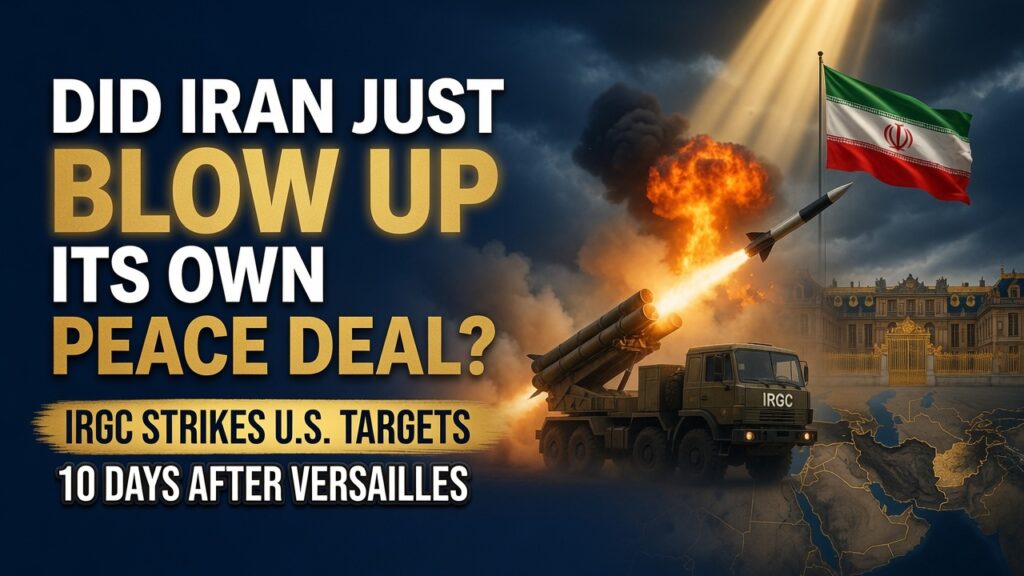
The ink on the ceasefire wasn’t even dry. Ten days after Donald Trump and Iranian President Masoud Pezeshkian signed the Islamabad Memorandum at the Palace of Versailles, U.S. fighter jets are striking Iranian soil again, the IRGC has fired on American military positions across the Gulf, and a Singapore-flagged cargo ship lies damaged in the Strait of Hormuz with a suicide drone hole in its hull. The ceasefire that was supposed to end a four-month war isn’t holding — and both sides are already pointing the finger at each other.
What Exactly Did the U.S. and Iran Actually Agree To?
Before unpacking the collapse, it’s worth understanding what was signed in the first place — because the Islamabad Memorandum may be the most ambitious-sounding and least specific peace document in modern U.S. diplomatic history.
Support Independent Local Journalism
TheTownHall.News is a non-profit reader-supported journalism. Just $5 helps us hire local reporters, investigate important issues, and hold public officials accountable across Alameda County. If you believe our community deserves strong, independent journalism, please consider donating $5 today to support our work.Signed electronically on June 14 and physically by Trump at Versailles on June 17, the MOU is a 14-point “framework agreement” that provides for an end to military strikes, the reopening of the Strait of Hormuz to commercial shipping toll-free for 60 days, an end to the U.S. naval blockade of Iranian ports, and a 60-day window to negotiate a permanent deal. JD Vance acknowledged it was “a very general document” roughly “a page and a half” long. The Washington Post
What it does not include: any specific accord on Iran’s nuclear program, its uranium stockpiles, its ballistic missile arsenal, or its network of regional proxy forces. Those issues were deferred entirely to future talks. The Washington Post
Iran’s Supreme Leader Ayatollah Mojtaba Khamenei said he had approved the agreement despite having a “different view,” elaborating no further. Iran’s chief negotiator Mohammad Bagher Ghalibaf called the agreement “a record of U.S. failure.” Trump characterized the MOU as representing Iran’s “unconditional surrender.” Both statements cannot be true. That contradiction is now playing out in real time. NPRWikipedia
How the Ceasefire Fell Apart in 10 Days

June 17: Trump signs at Versailles. CENTCOM removes the naval blockade. Pakistan announces the Strait will reopen “instantly.”
June 18–24: Low-level skirmishing continues in Lebanon. Israel, which was not party to the MOU negotiations and explicitly rejected the notion that the deal applied to Lebanon, continues strikes on Hezbollah positions. Iran accuses the U.S. of allowing Israel to violate Article One of the memorandum, which calls for permanent termination of military operations on all fronts.
June 25: Iranian forces launched a one-way attack drone at the M/V Ever Lovely, a Singapore-flagged cargo ship exiting the Strait of Hormuz along the Omani coast. Trump told reporters Iran fired four drones — “we knocked down three.” One got through and struck the vessel’s bridge. All crew survived. NPR
June 26: CENTCOM retaliated, striking Iranian missile and drone storage locations as well as coastal radar sites, calling the drone attack “unwarranted aggression” that “clearly violated the ceasefire.” Fox News, citing a senior U.S. official, reported that the U.S. military used six aircraft to strike four targets along Iran’s coastline and on Qeshm Island. This was the first U.S. military strike against IRGC targets since the MOU was signed. NPRMedical Marketing + Media
June 27: The IRGC Navy announced it had targeted U.S. military positions in the region in response to what it described as U.S. “aggression and breach of commitments.” Bahrain — host of the U.S. Navy’s Fifth Fleet — condemned what it called an Iranian drone strike on its territory, calling it a flagrant violation of its sovereignty and “a blatant threat to the security of its citizens.” Encyclopedia BritannicaWikipedia
Support Independent Local Journalism
TheTownHall.News is a non-profit reader-supported journalism. Just $5 helps us hire local reporters, investigate important issues, and hold public officials accountable across Alameda County. If you believe our community deserves strong, independent journalism, please consider donating $5 today to support our work.The ceasefire, ten days old, is now an active exchange of fire.
Both Sides Are Accusing Each Other of the Same Violation
Here is where the story gets genuinely alarming: the legal dispute at the center of this collapse is not about whether the ceasefire exists — it’s about what the ceasefire actually means.
The IRGC explicitly invoked Article Five of the Islamabad Memorandum, which it says places responsibility for controlling transit through the Strait of Hormuz with the Islamic Republic of Iran. In the IRGC’s view, the U.S. sought to “violate this commitment through various provocations.” Encyclopedia Britannica
The U.S. position is the opposite. The U.S.-approved route for ships to travel through the Strait of Hormuz involves hugging the Omani coastline, while Iran has called for ships to travel along a northern route — closer to Iranian-controlled waters. Two countries that signed the same document have produced two entirely incompatible readings of who controls the world’s most critical oil chokepoint. BizPac Review
20% of the world’s oil supply transits the Strait of Hormuz. Every escalation cycle adds days — or weeks — to the full reopening timeline. Treasury Secretary Scott Bessent told Americans this week that gasoline prices are coming down. That assurance was made before today’s strikes.
The Fault Lines That Were Always There
This didn’t happen by accident. The memorandum was structurally fragile from the moment it was signed.
Israel never accepted it. Israel expressed strong disapproval of the Islamabad Memorandum and intended to continue military operations in Lebanon. Israel was not part of the U.S.-Iran negotiations, and Israeli officials indicated military operations would continue regardless of the MOU’s wording. Iran has used every Israeli strike in Lebanon as justification to accuse the U.S. of violating the deal. The Washington Post
The nuclear question was punted entirely. Unlike the 2015 JCPOA, which attempted to regulate centrifuges, stockpiles, enrichment levels, and inspections with specific technical parameters, the Islamabad Memorandum avoids all such precision and creates only a temporary political framework within which those issues may be discussed. Iran still has weapons-grade uranium. That hasn’t changed. NBC News
Mines in the Strait were never cleared. Iran reportedly lost track of mines it planted in the Strait of Hormuz during the war, making it unable to fully open the strait. The dispute over which shipping lane is “authorized” under the MOU is, at its core, a dispute about which route avoids those mines — and who is responsible for clearing them. The White House
Oman is already positioning to charge tolls. Omani authorities reportedly told European officials this week there is “no way of going back to the pre-war status quo” and that ships may be charged fees for passage — potentially in collaboration with Iran. The Trump administration has rejected any such arrangement. Iran has long maintained sovereign claims over Strait navigation. The MOU papered over that dispute without resolving it.
The Supreme Leader signed it reluctantly — and said so publicly. Khamenei issued a written statement saying he endorsed the memorandum despite misgivings. That is a political signal to the IRGC hardliners who never wanted the deal. The Washington Post
What Happens Now?
Trump said Friday: “Obviously, this is a foolish violation of our Ceasefire Agreement.” Vance was blunter: “If they have disagreements about how the MOU is being applied, they can pick up the phone. But violence will be met with violence.” WikipediaWikipedia
The head of Iran’s parliament’s national security commission responded: “The failed U.S. President has shown he has no commitment to the principles of negotiation or a ceasefire.” Al Jazeera
The 60-day clock on the Islamabad Memorandum runs to approximately mid-August — right before midterm election season. That window was supposed to produce agreements on Iran’s nuclear program, its missile arsenal, sanctions relief, the release of up to $25 billion in frozen Iranian assets, and a $300 billion regional reconstruction package. None of those talks have meaningfully advanced. Instead, both sides are trading strikes and statements.
The question is no longer whether the Islamabad Memorandum is fragile. It is whether it still exists.