Venezuela Earthquake 2026: Twin 7.5 Quakes Kill 164, Thousands Feared Dead
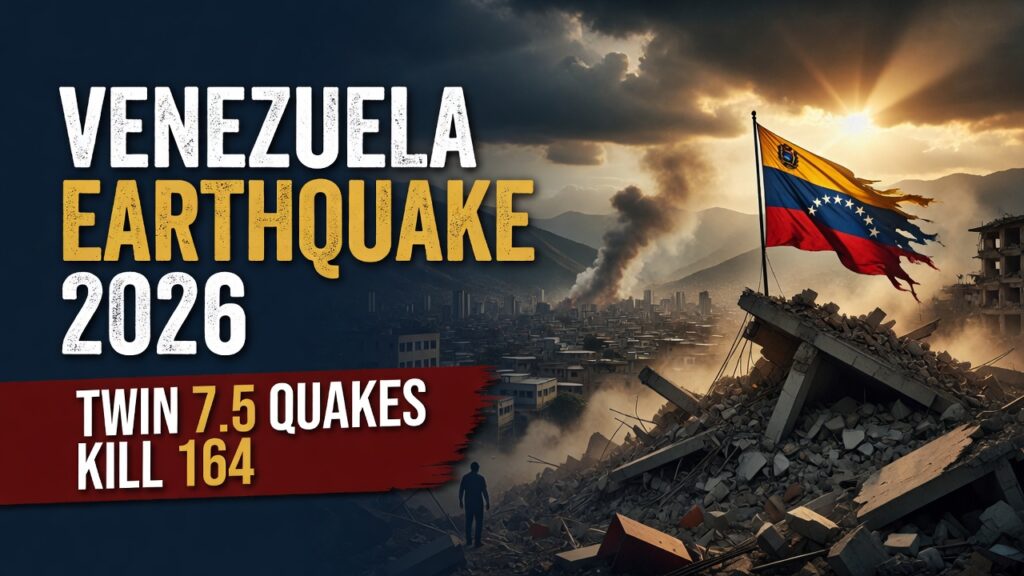
Twin earthquakes just dealt the most devastated country in the Western Hemisphere its worst blow in over a century. What comes next may reshape the entire region.
Wednesday evening felt like any other national holiday in Venezuela — families home, streets quiet, people marking the 205th anniversary of independence from Spain. Then, at 6:04 p.m. Eastern, the ground split open.
A magnitude 7.2 earthquake struck near San Felipe. Thirty-nine seconds later, a 7.5 hit near Yumare. Back to back. The most powerful one-two seismic punch Venezuela has experienced in more than 125 years.
Support Independent Local Journalism
TheTownHall.News is a non-profit reader-supported journalism. Just $5 helps us hire local reporters, investigate important issues, and hold public officials accountable across Alameda County. If you believe our community deserves strong, independent journalism, please consider donating $5 today to support our work.By Thursday morning, at least 164 people were confirmed dead and 971 injured — numbers the government itself acknowledged would rise sharply. The U.S. Geological Survey issued a rare red alert and its predictive models put the likely final death toll in the thousands, with a substantial probability of surpassing 10,000.
Venezuela was already on its knees. Now the ground beneath it is gone.
“It Looked Like Something Out of a Horror Movie”
Maria Alejandra was inside her Caracas building when the shaking started.
“I managed to get dressed as all the walls cracked. We somehow managed to get the door open. There was a cloud of dust that made it impossible to see,” she told Al Jazeera. “When we went downstairs, it looked like something out of a horror movie. We had to climb over the rubble from the building. I only saw one family make it out.”

Twenty-five-year-old Luis Alejandro Ruiz Garcia had a split-second warning — a Google earthquake alert — before violent shaking tore through his apartment. “You could feel things falling. I saw one of my walls crack,” he said. “I think it was one of the scariest moments of my life.”
Thousands of Caracas residents spent Wednesday night sleeping in the streets or in their cars, too afraid to go back inside.
A 14-story building was leveled. Dozens of others collapsed across the capital, including a bank. The coastal state of La Guaira — just 30 kilometers north of Caracas — bore the worst of it and has been declared a disaster zone. A waterfront hotel in Macuto is now rubble. In one half-mile stretch of road in Caraballeda alone, at least eight apartment blocks were leveled, along with shops and storefronts.
Simón Bolívar International Airport, situated directly in the impact zone, sustained severe structural damage. The runway cracked. All flights were canceled. Schools, metro lines, and the Supreme Court suspended operations.
Then came the aftershocks. More than 100 of them.
Support Independent Local Journalism
TheTownHall.News is a non-profit reader-supported journalism. Just $5 helps us hire local reporters, investigate important issues, and hold public officials accountable across Alameda County. If you believe our community deserves strong, independent journalism, please consider donating $5 today to support our work.Why Venezuela Can’t Handle This Alone
Geophysicist Vashan Wright of UC San Diego put it plainly: Venezuela sits on a massive strike-slip fault zone straddling the Caribbean and South American tectonic plates. Caracas itself sits in a deep sedimentary basin that amplifies seismic waves. About 80% of Venezuela’s population lives in earthquake-prone areas, and most of the housing stock — especially the informal settlements climbing the hillsides around Caracas — was never built to withstand a quake of this magnitude.
That’s the geological reality. The political and economic reality is worse.
Under Nicolás Maduro’s regime — ousted by U.S. special forces in January — Venezuela’s economy imploded. Today the country carries public debt at roughly 180% of GDP, triple-digit inflation, a shattered healthcare system, and firefighters and rescue workers who lack basic equipment. The IMF has described socioeconomic conditions as “very difficult,” with high poverty, high inequality, and widespread shortages of basic services.
Acting President Delcy Rodríguez — Maduro’s former vice president, now running the country under U.S. pressure — declared a state of emergency Wednesday night. She said she’s coordinating with the IMF on an initial assistance fund of $200 million and confirmed the United Nations is dispatching specialized personnel.
Meanwhile, internet outages are compounding the chaos. More than 200 websites were already blocked in Venezuela. The state telecom provider announced it would offer free internet and phone service for 48 hours just to help people find their families.
One family in Colombia found out their relatives were alive through a WhatsApp message: “Lissett and Anarella are alive, they are removing the debris around them. Lissett has a broken leg but she’s been taken to hospital. They found them hugging under the rubble.”
For millions of Venezuelan diaspora across the Americas, that is what information looks like right now. A trickle through a cracked pipe.
The Geopolitics Nobody Is Saying Out Loud
Here is where the story gets complicated.
Trump was among the first world leaders to respond, posting on Truth Social that the U.S. was “ready, willing, and able to help” and calling Venezuelans “our new and great friends.” Secretary of State Marco Rubio announced the immediate deployment of search and rescue teams from Fairfax County, Virginia, and Los Angeles, as well as medical resources and aerial imaging to assess coastal damage.
It’s a notable pivot for an administration that, just five months ago, ordered the military abduction of Venezuela’s sitting president.
Since the January intervention, the U.S. has taken effective control of Venezuela’s oil exports — a figure the Council on Foreign Relations estimates surged from $600 million in January to $3.7 billion in April alone, with roughly $8 billion in total flows moving through the arrangement with limited public accounting. Now Treasury Secretary Scott Bessent says the U.S. might lift additional sanctions and unlock nearly $5 billion in frozen IMF Special Drawing Rights to help rebuild.
Analysts are already asking the obvious question: Is this humanitarian aid, or is it leverage?
“On the one hand, aid will not be able to reach those in need,” said Sarah Schiffling, deputy director of Finland’s HUMLOG Institute. “On the other, this disaster will be used by the US to gain more influence in Venezuela.”
The USGS estimates a 39% probability of economic losses between $10 billion and $100 billion from the quakes — and a 30% probability of losses exceeding $100 billion, potentially equal to 20% of Venezuela’s entire GDP. A country that was already dependent on U.S.-controlled oil revenue just became significantly more dependent on Washington’s goodwill.
Italy, Spain, France, Switzerland, Brazil, El Salvador, and the Dominican Republic have all pledged support. European Commission President Ursula von der Leyen expressed solidarity. But the scale of the destruction means that international goodwill alone won’t be sufficient.
What Needs to Happen Now
The Venezuelan Red Cross said the full human toll is not yet known and that aftershocks continue to pose active risks to both survivors and rescue teams. Immediate priorities, it said, include search and rescue, emergency shelter, and trauma care. In the days ahead: safe water, sanitation, and essential household supplies.
Rescuers are already pulling people from the rubble. A video aired on Venezuelan state TV showed three children emerging from debris in La Guaira, apparently uninjured, as rescue workers rushed to assist them.
But the airport is cracked. The roads in La Guaira are lined with collapsed buildings. Internet is spotty. And the country’s first responders are under-equipped even in normal times.
Key Questions
Will the death toll reach the USGS’s worst-case projections? Models suggest it could surpass 10,000. The coming 72 hours of rescue operations will be decisive.
Can international aid actually get in? With the airport damaged and the Rodriguez government still navigating U.S. sanctions, logistics will be a serious bottleneck.
Does this disaster give Washington more leverage over Venezuela’s political future? The U.S. controls the oil, is now the main aid donor, and has given no timeline for democratic transition. The earthquake may accelerate Venezuela’s de facto dependency.
Who fills the vacuum on the ground? With formal institutions — courts, schools, metro — suspended and internet censorship in place, civil society and diaspora networks are already doing triage. Whether they can scale matters enormously.
This is a developing story. The Town Hall News will continue to update as rescue operations proceed and the full scope of the damage becomes clear.