Israel Smashed a Jesus Statue in Lebanon — Then Claimed Credit for Fixing It
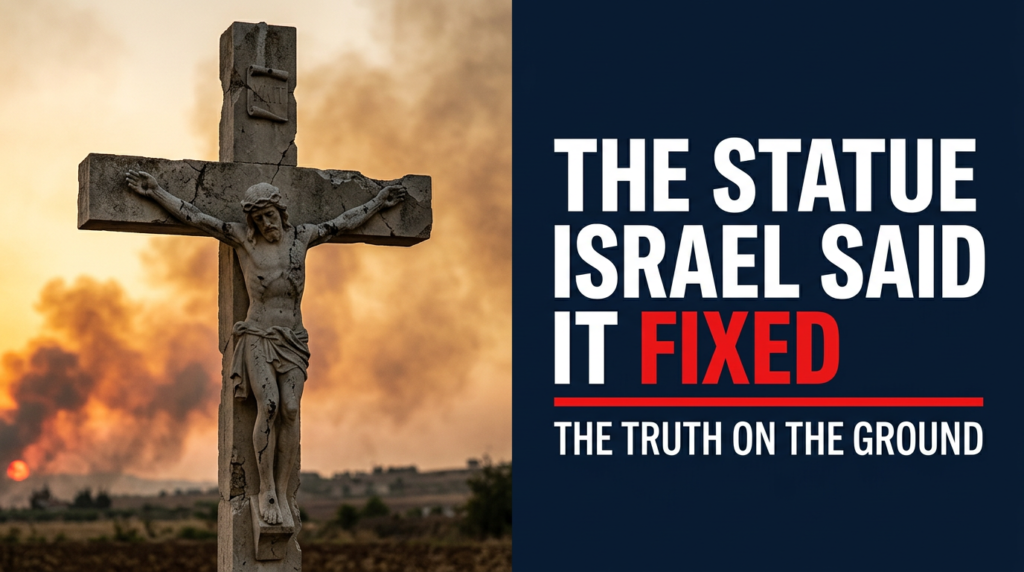
An IDF soldier destroyed a sacred Christian monument in southern Lebanon — then Israel launched a PR campaign to take credit for the repair. But peacekeepers on the ground tell a very different story.
A sledgehammer. A statue of Jesus Christ. A soldier in uniform.
When that image surfaced online on April 19, 2026, it didn’t just go viral — it detonated. The photograph, showing an Israeli Defense Forces soldier striking a crucifix in the village of Debel, southern Lebanon, sparked outrage across the political spectrum, from evangelical Christians in the American heartland to Catholic bishops in Rome. In a conflict already straining Western sympathy, this was a moment no PR team could spin away quietly.
Support Independent Local Journalism
TheTownHall.News is a non-profit reader-supported journalism. Just $5 helps us hire local reporters, investigate important issues, and hold public officials accountable across Alameda County. If you believe our community deserves strong, independent journalism, please consider donating $5 today to support our work.Except Israel tried anyway. And that attempt — more than the original act of vandalism — reveals something important about accountability, truth, and who gets to write the narrative when the cameras are rolling.
What Actually Happened in Debel
The facts are not in dispute. An IDF soldier was photographed using a sledgehammer to smash a statue of the crucified Christ in Debel, a village in the Nabatieh governorate of southern Lebanon. A second soldier filmed the act. The images spread across social media within hours.
By Monday, April 21, the IDF had confirmed the incident. By Tuesday, Israel announced that both soldiers had been jailed for 30 days and removed from combat duty. Six additional soldiers were summoned for questioning.
Israeli Prime Minister Benjamin Netanyahu, consistent with his long-standing talking points, stated that Israel “respects all religions.” His office moved quickly — not just to discipline the soldiers, but to announce that the IDF had replaced the damaged statue, claiming it acted “in coordination with the local Christian community.”

It was a tidy narrative: vandalism occurred, soldiers were punished, damage was repaired. Case closed.
There was just one problem.
Italy’s UNIFIL Forces Say Israel Didn’t Fix It
According to Italian UNIFIL forces stationed in Debel — the United Nations peacekeeping contingent with boots on the ground in the very village where this occurred — the statue was not repaired by the IDF.
This is not a minor discrepancy. Israel’s public messaging specifically credited its own military with replacing the statue as a gesture of goodwill and religious respect. If peacekeepers on the scene say that didn’t happen, then what the world witnessed was not accountability. It was a carefully managed image operation.
This matters deeply to anyone who values honesty in public life. The original act of vandalism was wrong and deserved punishment. But attempting to claim unearned moral credit — particularly when international observers can contradict you — compounds the offense. Accountability means owning what you did and what you didn’t do. It does not mean staging a redemption arc for the cameras.
Support Independent Local Journalism
TheTownHall.News is a non-profit reader-supported journalism. Just $5 helps us hire local reporters, investigate important issues, and hold public officials accountable across Alameda County. If you believe our community deserves strong, independent journalism, please consider donating $5 today to support our work.Why Christians Are Paying Attention
For many American Christians — particularly the evangelical and Catholic communities that form a significant part of the conservative coalition — this story is not distant or abstract. It is personal.
The Rossing Center for Education and Dialogue, an interreligious organization based in Israel, recorded 155 incidents targeting Christians in Israel in 2025, a sharp increase from the previous year. Physical assaults accounted for nearly 40 percent of those incidents. Priests and nuns in Jerusalem reported being harassed simply for wearing visible Christian symbols in public spaces.
Just months earlier, in March 2026, Netanyahu had to personally explain why Israeli police blocked Cardinal Pierbattista Pizzaballa, the Latin Patriarch of Jerusalem, from entering the Church of the Holy Sepulchre on Palm Sunday. The explanation? “Concern for his safety.”
And in April 2025, the IDF had already destroyed a statue of Saint George in the town of Yaroun, also in southern Lebanon, with videos capturing the demolition.
A pattern is not a coincidence.
The Political Calculation Behind the Outrage Management
Yossi Mekelberg, a senior consulting fellow at Chatham House, was direct in his analysis: Israel’s swift response to the Debel vandalism was driven in large part by the political need to preserve its relationship with Christian supporters in the United States — including figures like US Ambassador Mike Huckabee, a prominent Christian Zionist whose influence in the Trump administration is well established.
“This, and the attacks upon mosques by settlers and the killing of Palestinians, are all war crimes. The problem is that we don’t know how widespread it is. We only know about this one because they filmed it.” — Yossi Mekelberg, Chatham House
That quote deserves to land with full weight. The discipline of these two soldiers — remarkable precisely because Israeli military investigations almost never result in accountability — happened because there was footage. Because the world was watching. Because Christian voters in America were angry.
That is not justice. That is reputation management. And citizens who believe in equal application of the law should recognize the difference.
What Critics Get Wrong — And What They Get Right
Some voices will argue that punishing the soldiers proves the system works — that accountability happened, and the story should end there. That is a fair point, and it deserves a fair response.
The soldiers were punished. That is correct and appropriate. Swift, visible consequences for misconduct reflect the kind of law-and-order standard that any functioning military must uphold. On that narrow point, Israel acted.
But accountability cannot be selective. It cannot be reserved for incidents that trend on social media and threaten diplomatic relationships. The same standard applied to two soldiers photographed smashing a Christian statue must apply with equal force when the cameras aren’t rolling — whether the targets are Christian symbols, mosques, or unarmed civilians.
When punishment depends on optics rather than principle, it is not justice. It is crisis management wearing justice’s clothing.
The Repair That Wasn’t: A Lesson in Information Integrity
In an era of curated narratives and strategic communications, the UNIFIL contradiction to Israel’s repair claim is a small but instructive example of why independent verification matters.
Governments — all governments — have an incentive to control their own stories. The tools available to do so have never been more powerful or more sophisticated. A press release, a social media post, a video of a new statue being installed: these are the instruments of modern narrative architecture.
This is precisely why independent journalists, international observers, and on-the-ground peacekeepers remain essential. The Italian UNIFIL contingent in Debel didn’t hold a press conference. They simply corrected the record. That correction — unspectacular, undramatic, and quietly devastating — is exactly the kind of accountability that free societies depend on.
When a government claims credit for fixing what it broke, the first question a free press must ask is: did anyone on the ground actually see that happen?
The Broader Stakes for Religious Liberty
Freedom of religion is not a partisan value. It is a foundational one. The right to worship, to maintain sacred spaces, and to practice faith without fear of state-sponsored destruction is among the oldest and most essential liberties a civilization can protect.
When religious monuments are desecrated — regardless of which faith they represent — and when those responsible face no genuine consequences, the message sent to every minority faith community is the same: your sacred spaces are not safe, and power will protect its own interests before it protects your rights.
That message should disturb every reader who has ever stood in a church, a synagogue, a mosque, or any place they considered holy.
Conclusion: Accountability Is Not a PR Strategy
The story of the Jesus statue in Debel, Lebanon is not complicated. A soldier committed an act of desecration. The act was documented, condemned, and — eventually — punished. So far, so good.
What followed, however, was a lesson in how governments manage perception rather than practice genuine accountability. Israel announced a repair it apparently didn’t make. It accepted international credit for a gesture it may not have performed. And it moved quickly to protect not the principle of religious respect, but the political relationships that principle was threatening.
For readers who believe in honesty, transparency, equal application of the law, and the sanctity of religious life, this story demands more than a headline. It demands continued scrutiny.
The original sin was a soldier with a sledgehammer. The second sin was a government with a press release.
Both matter. Both deserve to be called what they are.
Share this article if you believe accountability must be more than optics. Stay informed — stories like this get buried fast. Support independent journalism that asks the hard questions long after the cameras move on.