US Withdrawal from WHO Is Complete: Why America Made the Right Call on Sovereignty and Accountability
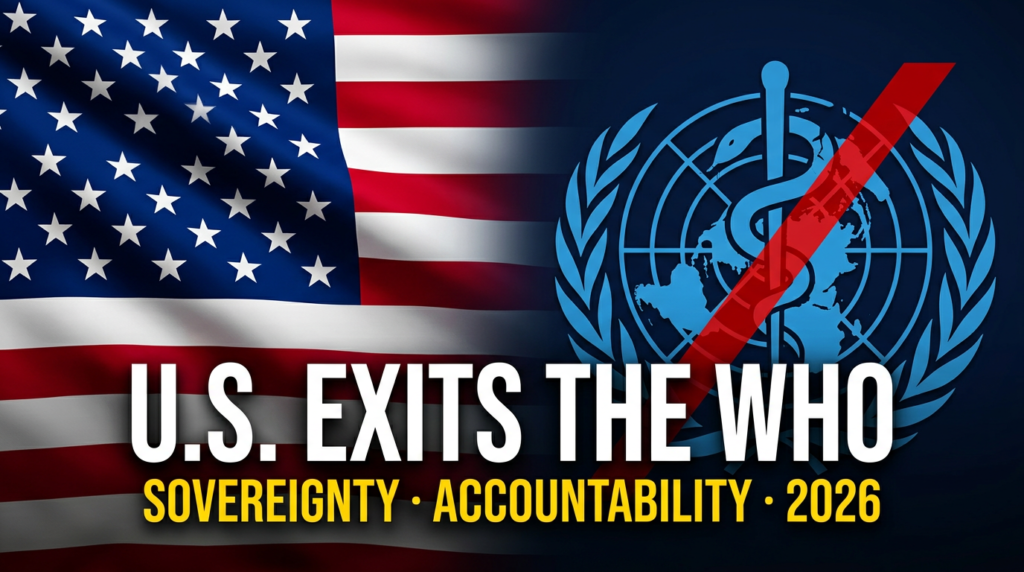
After decades of misplaced funding and political compromise, the United States has officially left the World Health Organization — and the case for this decision is far stronger than its critics will admit.
On January 22, 2026, the United States formally completed its withdrawal from the World Health Organization, closing the door on nearly 78 years of membership in one of the United Nations’ most politically entangled institutions. It was a moment years in the making — and for millions of Americans who watched the WHO fumble catastrophically through the COVID-19 pandemic, it was long overdue.
This wasn’t a reckless act of isolationism. It was a deliberate, methodical decision, initiated through Executive Order 14155 signed by President Trump on January 20, 2025, and executed across a full yearlong transition period that included a funding freeze, full personnel withdrawal, and a strategic pivot toward direct bilateral health partnerships. Whatever your politics, the United States just made the most consequential shift in global health leadership in a generation — and the country deserves an honest accounting of why.
Support Independent Local Journalism
TheTownHall.News is a non-profit reader-supported journalism. Just $5 helps us hire local reporters, investigate important issues, and hold public officials accountable across Alameda County. If you believe our community deserves strong, independent journalism, please consider donating $5 today to support our work.What the WHO Got Wrong — And Why It Cost the World Dearly
The official reasons for withdrawal, as documented by the U.S. Department of Health and Human Services and the State Department, read like a damning performance review of an institution that had long since lost its way.
During the COVID-19 pandemic, the WHO delayed its declaration of a global public health emergency at a moment when every day mattered. It praised China’s early pandemic response publicly even as mounting evidence pointed to suppressed case data, withheld genetic sequences, and obstructed international investigators. The organization’s own report on COVID-19 origins — widely criticized by independent scientists — dismissed the possibility of a laboratory-linked origin while China refused to hand over basic biosafety information.
These were not bureaucratic missteps. They were systemic failures at the core of the WHO’s mission. The organization tasked with protecting global health became a vehicle for protecting the political interests of its most powerful member states. Critical weeks were lost. Lives were lost. And the United States — the WHO’s largest funder — was left watching from the sidelines as the institution it bankrolled failed in real time.
The Financial Reality: What American Taxpayers Were Actually Funding
For years, the United States was the WHO’s single largest government contributor. According to the WHO’s own financial records, the U.S. contributed $1.284 billion during the 2022–2023 biennium alone. Prior to the funding freeze, the U.S. was projected to provide approximately $958 million — nearly 15% of the agency’s roughly $6.5 billion budget — making it the dominant financial force in an organization it could not meaningfully control.

Fiscal accountability demands a basic question: what did American taxpayers get in return for that investment? The answer, increasingly, is not enough. A bloated multilateral bureaucracy headquartered in Geneva, operating under the influence of member states with competing geopolitical agendas, is not structurally capable of acting in America’s national interest — or, frankly, in the interest of global health when those priorities conflict with its political benefactors.
Withdrawing from the WHO is not merely a foreign policy statement. It is a statement about accountability: that no institution, however prestigious or entrenched, is immune to performance standards. American taxpayers are not a blank check.
Sovereignty, Science, and the Right to Lead Differently
One of the most underreported aspects of this withdrawal is what it signals about America’s future role in global health — not an exit, but a realignment.
The United States has not stopped engaging in global health. It has reoriented how it does so. In place of WHO-routed funding and layered multilateral bureaucracy, the U.S. is now pursuing direct bilateral health partnerships with other nations, working through the private sector, non-governmental organizations, and faith-based institutions with proven track records of delivery. U.S.-led priorities will focus on emergency response, biosecurity coordination, and health innovation — closer to the mission, and more directly accountable for results.
This model reflects a governing philosophy that many Americans instinctively understand: that proximity to the problem produces better solutions than distant centralized institutions. When you cut out an ineffective middleman, you can move faster, spend more efficiently, and hold partners accountable for outcomes rather than process.
Support Independent Local Journalism
TheTownHall.News is a non-profit reader-supported journalism. Just $5 helps us hire local reporters, investigate important issues, and hold public officials accountable across Alameda County. If you believe our community deserves strong, independent journalism, please consider donating $5 today to support our work.“America isn’t abandoning global health. It’s choosing to lead it on its own terms.” (share this)
What Critics Get Wrong About the Exit
Critics of the WHO withdrawal have raised two central objections: that leaving weakens global health security, and that it isolates the United States from essential international coordination mechanisms. Both arguments deserve honest engagement — and serious scrutiny.
On global health security: yes, the WHO plays a coordinating role in disease surveillance and outbreak response. But coordination is only as valuable as the institution performing it. The COVID-19 pandemic demonstrated that the WHO’s early warning systems failed precisely when the stakes were highest. Continued unconditional funding of a demonstrably unreformed institution is not a health policy — it’s an act of institutional loyalty masquerading as one.
On isolation: withdrawing from the WHO is not withdrawing from the world. The United States continues to maintain bilateral health agreements globally, fund disease programs through alternative channels, and deploy unmatched public health expertise through institutions like the CDC and NIH. Conflating departure from one multilateral body with global health isolationism is a false and misleading framing.
The real danger is not that the U.S. will stop engaging in global health. The real danger is that unreformed institutions will continue receiving unconditional funding — and continue failing the people they exist to serve.
The Bigger Picture: A Nation Reasserting Its Priorities
The WHO withdrawal does not stand alone. It is part of a broader, deliberate recalibration of America’s relationship with international institutions spanning trade policy, defense commitments, climate agreements, and global health. In January 2026, the Trump administration formally withdrew the U.S. from 66 international organizations, including 31 UN entities, citing mission drift, governance failures, and a systematic lack of accountability to taxpayers.
For Americans who believe in limited government, fiscal responsibility, and the primacy of national sovereignty, this represents something long overdue: a government willing to ask hard, uncomfortable questions about where public money goes and whether decades-old commitments still serve the American people.
These are not fringe positions. They are the foundational questions of democratic governance. And as institutional trust erodes globally, more citizens — not fewer — are demanding answers.
“The question was never whether America should engage with the world. The question is always: on whose terms, and with what accountability?” (share this)
Key Takeaway
The U.S. exit from the WHO is a realignment — driven by documented institutional failure, fiscal responsibility, and a reassertion of national sovereignty. The WHO failed during the most critical public health emergency of the modern era. American taxpayers funded that failure to the tune of over a billion dollars per biennium. And the U.S. government chose to stop.
History will not judge this decision by the diplomatic discomfort it caused. It will judge it by what is built in its place — and whether the WHO, now operating without its largest funder, finally finds the political will to reform.
The Verdict: Accountability Over Inertia
The era of open-ended financial commitments to unreformed bureaucracies, insulated from scrutiny and accountability, is being challenged head-on. That challenge is uncomfortable for those who benefit from the status quo. It is also, for millions of Americans who believe every dollar of public spending must be justified, exactly the kind of reckoning that was needed.
The WHO had decades to earn the trust placed in it. When the moment came, it chose politics over science, appeasement over transparency, and institutional preservation over public health. The United States noticed. And it responded accordingly.
This story is not over — it is just beginning. Follow it closely, share it widely, and make sure your voice is part of the conversation that shapes what comes next.
If this article informed your understanding of a critical policy issue, share it with someone who needs to read it. Independent journalism depends on engaged, informed citizens. Stay informed. Stay involved.