Nationwide Injunctions and Judicial Overreach: How Congress and the Supreme Court Are Fighting Back
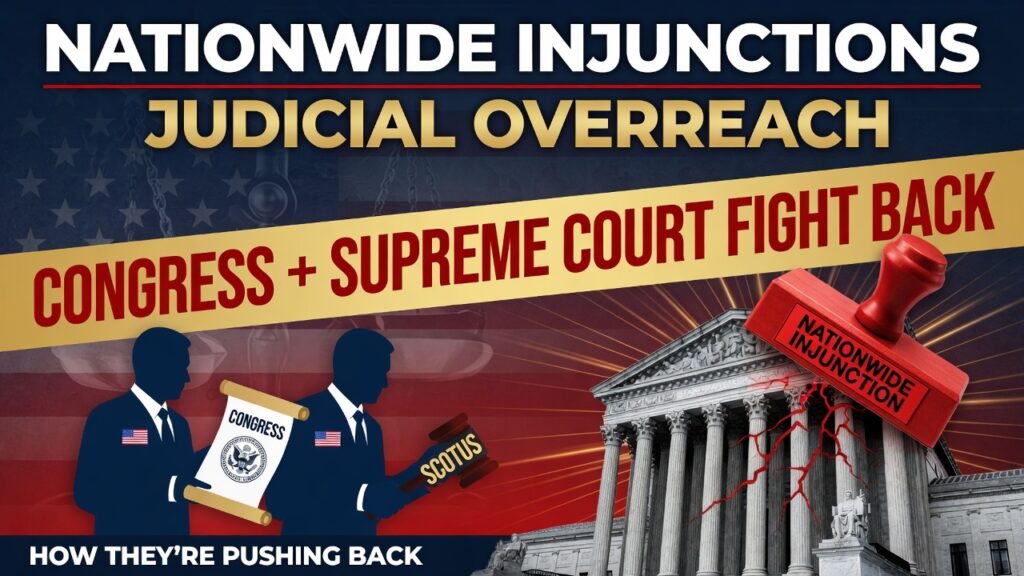
For decades, a single unelected district judge could freeze the entire executive branch in its tracks. A House-passed bill and a landmark Supreme Court ruling are changing that — and the implications for American self-governance are enormous.
Picture this: a president wins a national election with a clear policy mandate. Within weeks, a single federal judge in a politically sympathetic district issues a ruling — not just for the parties in front of the court, but for all 330 million Americans. The elected executive is stopped cold. No appeals court has weighed in. The Supreme Court hasn’t spoken. One judge, appointed for life, has effectively become a one-person veto over national policy.
That is not a hypothetical. It has been the operating reality of American government for years — and the pushback is now serious, bipartisan in origin, and backed by the highest court in the land.
Support Independent Local Journalism
TheTownHall.News is a non-profit reader-supported journalism. Just $5 helps us hire local reporters, investigate important issues, and hold public officials accountable across Alameda County. If you believe our community deserves strong, independent journalism, please consider donating $5 today to support our work.What Is a Nationwide Injunction — and Why Should You Care?
A nationwide injunction, also called a universal injunction, is a court order that prevents the federal government from enforcing a policy anywhere in the country — even against people who were never part of the lawsuit. Unlike a traditional injunction, which protects only the plaintiffs before the court, a universal injunction effectively makes one district judge’s opinion the law of the land.
Legal scholars have found no clear historical record of such an order being issued before 1963. The practice has exploded in recent decades, with both Republican and Democratic administrations on the receiving end. But the numbers in recent years have become extraordinary. According to Senate Judiciary Committee Chairman Chuck Grassley, in just the first two months of President Trump’s second term, district court judges issued more universal injunctions against his policies than the Biden administration faced across its entire four-year term.
This is not a functioning checks-and-balances system. It is a structural malfunction — and it is costing taxpayers and democratic accountability dearly.
The “No Rogue Rulings Act”: What Congress Did
In April 2025, the House of Representatives passed H.R. 1526, the No Rogue Rulings Act of 2025 (NORRA), by a vote of 219–213. Led by Rep. Darrell Issa (R-CA) and championed by House Judiciary Committee Chairman Jim Jordan (R-OH), the bill takes a measured, legally sound approach to the problem.

Under NORRA, federal district courts would be prohibited from issuing injunctive relief that applies beyond the actual parties to a case. A single judge in San Francisco or Washington, D.C., could no longer unilaterally halt a presidential executive order from taking effect across the entire country. There is a carefully crafted exception: if two or more states from different judicial circuits bring a challenge together, a three-judge panel — not a single judge acting alone — could still issue broader relief after weighing the interests of justice, the risk of irreparable harm, and the constitutional separation of powers.
The bill is now sitting in the Senate Judiciary Committee, referred there on April 10, 2025. It faces a steep path, requiring 60 votes to overcome a filibuster. Senate Majority Leader John Thune has acknowledged the problem needs to be addressed but has not committed to a floor vote.
“One unelected district judge should not have the power to halt the President of the United States from executing the policies the American people elected him to enact — that defies all common sense.” — House Majority Whip Tom Emmer
The Supreme Court Beat Congress to the Punch
While the Senate deliberated, the Supreme Court acted. On June 27, 2025, in a 6–3 decision in Trump v. CASA, Inc., the Court fundamentally reshaped the legal landscape around nationwide injunctions.
Justice Amy Coney Barrett, writing for the majority, held that universal injunctions “likely exceed the equitable authority that Congress has given to federal courts.” The ruling was grounded in the original Judiciary Act of 1789: because English equity practice at the Founding recognized only party-specific remedies, the Court concluded that nationwide injunctions lack statutory authority when they go beyond what is necessary to provide “complete relief” to the actual plaintiffs before the court.
The ruling was careful, not sweeping. Class action lawsuits — where large groups of affected parties formally join together — remain a valid path to broader relief. Justice Brett Kavanaugh noted separately that the Supreme Court itself retains the authority to issue nationally uniform interim decisions on major federal statutes and executive orders. The decision does not leave citizens without recourse; it ensures that recourse flows through proper legal channels rather than through one judge’s personal policy preferences.
Support Independent Local Journalism
TheTownHall.News is a non-profit reader-supported journalism. Just $5 helps us hire local reporters, investigate important issues, and hold public officials accountable across Alameda County. If you believe our community deserves strong, independent journalism, please consider donating $5 today to support our work.This is how the system is supposed to work.
What Critics Get Wrong
Opponents of these reforms — both the NORRA legislation and the Trump v. CASA ruling — argue that nationwide injunctions are essential safeguards against executive overreach. Without them, they say, an unlawful policy could harm millions of Americans who lack the resources to file their own lawsuits.
That concern deserves a genuine answer. And the answer is this: the class action mechanism exists precisely for situations involving large numbers of affected parties. Federal courts have certified nationwide classes before and will do so again. The difference is that class certification requires procedural rigor — actual plaintiffs, demonstrated harm, legal representation — rather than a single judge deciding unilaterally to grant blanket protection to the entire country.
Justice Sonia Sotomayor’s dissent in Trump v. CASA warned that the ruling “renders constitutional guarantees meaningful in name only” for those not party to a lawsuit. But Justice Jackson’s separate dissent went further, and in doing so revealed the core of the opposing argument: she argued that a district court’s reasoning, not just its orders, should have “universal adherence” when the Executive is involved. That is not a theory of checks and balances. That is a theory of judicial supremacy — a doctrine with no foundation in the Constitution’s text or original design.
Personal responsibility, civic engagement, and access to legal process are the answers to broad government harm — not a system where any plaintiff’s lawyer can pick a sympathetic judge and freeze national policy overnight.
The Real Cost of Leaving This Unchecked
The financial stakes are concrete. Senate Judiciary Chairman Grassley cited one example: a Biden-appointed judge issued a temporary restraining order against a pause on some USAID funding. Had the Supreme Court not intervened to require clarification, that order could have forced approximately $2 billion in taxpayer money out the door — most of it to organizations that never even sued.
Two billion dollars. Ordered by one judge. To non-parties. On a temporary basis.
This is fiscal accountability in reverse. Nationwide injunctions create a system where motivated legal organizations can weaponize the courts to drain government resources, delay legitimate policy implementation for years, and forum-shop for the most sympathetic venue — all without winning a single case on the merits.
Families and small business owners who depend on stable governance, predictable regulations, and a functioning executive branch pay the price.
Why This Moment Matters for Democratic Self-Governance
At its core, this issue is about who governs. The American founders created a system in which the people choose their leaders, those leaders implement policy, and courts adjudicate specific disputes according to law. They did not design a system in which a single district judge — unelected, unaccountable, and tenure-protected — could unilaterally suspend the acts of the elected branches for millions of Americans who have no say in the matter.
The No Rogue Rulings Act and the Trump v. CASA decision both restore something essential: the principle that judicial power is real, important, and bounded. Courts that respect their own limits are courts that the public can trust. Courts that routinely exceed those limits invite the kind of institutional backlash that ultimately harms everyone — including the judiciary itself.
The House has acted. The Supreme Court has spoken. The Senate must follow through.
The question is no longer whether nationwide injunctions are constitutional. The Supreme Court has answered that. The question now is whether Congress has the will to make that principle permanent in statute.
Key Takeaways
- The No Rogue Rulings Act passed the House 219–213 in April 2025 and is pending in the Senate Judiciary Committee.
- The Supreme Court ruled 6–3 in Trump v. CASA (June 2025) that universal injunctions exceed courts’ statutory authority under the 1789 Judiciary Act.
- Class actions remain valid as a pathway to broader relief — the reform does not eliminate judicial checks on the executive.
- Nationwide injunctions cost taxpayers and delay democratically enacted policy, often for years.
- Legislative action is still needed to codify the Supreme Court’s holding into permanent statute.
Stay Informed. Make Your Voice Count.
This debate goes to the heart of how American democracy functions — whether elected officials or unelected judges hold ultimate authority over national policy. Share this article with someone who cares about constitutional governance, judicial accountability, or limited government. Reach out to your senators and let them know where you stand on the No Rogue Rulings Act.
Independent journalism that holds institutions accountable depends on engaged readers. If this piece informed your understanding of a consequential legal and political debate, consider sharing it — and come back for continued coverage as the Senate weighs its next move.