Tulsi Gabbard CIA Office Raid Rumors: The Real Story Behind the JFK Files Standoff
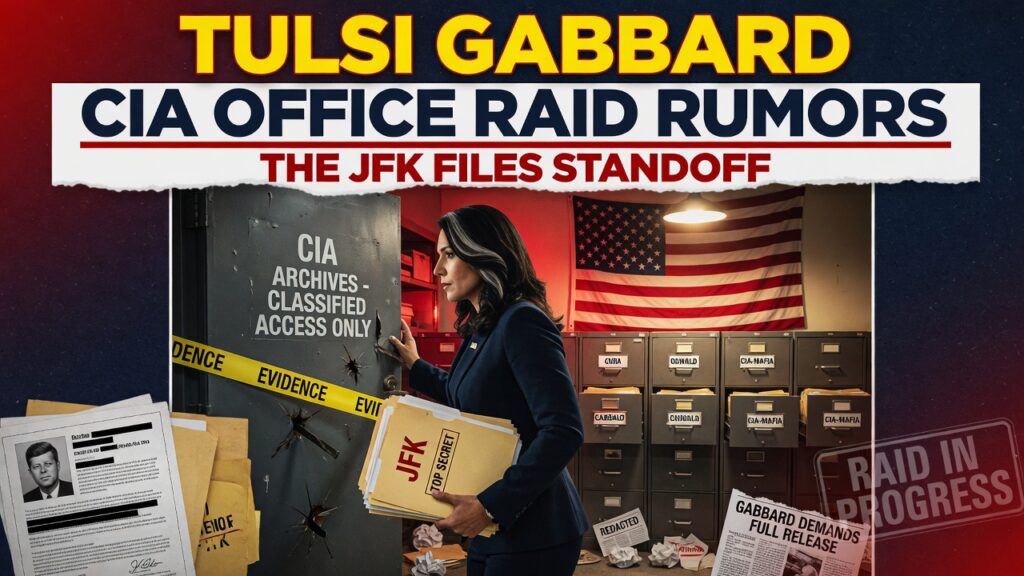
As conflicting reports swirl regarding the seizure of JFK and MKUltra files, Washington faces a critical reckoning over transparency, executive authority, and the rule of law.
The foundational premise of American governance is that the people rule through their elected representatives. For decades, however, a quiet skepticism has grown across the nation—a nagging suspicion that a permanent, unelected bureaucracy operates above the law, answering to no one. This tension exploded into the public square this week following explosive allegations that the Central Intelligence Agency (CIA) overstepped its bounds to suppress the declassification of highly sensitive historical documents.
Rumors spread like wildfire across social media that the CIA had conducted a physical “raid” on the Office of the Director of National Intelligence (ODNI), helmed by Tulsi Gabbard. The reports alleged that agents hauled away boxes of documents related to the John F. Kennedy assassination and the Cold War-era mind-control project, MKUltra. While top officials have moved quickly to clarify the specific details of the confrontation, the underlying conflict exposes a profound constitutional crisis.
The Genesis of the Intelligence Clash
The controversy ignited during a Senate Homeland Security Committee hearing, where CIA whistleblower James Eardman III gave explosive testimony. Eardman alleged that the CIA had stepped in to take possession of roughly 40 boxes of historical files linked to MKUltra and the JFK assassination. According to the testimony, these files were actively being processed for public release by the ODNI under a direct executive declassification mandate from President Donald Trump.
Support Independent Local Journalism
TheTownHall.News is a non-profit reader-supported journalism. Just $5 helps us hire local reporters, investigate important issues, and hold public officials accountable across Alameda County. If you believe our community deserves strong, independent journalism, please consider donating $5 today to support our work.The political reaction was instantaneous. Florida Representative Anna Paulina Luna, chair of the House Oversight Task Force on the Declassification of Federal Secrets, launched a fierce public broadside against the intelligence agency. Luna issued an ultimatum demanding the immediate preservation and return of the records, threatening congressional subpoenas and contempt charges. The escalation sent shockwaves through Washington, signaling that the friction between reform-minded officials and the intelligence community had reached a boiling point.
Separating Rumor from Reality in Washington
In the digital age, a critical story can morph into hyperbole in a matter of minutes. As online platforms erupted with claims of a tactical federal raid on Gabbard’s headquarters, official channels scrambled to correct the record. ODNI Press Secretary Olivia Coleman issued a definitive statement on X, writing, “This is false—the CIA did not raid the DNI’s office.”
Representative Luna later clarified her initial, aggressive statements. In a follow-up post, she noted that while a tactical “raid” did not occur, the core substance of the dispute remains real: the CIA took physical custody of documents that the ODNI maintained jurisdiction over, bypassing standard transparent protocols. This distinction is vital for a public seeking objective truth. It was not an armed standoff, but rather an administrative power grab—a bureaucratic jurisdictional war fought behind closed doors over who controls information.
Why Executive Authority and Law and Order Matter
At its core, this battle is not merely about decades-old historical secrets; it is about law and order and the preservation of constitutional hierarchy. Under the United States Constitution, the President is the head of the Executive Branch. Agencies like the CIA are not independent fourth branches of government; they are subordinate entities designed to execute the policy and directives of the Commander-in-Chief.

When a President issues an executive order directing the declassification of historical records, compliance is not optional. For an agency to interfere with, delay, or reclaim documents slated for public release undermines the chain of command. If the permanent bureaucracy can successfully ignore or circumvent executive directives, it fundamentally compromises the rule of law. Traditional civic values dictate that elected leaders—accountable to the voters—must hold the reins of state power, not unaccountable intelligence directors.
The Real Cost of Bureaucratic Secret-Keeping
The insistence on keeping decades-old files under lock and key incurs a massive cost to American civic health. Trust in public institutions is at an all-time low. When the government hides the truth about seismic historical events like the JFK assassination or the dark overreaches of Project MKUltra, it breeds deep cynicism.
“Sunlight is the best disinfectant, and the American people have a right to know their own history without a permanent bureaucracy filtering the facts.”
By maintaining an unnecessary shroud of secrecy over events that occurred more than half a century ago, the intelligence apparatus inadvertently fuels wild speculations and erodes national unity. Fiscal accountability and limited government demand that agencies spend taxpayer dollars protecting genuine, modern national security threats—not managing public relations for historical misdeeds.
What Critics and Establishment Defenders Get Wrong
Defenders of the intelligence community’s actions argue that strict jurisdictional boundaries must be maintained to protect sensitive sources and methods, even within historical archives. They claim that the CIA is merely ensuring that proper protocol is followed before highly sensitive files enter the public domain, preventing premature leaks that could compromise intelligence integrity.
However, this argument collapses under close scrutiny. The ODNI was explicitly given the direction and authority by the President to oversee the unredacted release of these files. The National Archives had already declassified over 60,000 pages of JFK records in a massive push toward transparency, demonstrating that systematic release is entirely feasible. Using administrative maneuvers to claw back documents under active review looks less like careful vetting and more like institutional self-protection.
Support Independent Local Journalism
TheTownHall.News is a non-profit reader-supported journalism. Just $5 helps us hire local reporters, investigate important issues, and hold public officials accountable across Alameda County. If you believe our community deserves strong, independent journalism, please consider donating $5 today to support our work.How This Institutional Friction Affects American Families
This Beltway battle has direct implications for everyday citizens, families, and communities. A healthy republic requires shared truth and a transparent government. When families lose faith that their government is acting transparently, the social fabric begins to fray.
Furthermore, the weaponization of bureaucratic procedures to stymie congressional oversight directly threatens the checks and balances that safeguard individual liberty. If a federal agency can successfully resist the combined oversight of the House of Representatives and a presidential mandate, it establishes a dangerous precedent. It signals that the government is no longer limited, but self-governing and self-sustaining—an idea entirely antithetical to the American founding.
Key Takeaways on the Intel Community Dispute
- No Physical Raid Occurred: The ODNI formally denied claims of a tactical CIA raid on Tulsi Gabbard’s office, dismissing initial viral social media rumors.
- The Jurisdictional Dispute is Real: Whistleblower testimony confirms the CIA took custody of approximately 40 boxes of JFK and MKUltra files that were being processed for public declassification.
- Congress is Intervening: The House Oversight Task Force on the Declassification of Federal Secrets has issued document preservation demands to prevent the suppression of historical records.
- Constitutional Stakes: The standoff highlights a critical constitutional friction between elected executive authority and the autonomy of unelected federal bureaucracies.
Conclusion: Reclaiming Accountability and Free Speech
The friction between Director Tulsi Gabbard’s office and the CIA is a vital reminder that the preservation of a free republic requires constant vigilance. While the sensationalized internet rumors of a tactical raid were debunked, the reality of a deep bureaucratic tug-of-war over public transparency is arguably more concerning. A self-governing populace cannot exercise true freedom of speech or engage in meaningful civic life if the truth of its own history is indefinitely withheld by bureaucratic fiat.
The path forward demands absolute accountability. Federal agencies must respect the executive orders issued by the presidency and comply fully with congressional oversight. Restoring faith in our national institutions requires a commitment to radical transparency, ensuring that the government remains a servant of the people, rather than their master.