Lake Tahoe Power Crisis: How AI Data Centers Are Cutting Power to 50,000 Residents
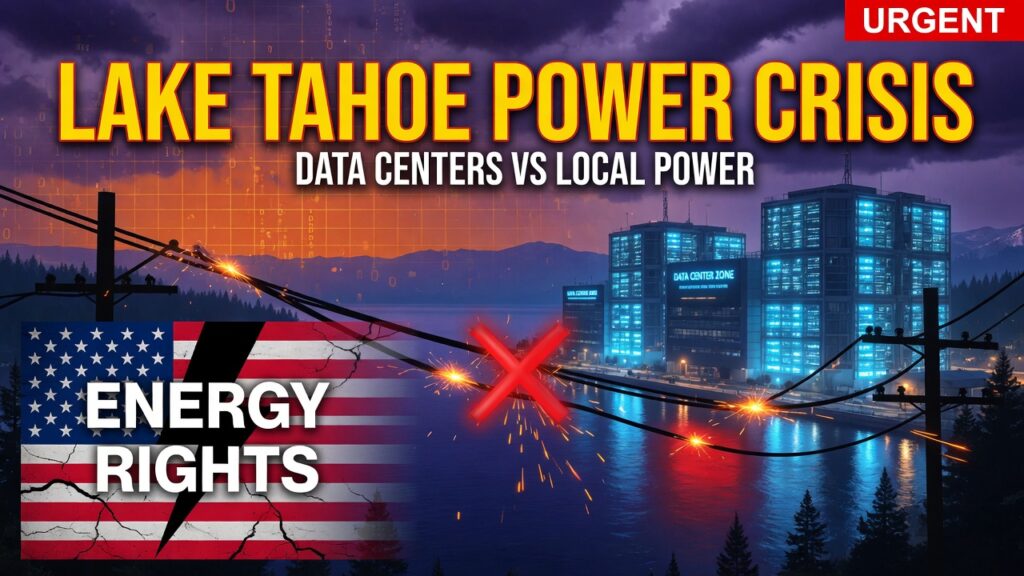
The company that has powered Lake Tahoe for decades just told 49,000 residents they’re on their own — because data centers need the electricity more. This is what happens when corporate interests outrun accountability.
Imagine receiving notice that the utility powering your home, your business, your child’s school, and the hospital down the road has decided your community’s needs simply aren’t a priority anymore. Not because of a natural disaster. Not because of grid failure. But because a tech giant needs more electricity to run its artificial intelligence servers.
That’s not a hypothetical. It’s happening right now at Lake Tahoe — and it should alarm every American who believes that ordinary citizens deserve basic accountability from the companies and regulators that control their daily lives.
Support Independent Local Journalism
TheTownHall.News is a non-profit reader-supported journalism. Just $5 helps us hire local reporters, investigate important issues, and hold public officials accountable across Alameda County. If you believe our community deserves strong, independent journalism, please consider donating $5 today to support our work.What’s Actually Happening at Lake Tahoe
NV Energy, the Nevada-based utility that has supplied the bulk of Lake Tahoe’s electricity for decades, has informed Liberty Utilities — the small California company that services roughly 49,000 residents in the Tahoe Basin — that it will stop delivering power to the region after May 2027. The reason, according to reporting by Fortune: NV Energy needs the capacity for the exploding wave of AI data centers moving into northern Nevada.
The affected residents, who live along California’s eastern border in a jurisdictional no-man’s-land, are now left with less than a year to find an entirely new power source — one that must still travel over NV Energy’s own transmission lines, putting Liberty Utilities in direct competition with Apple, Google, and Microsoft for access to the same grid.
This is not a utility billing dispute. This is a community of nearly 50,000 Americans — including low-income families, essential workers, ski resort employees, and hospital patients — being told that their energy security is less important than server farms.
The AI Boom’s Hidden Tax on American Communities
Northern Nevada has become one of the fastest-growing data center corridors in the country. Tax incentives, cheap land, and proximity to Silicon Valley have made the Tahoe-Reno Industrial Center a magnet for the tech industry’s most power-hungry operations.

The Western Resource Advocates, a climate and energy policy group, estimates that 12 proposed data center projects in northern Nevada alone could demand nearly 5,900 megawatts of electricity by 2033 — a staggering increase driven almost entirely by the AI compute race.
To put that in perspective: the entire state of Nevada currently generates roughly 10,000 megawatts of capacity. These facilities aren’t just drawing on the grid — they’re reshaping it, and in Lake Tahoe’s case, they’re doing it at the direct expense of a residential community with zero seat at the table.
When corporations can redirect a community’s power supply without a single vote being cast, something has gone deeply wrong.
A Bureaucratic Maze With No One in Charge
What makes the Lake Tahoe situation particularly infuriating is the complete absence of accountability — a maze of overlapping jurisdictions that guarantees no single authority can be held responsible.
Lake Tahoe spans two states, multiple counties, one incorporated city, and the Tahoe Regional Planning Agency. Liberty Utilities is a California investor-owned utility, regulated by the California Public Utilities Commission — but its grid operates entirely within NV Energy’s Nevada balancing authority. It connects to NV Energy at 38 separate points and relies entirely on Nevada transmission infrastructure. The California grid authority, known as CAISO, has essentially no reach here.
Support Independent Local Journalism
TheTownHall.News is a non-profit reader-supported journalism. Just $5 helps us hire local reporters, investigate important issues, and hold public officials accountable across Alameda County. If you believe our community deserves strong, independent journalism, please consider donating $5 today to support our work.The result? County supervisors point to state regulators. State regulators point across the border. Nevada authorities answer to a different legislative mandate. And 49,000 people simply fall through the cracks.
Danielle Hughes, a North Lake Tahoe resident, CEO of the nonprofit Tahoe Spark, and a supervisor within the California Energy Commission’s Efficiency Division, put it plainly: “It’s like we don’t exist.”
She went further: “We have no representation. It’s resource extraction.”
She’s right — and that language should resonate with anyone who believes government exists to protect citizens, not to serve as a passive bystander while corporate infrastructure deals override the basic needs of American communities.
The Real Cost: Families, Workers, and the Community Left Behind
The narrative that Lake Tahoe is merely a playground for wealthy second-home owners is both lazy and wrong — and it’s precisely the kind of dismissive framing that has allowed this crisis to fester for years without serious action.
Hughes points out that both South Lake Tahoe and North Lake Tahoe — particularly the Kings Beach area — are home to significant low-income populations. These are families for whom a rate spike or a power disruption isn’t a minor inconvenience. It’s a financial emergency.
The region also hosts at least one regional hospital that draws from the same power supply, along with the ski resorts, restaurants, and small businesses that form the economic backbone of a year-round community. Liberty Utilities’ demand actually peaks around Christmas, when seasonal workers and residents alike depend on reliable power for everything from heating to medical equipment.
A 19.1% rate increase Liberty originally sought in its last rate case — driven partly by infrastructure costs — was partially approved by the CPUC at 11.4%. Residents are already paying more. Now they face the prospect of paying even more still, for a patchwork power arrangement that may or may not hold.
What Critics Get Wrong
Some will argue this situation isn’t about data centers at all. NV Energy has stated that the transition away from serving Liberty Utilities was planned “well before data center load growth was a consideration,” and that it represents the completion of a separation process that began when NV Energy sold Liberty its California assets back in 2009.
That’s technically accurate — and entirely beside the point.
The fact that regulators, utilities, and state agencies allowed a temporary 2009 arrangement to be extended in 2015, then again in 2020, then again in 2025, is not a defense of the current situation. It is an indictment of it. This problem was allowed to linger for sixteen years without a durable solution, and the arrival of insatiable data center demand has simply made an already broken system impossible to ignore.
Pointing to process is not the same as providing accountability. Residents deserve both.
The Broader Warning Every American Should Hear
Lake Tahoe is not an isolated case. Across the country, the AI infrastructure boom is straining grids, inflating utility bills, and reordering energy priorities in ways that ordinary citizens never voted for and were never consulted on.
Reports from just the past several weeks describe a Utah data center that could consume twice the state’s current energy output. A $1 billion Microsoft facility in Africa was linked to warnings about widespread power disruption for local residents. In the American Midwest, rural towns are watching their utility rates spike as data centers lock in preferential long-term power contracts.
The question isn’t whether AI has legitimate energy needs. The question is who bears the cost — and who gets to decide.
If the answer is “not the people actually living in these communities,” then something fundamental about the relationship between government, corporations, and citizens has broken down.
Key Takeaway
The Lake Tahoe power crisis isn’t just a local utility dispute. It’s a case study in what happens when regulatory frameworks fail to keep pace with corporate power, when jurisdictional complexity shields decision-makers from accountability, and when ordinary Americans — including low-income families and essential workers — are treated as afterthoughts in deals made between utilities and tech giants.
Forty-nine thousand people didn’t lose a vote on this. They never had one.
What Needs to Happen Now
State and federal legislators need to close the regulatory gaps that allow cross-border utility arrangements to leave communities stranded. Energy regulators in both California and Nevada must be compelled to treat residential customers — not just industrial clients — as stakeholders with enforceable rights.
Most importantly, the companies driving data center demand — and the utilities profiting from serving them — need to be required to demonstrate that existing residential customers will not be displaced, disrupted, or financially burdened as a result of new industrial load.
The free market functions best when accountability is real. Right now, for 49,000 Lake Tahoe residents, it isn’t.
Stay informed. Share this article. And if you believe citizens deserve accountability from the utilities and regulators that control their basic needs — make your voice heard with your local representatives before the next community finds itself in the dark.