Has Trump’s Los Angeles National Guard Takeover Finally Gone Too Far?
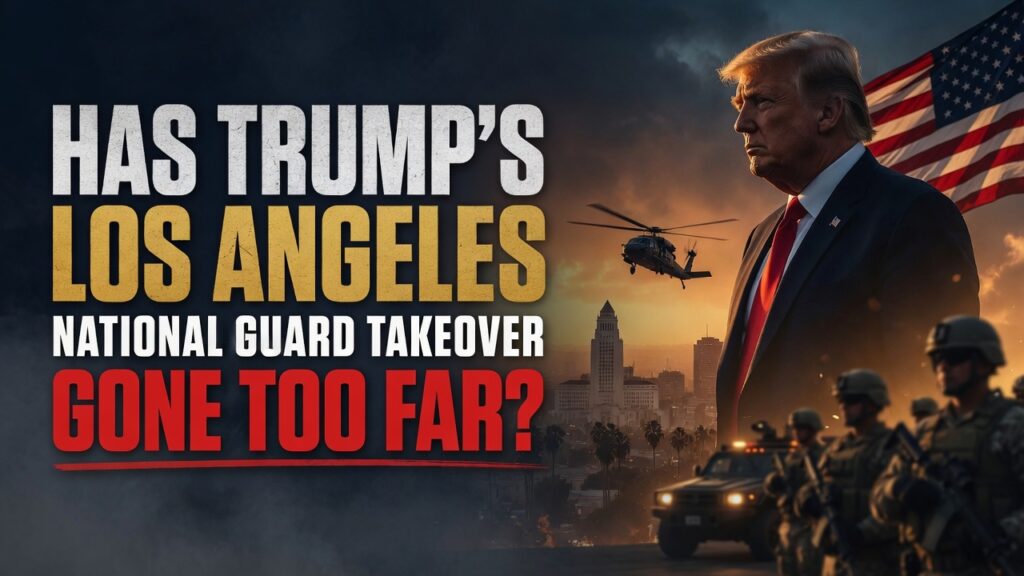
As the dust settles on one of the most aggressive federal-state confrontations in modern American history, millions of taxpayers are left asking: who authorized this — and who is going to foot the $120 million bill?
The federal government just deployed thousands of troops to an American city against the will of its governor. That sentence should alarm every citizen who believes in limited government, regardless of where they stand politically. In June 2025, President Trump invoked federal law to seize control of approximately 4,000 California National Guard troops and 700 Marines, deploying them to Los Angeles in response to protests against ICE immigration raids. By December 31, 2025, federal courts had ruled the entire operation illegal — but not before the damage, financial and constitutional, had already been done.
What Actually Happened on the Streets of Los Angeles?
The deployment began with an initial wave of 2,000 troops, later expanded to 4,000 National Guard soldiers alongside 700 Marines. The Trump administration’s stated justification was restoring order amid protests targeting federal immigration enforcement operations. President Trump invoked the law that allows the federal government to federalize state National Guard units — a power with deep constitutional roots, but one that has historically been used with significant restraint and, crucially, with gubernatorial cooperation.
Support Independent Local Journalism
TheTownHall.News is a non-profit reader-supported journalism. Just $5 helps us hire local reporters, investigate important issues, and hold public officials accountable across Alameda County. If you believe our community deserves strong, independent journalism, please consider donating $5 today to support our work.Governor Gavin Newsom refused to cooperate from the outset, calling the move an unconstitutional seizure of California’s own military force. That political clash quickly escalated into a full-blown federal court battle, with the State of California filing suit almost immediately. What followed was six months of legal warfare, troop withdrawals, appeals court reversals, and ultimately a federal judicial ruling that the president had broken the law.
Is This What Law and Order Actually Looks Like?
Here is where the conversation must be honest. Supporters of law and order — a value this publication takes seriously — should not conflate enforcement of immigration law with the unchecked deployment of military force inside an American city. These are two separate issues, and conflating them does a disservice to both.
$120 million. That is what Trump’s federalization of the California National Guard cost American taxpayers — for a deployment a federal court later ruled was illegal.
A federal judge ruled in August 2025 that the Trump administration violated a 19th-century statute when it mobilized those troops. The 9th Circuit Court of Appeals ultimately ordered the remaining federalized soldiers out of Los Angeles. By December 31, 2025 — more than six months after the initial deployment — the federalization finally ended. The question law-and-order conservatives must wrestle with is straightforward: does the end justify the means when the means are ruled unlawful by the courts?

Who Is Really Paying for This Decision?
The $120 million figure deserves its own paragraph. According to data published by the California Governor’s office [state government data], the cost of the deployment fell squarely on the American taxpayer. There was no emergency appropriation voted on by Congress. There was no budget line approved by elected representatives. The money moved, the troops deployed, and the bill arrived — all before a single court had the opportunity to weigh in.
“When the federal government deploys military force inside an American city over a state’s explicit objection — and a court later calls it illegal — the burden of proof for justification must be extraordinarily high. It was not met here.”
This is the essence of fiscal accountability. It is not enough to argue that the policy goal was legitimate if the mechanism used to achieve it bypassed the constitutional guardrails designed to protect taxpayers and state sovereignty alike. The Founders understood this tension well. The entire architecture of American federalism exists precisely to prevent one branch, or one executive, from unilaterally militarizing domestic policy.
What Does the Law Actually Say About Federalizing State Troops?
The legal framework here is not ambiguous, though the Trump administration argued otherwise. The federal government does possess authority to federalize state National Guard units under specific statutory conditions. However, the federal judge who ruled in August 2025 found that the administration had not met those conditions. The court cited violations of a 19th-century law — a statute that has existed for over a century specifically to limit the circumstances under which federal power can override state military authority.
If a 19th-century law designed to protect states from federal military overreach can be bypassed by executive order, what exactly does that law still protect?
The Ninth Circuit’s intervention, and ultimately the administration’s own decision to abandon the effort by late December, suggests the legal foundation for the deployment was far weaker than originally claimed.
Support Independent Local Journalism
TheTownHall.News is a non-profit reader-supported journalism. Just $5 helps us hire local reporters, investigate important issues, and hold public officials accountable across Alameda County. If you believe our community deserves strong, independent journalism, please consider donating $5 today to support our work.What Do Supporters of This Policy Actually Believe?
This is a fair question, and it deserves a fair answer. Supporters of the deployment argue that the federal government has both the right and the responsibility to enforce immigration law, and that when local governments actively obstruct federal enforcement — as California’s sanctuary policies have done — the executive branch must have tools available to compel compliance. They contend that the protests in Los Angeles represented a direct challenge to federal law enforcement authority, and that deploying National Guard troops was a proportionate response to a deteriorating public safety situation.
These are not frivolous arguments. Immigration enforcement is a federal responsibility. The breakdown of cooperation between California and the federal government on immigration policy is a genuine governance failure with real public safety consequences. Federal law does grant the president meaningful authority over the National Guard in certain circumstances.
The problem is that invoking that authority without meeting the legal threshold required to do so is not enforcement — it is overreach. The courts agreed. And when $120 million of public money is spent on an action later ruled illegal, accountability cannot be optional. Acknowledging the legitimacy of the underlying policy goal does not require excusing the unconstitutional method used to pursue it.
Are We Watching the Erosion of Federalism in Real Time?
The California National Guard deployment did not occur in a vacuum. It is part of a broader pattern in which the executive branch — under administrations of both parties, though with escalating intensity — has tested the outer limits of presidential power over domestic military deployment. The question is not whether immigration enforcement matters. It does. The question is whether any president should be able to unilaterally deploy thousands of troops into an American city over the objection of its governor, in violation of federal statute, and at a cost of $120 million to the public.
If a president can deploy 4,000 troops to Los Angeles against a governor’s will, declare it a law enforcement measure, and spend $120 million before the courts can stop it — what check on that power actually remains?
This is the accountability moment that transcends party. Citizens who value limited government, personal responsibility, and constitutional order should be among the loudest voices demanding answers — not because the deployment’s stated goals were wrong, but because the process used to achieve them was.
Key Questions This Article Raises:
- If the federalization of the California National Guard was ruled illegal by federal courts, what accountability measures exist to prevent a future administration from repeating the same action?
- Who in Congress is demanding a full accounting of the $120 million in taxpayer funds spent on a deployment the courts ultimately struck down?
- Does the current legal framework governing the federalization of state National Guard units need to be strengthened to close the loopholes this deployment exposed?
The real question this episode leaves behind is not whether immigration enforcement is necessary — it is. The question is whether Americans are willing to demand that enforcement happen through lawful means, with fiscal transparency, and with respect for the constitutional boundaries that protect all of us, regardless of which party holds the White House.
The precedent set by unchecked federal military deployment inside American cities does not disappear when the troops go home. The real question isn’t whether this will affect you — it’s whether you’ll demand accountability before the next deployment begins.
Still have questions? Stay informed — subscribe for daily coverage of the issues that matter to you. Think others need to hear this? Share this article and tell us — did the courts get this right? Want to make your voice count? Contact your congressional representative and ask them directly: who authorized $120 million in spending on a deployment the courts ruled illegal, and what are they doing to prevent it from happening again?