USPS Mail-In Voting Rules Explained: What the New Federal Ballot Mandate Means for You
The U.S. Postal Service now wants your state’s complete voter lists, personalized ballot barcodes, and full compliance — or it may stop delivering your mail ballot entirely. As the 2026 midterms approach, millions of Americans are asking: who is actually in charge of your vote, and what happens when Washington decides it knows better than your state?
The federal government is attempting something it has never done before. Under a sweeping executive order signed by President Donald Trump on March 31, 2026, the U.S. Postal Service has been directed to become the gatekeeper of who can vote by mail in federal elections — threatening to withhold ballot delivery from any state that refuses to comply with unprecedented new data mandates.
This is not a procedural footnote. With the 2026 midterm elections less than five months away, the proposed rules published in the Federal Register on June 2, 2026, represent the most significant federal intervention into state-run election administration in modern American history. The question every voter — conservative, moderate, and independent alike — should be asking is simple: does Washington have the constitutional authority to pull this off, and at what cost to the republic?
Support Independent Local Journalism
TheTownHall.News is a non-profit reader-supported journalism. Just $5 helps us hire local reporters, investigate important issues, and hold public officials accountable across Alameda County. If you believe our community deserves strong, independent journalism, please consider donating $5 today to support our work.What the New USPS Rules Actually Require
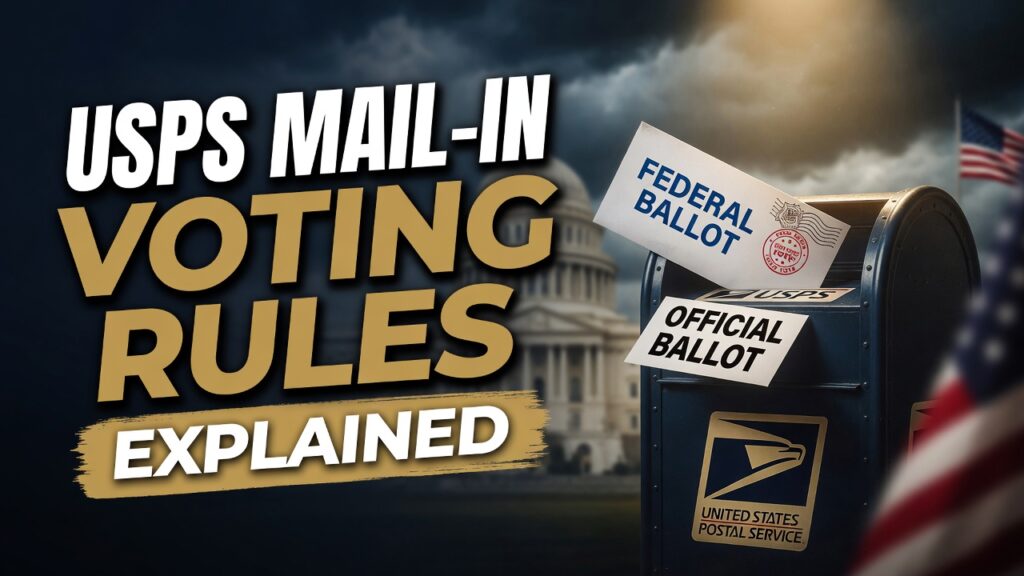
The proposed rules are detailed, technical, and consequential. Under the plan, every state must submit to USPS the names and addresses of all registered voters who are being sent a mail-in or absentee ballot in general, special, and runoff federal elections. That is not all. Each outbound ballot envelope and each return envelope must carry a unique, personalized barcode tied to a specific voter — and states must upload that barcode data to a new federal portal called the Federal Ballot Mail Portal.
USPS would then use that data to create what it calls “Mail-In and Absentee Participation Lists.” Any ballot mailed to a voter not on the federally approved list, or any envelope that fails to meet the new design and barcode standards, could be returned or blocked entirely. The postal service would effectively be transformed from a neutral mail carrier into an active election compliance officer — a role it has never held and, critics argue, was never designed to hold.
The rule does not apply to primary elections or to military and overseas ballots. A 30-day public comment period opened after the June 2 publication. The clock is running.
Is This Election Integrity — or Federal Power Grab?
Supporters of the order frame it as a common-sense accountability measure. The executive order’s stated goal is to ensure that only eligible voters receive federal mail ballots — and that the number of ballots mailed matches the number returned, creating a verifiable audit trail. From a law-and-order perspective, that argument has surface-level appeal. Accountability in elections is not a radical idea; it is a civic cornerstone.

But here is what the law actually says: the U.S. Constitution’s Elections Clause reserves the authority to set election rules to state legislatures — not the president, and not the postal service.
The Brennan Center for Justice, analyzing the order in detail, noted that multiple federal courts have already blocked major provisions of Trump’s earlier March 2025 election executive order on precisely this constitutional basis — that the president simply does not have the power to rewrite election rules. Those court rulings are now on appeal, but their logic is clear: when a president attempts to direct an independent federal agency to serve as an election gatekeeper, separation of powers is breached.
A federal judge in Washington, D.C., declined to immediately block the new order on May 28, 2026 — but only because USPS had not yet published its rules. The court left the door open for fresh challenges the moment implementation began. That door is now wide open.
Who Actually Pays When Washington Mandates and Disappears?
The operational burden being placed on local election officials is staggering — and entirely unfunded. Jennifer Morrell, CEO of The Elections Group and a former Colorado election administrator, warned that the proposal creates “onerous new regulations that could be difficult and costly for local elections officials to follow, especially in rural counties which do not currently have the technology to produce the required barcodes.”
$10,000. That is the estimated cost for a small jurisdiction of just 2,500 voters to purchase new compliant envelope systems — with zero federal funding attached to the mandate.
Support Independent Local Journalism
TheTownHall.News is a non-profit reader-supported journalism. Just $5 helps us hire local reporters, investigate important issues, and hold public officials accountable across Alameda County. If you believe our community deserves strong, independent journalism, please consider donating $5 today to support our work.Who bears that cost? Taxpayers at the local level, in communities that are often already underfunded. Kathy Boockvar, former Pennsylvania Secretary of State, said it plainly: “You can’t just snap your fingers and change how elections are run overnight.” The executive order contains no appropriations, no transition funding, and no implementation assistance. It simply demands compliance — or else.
This is a pattern worth recognizing. Federal mandates issued without funding are not a new phenomenon in Washington, but rarely has one arrived with a deadline as consequential as a national midterm election.
What Do Supporters of This Policy Actually Believe?
The administration and its allies argue that the reforms are both necessary and legally defensible. The White House stated that the policy fulfills a direct campaign promise to secure American elections, with spokesperson Abigail Jackson saying the administration would “continue lawfully enacting the agenda President Trump was elected to enact.” Supporters point to legitimate concerns about ballot traceability, the risk of ballots being sent to outdated addresses, and the general lack of a standardized federal audit trail for mail voting.
These are not frivolous concerns. Ballot integrity is a value that resonates across the political spectrum, and improving the traceability of mail-in ballots is a goal many nonpartisan election experts have endorsed in principle. Some of the technical standards in the proposed rule — such as intelligent barcodes and tracking systems — have actually been recommended as best practices by election administrators for years.
The critical distinction, however, is between adopting best practices voluntarily and having the federal executive branch mandate compliance under threat of cutting off ballot delivery. The former respects constitutional federalism; the latter dismantles it. As Gideon Cohn-Postar of the Institute for Responsive Government noted, “The executive order they are trying to fulfill is incoherent in and of itself.”
“The real question isn’t whether mail voting needs reform — it may well. The question is whether a president has the constitutional authority to unilaterally decide what that reform looks like, and whether a postal agency has the right to decide whose ballot gets delivered.”
Are the Courts the Last Line of Defense?
The legal resistance has been swift and broad. The ACLU, Brennan Center, the Oregon Attorney General, and coalitions of voting rights organizations have all filed suit. In a parallel case, the Campaign Legal Center won a significant victory when a federal judge in Washington, D.C., permanently halted a provision of Trump’s 2025 election order that attempted to add a documentary proof-of-citizenship requirement to the national voter registration form — ruling it an unconstitutional violation of the separation of powers.
If courts have already permanently blocked parts of Trump’s 2025 election order as unconstitutional, what does that signal about the legal durability of this far more expansive 2026 order?
The Massachusetts federal court is actively hearing challenges from multiple states and voting rights groups. Given the precedent, legal analysts expect significant portions of the USPS rule to face injunctions before the November elections. But court timelines are unpredictable, and election officials cannot afford to wait.
What Happens If No One Speaks Up?
The 30-day public comment period on the proposed USPS rule is the first formal mechanism through which ordinary citizens and election officials can put their objections on the record. After that window closes, the rule could move forward — and states could find themselves facing the choice between surrendering comprehensive voter data to a federal portal or watching their residents lose the ability to vote by mail in November.
If the federal government can threaten to withhold mail ballot delivery to force state compliance, what other constitutional rights might be next on the bargaining table?
Tammy Patrick of the Election Center, which represents local and state election officials, captured the mood of officials nationwide when she said: “I haven’t seen much here that is giving me much confidence this can be done by the fall without creating a lot of confusion and potential chaos.”
Confusion and chaos in November 2026 are not abstract risks. They are the predictable outcome of a rushed, underfunded federal mandate colliding with the operational realities of 50 different state election systems — each with its own laws, vendors, and timelines.
Key Questions This Story Raises:
- Does the president have the constitutional authority to direct USPS to withhold ballot delivery as a compliance enforcement mechanism against sovereign states?
- Who will fund the estimated millions of dollars in local compliance costs — and what happens to the jurisdictions that simply cannot afford to comply before November?
- If federal courts have already permanently blocked earlier provisions of Trump’s election orders as unconstitutional, can this far broader order survive legal scrutiny in time to matter?
The core question this moment demands is not whether mail-in voting should have stronger accountability standards — reasonable people can debate that. The question is whether the executive branch of the federal government has the constitutional right to seize control of election administration from the states, weaponize the postal system as a compliance tool, and impose an unfunded mandate with a national election five months away.
The answer to that question belongs to the courts, to state officials willing to push back, and ultimately to you.
The real question isn’t whether this will affect you — it’s whether you’ll act before it’s too late.
Still have questions? Stay informed — subscribe for daily coverage of the 2026 election and federal policy developments.
Think others need to hear this? Share the article and tell us: should states comply, fight back, or find a middle ground?
Want to make your voice count? Submit a public comment on the proposed USPS rule through the Federal Register at federalregister.gov, or contact your state’s Secretary of State office to ask how your jurisdiction plans to respond.