FDA Approves Inhaled Insulin for Kids — What Parents Need to Know About Afrezza
Inhaled Insulin for Kids: Has a Medical Breakthrough Finally Given Parents Back Their Power?
For years, parents of diabetic children have been told there is only one way — needles, every single day, no exceptions.
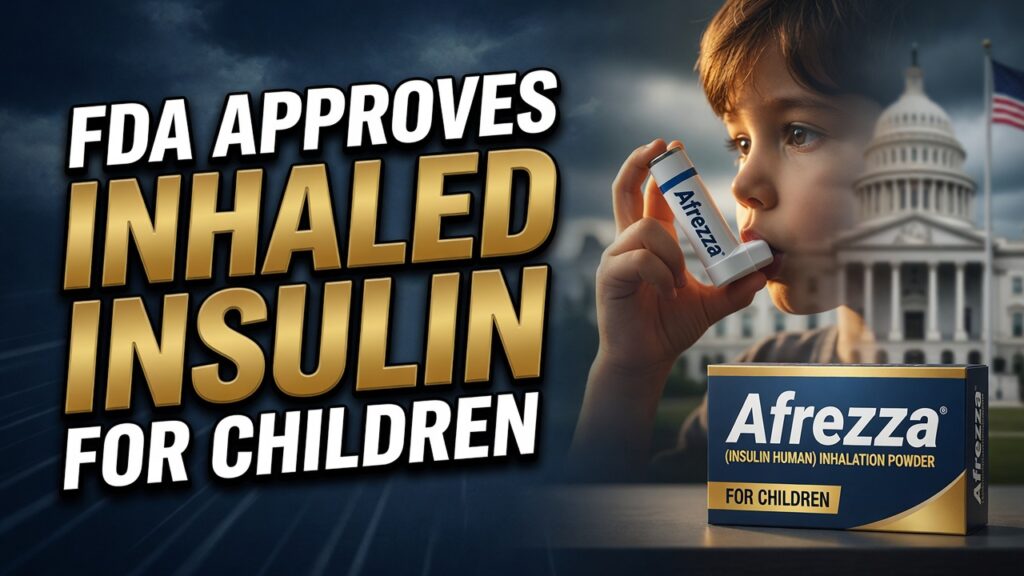
On May 29, 2026, the FDA approved Afrezza® (inhaled insulin) by MannKind Corporation for children and adolescents aged 6 and older with Type 1 or Type 2 diabetes. It is the first and only needle-free mealtime insulin option available to pediatric patients in the United States. For millions of American families who have navigated the exhausting, emotionally taxing daily ritual of injections, the question now shifts from whether this option exists — to whether the healthcare system will actually let families use it.
Support Independent Local Journalism
TheTownHall.News is a non-profit reader-supported journalism. Just $5 helps us hire local reporters, investigate important issues, and hold public officials accountable across Alameda County. If you believe our community deserves strong, independent journalism, please consider donating $5 today to support our work.A Decade in the Making — Why Did It Take This Long?
Afrezza has been available for adults since 2014. That’s twelve years during which children with diabetes were denied access to the same technology their adult counterparts could legally obtain.
The pediatric approval was built on data from the INHALE-1 clinical trial, which enrolled 230 children and teens between ages 4 and 17. After 26 weeks, children using Afrezza showed A1C outcomes comparable to those on traditional injectable insulin — with slightly less weight gain and, critically, significantly higher treatment satisfaction scores reported by both adolescent patients and their parents. [Clinical trial data, INHALE-1, MannKind/FDA submission, 2025.] The science was there. The drug worked. The question that deserves a direct answer is: what took so long?
A child diagnosed with diabetes today deserves every treatment option available — not just the ones that are easiest for a system to administer.
What Makes Inhaled Insulin Genuinely Different for Children?
The answer isn’t just about needles, though that matters enormously. Needle phobia is clinically documented among pediatric diabetes patients and is a recognized barrier to treatment adherence — meaning children who fear injections are statistically more likely to skip doses, leading to poor glycemic control and long-term health complications.

Afrezza starts lowering blood sugar in approximately 12 minutes — faster than any currently approved injectable rapid-acting insulin, which typically takes 15 to 20 minutes to begin working. Its effects also fade more quickly, more closely mimicking the body’s natural insulin response to a meal. For a child with an unpredictable schedule — school cafeterias, birthday parties, after-school sports — this flexibility is not a luxury. It is a practical clinical advantage that parents have been asking about for years.
The drug is administered through a small, portable inhaler at the first bite of food. No planning required. No injection anxiety. No clinical setting needed.
“The pediatric patients and their parents reported improved satisfaction with their treatment when they were on inhaled insulin.” — Dr. Jamie Wood, pediatric endocrinologist, on the INHALE-1 trial findings.
Are Clinicians Actually Ready to Offer This Option?
This is where the story gets complicated — and where parental vigilance becomes essential.
Despite the FDA approval, the biggest identified barrier to access is not medical. It is awareness. Dr. Kevin Kaiserman, Senior Vice President and Therapeutic Area Head for Diabetes at MannKind Corporation, stated plainly at the American Diabetes Association’s 2026 Scientific Sessions in New Orleans that low awareness among clinicians and patients “remains a central challenge for inhaled insulin adoption.” In plain terms: your child’s doctor may not bring this up. You may have to.
The ADA’s updated 2026 Standards of Care now explicitly require that discussions about all insulin delivery methods — including inhaled insulin — occur at every patient visit. That is a meaningful policy shift. But a standard of care written in a guideline document only translates into real change when individual physicians follow it. The responsibility to ask the question, to advocate for options, and to demand informed conversations about treatment choices still rests, in large part, with parents.
Support Independent Local Journalism
TheTownHall.News is a non-profit reader-supported journalism. Just $5 helps us hire local reporters, investigate important issues, and hold public officials accountable across Alameda County. If you believe our community deserves strong, independent journalism, please consider donating $5 today to support our work.If the ADA itself says doctors should discuss every delivery method at every visit, why are so many families still only hearing about needles?
What Do Supporters of This Approval Actually Believe?
It is fair to ask whether enthusiasm for this approval is fully warranted. Some medical professionals caution that Afrezza is not a universal solution. The INHALE-3 adult trial found that while 28% of participants improved their A1C by at least 0.5% on inhaled insulin, 21% saw their A1C worsen by the same margin. The drug works spectacularly for some patients and not at all for others. Additionally, Afrezza cannot be used by patients with asthma or chronic obstructive pulmonary disease (COPD), and a baseline lung function test (spirometry) is required before starting treatment. The most common side effect reported in children was cough, occurring in 21% of pediatric participants using Afrezza compared to 3% using injectable insulin.
These are legitimate medical considerations, and no responsible coverage of this approval should minimize them.
The case for Afrezza is not that it replaces all other options. It is that it expands options. In a healthcare system that has long defaulted to a one-size-fits-all approach to pediatric diabetes management, the introduction of a clinically validated, FDA-approved alternative is precisely the kind of patient-centered innovation that deserves enthusiastic support — provided families receive honest, complete information to make the right decision for their child.
Who Is Really Paying for This — and Can Families Afford It?
Here is the number every parent needs to see before celebrating.
$450 to $1,500. That is the monthly list price range for Afrezza, according to data from diaTribe.org and MannKind’s own patient resources. [diaTribe.org, Afrezza cost data, 2026.]
The question every insurance-paying American family needs to ask their insurer is straightforward: will you cover this for my child?
The Inflation Reduction Act’s insulin cost cap limits Medicare beneficiaries to $35 per month for covered insulin — a meaningful protection for older Americans. MannKind also offers a savings card allowing commercially insured patients to pay as little as $35 per month, and a direct-purchase program for uninsured patients at approximately $99 per month. Over 70% of patients with commercial insurance currently have access to Afrezza through their plans. [Afrezza.com, insurance access data, 2026.] But pediatric patients on Medicaid, or families navigating underfunded state insurance exchanges, may find prior authorization requirements and formulary exclusions standing between a prescription and a prescription being filled.
Medical breakthroughs that exist on paper but remain out of reach in practice are not victories. They are incomplete promises.
New Data From ADA 2026: What the Science Shows Right Now
The evidence base for Afrezza continued to strengthen this month. At the ADA’s 86th Scientific Sessions, held June 5–8, 2026, in New Orleans, MannKind presented multiple analyses reinforcing the safety and clinical utility of inhaled insulin across populations.
Two separate real-world evidence studies published in Diabetes Technology & Therapeutics found no statistically significant association between Afrezza use and long-term lung cancer risk compared to subcutaneous insulin — a concern that has historically followed the drug and deterred some prescribers. A third independent retrospective analysis presented at ADA confirmed consistent findings. Separately, an interim analysis of inhaled insulin in gestational diabetes showed comparable efficacy to injectable rapid-acting insulin, with fewer hypoglycemic events — opening a potential new population for future study.
The pharmacodynamic picture also became clearer: new clamp data showed Afrezza delivers over 50% of its glucose-lowering effect within 60 minutes, compared to just 10% for injectable lispro within the same window. [ADA 2026 Scientific Sessions, MannKind data presentations, June 2026.] For parents managing a child’s mealtime glucose in real time — not in a controlled clinical environment — that speed difference is consequential.
Key Questions This Story Raises
- Will pediatric insurers and Medicaid programs cover Afrezza for children without burdensome prior authorization barriers — or will cost remain the deciding factor over clinical need?
- Will the ADA’s 2026 mandate to discuss all delivery methods at every patient visit be meaningfully enforced, or will it remain a recommendation physicians quietly ignore?
- As the evidence base for inhaled insulin grows, what responsibility do medical schools and residency programs have to ensure the next generation of physicians actually knows this option exists?
The Right to Choose Must Mean Something
The approval of inhaled insulin for children is, in the most direct sense, a victory for parental rights in medical decision-making. It is a case study in what happens when science, patient advocacy, and regulatory process eventually align — even if it takes longer than it should.
But an approved drug that doctors don’t recommend, that insurers don’t cover, and that parents don’t know to ask about is not a real choice. It is a theoretical one. The families who will benefit most from this approval are those who are informed, engaged, and willing to advocate loudly inside the exam room. That is a responsibility that falls on parents — but it should not fall on them alone.
The healthcare system owes diabetic children and their families more than a press release. It owes them access, awareness, and honest conversations about every option available.
The real question is not whether inhaled insulin works — the data shows it can. The real question is whether an entrenched medical and insurance system will make room for it, or whether a landmark approval will quietly gather dust while children keep reaching for syringes.
Think this matters for families you know? Share this article and tell us — is your child’s doctor discussing all available insulin options, or is this the first time you’re hearing about Afrezza?
Still have questions? Stay informed — subscribe for daily coverage of the health policy and medical innovation stories that affect your family.
Want to make your voice count? Contact your state insurance commissioner or congressional representative and ask them directly: why isn’t needle-free insulin for children automatically covered under every pediatric health plan?